Showing posts with label Moorecroft. Show all posts

Saturday, 21 February 2026

Arthur Davis Moorecroft: Conductor

The TTC and its red streetcars have been a fixture on Toronto streets for over 100 years. Before that the Toronto Street Railway ferried Torontonians around. So it was exciting to learn that a Moorecroft ancestor worked for the Toronto Transit Commission.

Trolley Car 22 About 1904 Baldwin Collection of Canadiana

Arthur Davis Moorecroft, my husband’s great grandfather, was born in Northern Ireland on 12 July 1865, the fifth of six children born to Robert Moorecroft and Ellen Hunter. Ellen tragically died at the age of 40 in 1870 leaving Robert to make the move to Canada on his own. In May of 1873 the family crossed the Atlantic, travelling from Belfast to Quebec City. 

Manifest from the Missouri, Library and Archives Canada

The Moorecrofts settled in the village of Norway in the east end of Toronto with Robert purchasing a plot of land at the corner of Woodbine Avenue and Kingston Road (imagine what that land is worth today!).  

1886 Toronto City Directory, Baldwin Collection 

Looking through census records and city directories I was able to trace Arthur’s path.He first shows up in the 1886 Toronto City Directory working for Charles Ferguson.

From here on Arthur had a varied career path. When his first child, Ethel May, was born on 30 August 1886 he is listed as a cricket ball maker, working for Prest & Braun. The skills Arthur gained working with leather harnesses were transferable to creating cricket balls. Cricket was still popular in Toronto at this time, however, most cricket equipment in the 19th century was imported from England so this might not have been the most lucrative of career paths. It was time to change jobs as well as location.

1887 Toronto City Directory, Baldwin Collection

Ethel, Alma and Arthur, the first three children of Arthur and his wife Agnes Jane White were born in Toronto. But by the time the 1891 census was taken the Moorecroft family had moved to Markham where Agnes had been born and raised. Her father, William White, had been a hotel keeper up until his unfortunate death on 16 December 1880 following an 11 day bout of typhoid fever. His widow Sarah Jane had carried on with the inn but by 1892 she was on her third marriage and ready to move on. It was perfect timing and Arthur was ready for his new career. The Globe and Mail published a list of those granted licenses to sell liquor for the next year on 4 May 1892. Arthur was included on the list.


Being an innkeeper worked for Arthur a while. His next two children, Herman and Frederick, were born in Markham and the entire Moorecroft brood was baptized at the Bethlehem Evangelical Lutheran Church in Buttonville on 20 June 1894. Arthur’s younger sister Maggie and her husband Robert Lewis joined the family in Buttonville as well. We’ll never know what went wrong but by the time Percy was born in 1895 the family had returned to Toronto. Perhaps running a hotel was not to Arthur’s liking. I haven’t been able to determine the name or location of the White/Moorecroft Inn. Further research needed! In the 1898 Toronto directory Arthur is listed as a brick maker, working with his brother Thomas for Isaac Price. Manual labour was apparently not to Arthur’s liking either. Fortunately he was able to find a job that suited him until hist retirement in 1937.


In the 1900 Toronto City Directory the entry reads:

Subsequent censuses and city directories confirmed his ongoing employment first with the Toronto Street Railway and later the Toronto Transit Commission. Interestingly, in the 1908 and 1909 directories Arthur is listed as a Helper at the A B Ormsby Roofing Company—perhaps there was a temporary layoff? In any event, every other directory through 1937 reflects his job as a conductor.

The City of Toronto archives houses the TTC collection which includes employment records and more, for both the TTC and the Toronto Railway Company. Record of Conductors and Motormen, the register for employees covering the years 1885 to 1908 contained the following entry:

Fonds 16 Series 96 File 1,  City of Toronto Archives

His route was King East and his badge number 727. Some of the other employees were scratched out with a resignation or termination date noted. Sadly a few employees were killed on the job. Arthur was not scratched out, which seems to verify that his tenure continued on into the next century. Perhaps management did not return to older volumes to update employment status.  

Toronto Star 24 April 1901
Transit employees appeared to be a tight knit group, as evidenced by the this clipping from The Toronto Star. Perhaps a few after work pints were involved?


Arthur would have seen great changes during his years with the agency. When he began in 1899 horse drawn streetcars had only recently been retired. He would have worked on the first electric cars in the city. The process of operating a streetcar was on a two man basis with the motorman driving the streetcar. The conductor was responsible for collecting fares, issuing transfers, keeping the coal stove running and helping ladies on and off the streetcar. In the early days it was a cold hard job. The first streetcars had no protection from the elements so passengers and employees both would freeze in the winter. A running board extended along the length of these cars. The conductor would have to manoeuvre along this board to collect fares from passengers. It was eventually abolished after multiple injuries sustained. The trolley pole connecting the car to the overhead wire was the conductor’s responsibility. If it broke while rounding a curve the conductor would be charged 75¢ to replace the pole. 

The streetcars themselves evolved from early models to the beloved Peter Witts of the 1920s to the streamlined modern PCC (Presidents’ Conference Committee) types introduced in the late 1930s (which included electric heaters!). Arthur endured through the end of the Toronto Street Railway and the creation of the brand new Toronto Transit Commission in 1921.  In 1899 the starting wage was 16 2/3¢ an hour for a 11-12 hour shift. By 1915 wages had risen to 27 1/2¢/hour and no employee was expected to work more than 10 hours/day. At the time of amalgamation in 1921 Arthur made 66¢ an hour with an additional 4¢/hour paid on Sunday. Two weeks annual vacation was awarded. The depression hit the TTC hard as Torontonians were not taking transit. The transit union workers took extra days off each month, accepted pay cuts and gradually the number of operators on streetcars was reduced from two to one, much to the operators’ dismay. 

Fonds 16, Series 836, Subseries 3, Item 268, City of Toronto Archives

In 1899, cash fares were 5¢, rising to 10¢ for overnight rides. Tickets were sold by the conductor at a cost of $1.00 for 25, good for any time between 5:30 am. In 1937 day fares were 10¢ with 4 tickets coming 25¢ and 16 tickets $1.

Arthur died in 1940 and was buried in St John’s Norway Cemetery, across the street from where he first resided upon his arrival in Canada. Here is the one picture we have of Arthur Davis Moorecroft, taken from an article in The Toronto Telegram discussing the war service of his four sons.


Toronto Star 16 July 1940
                    
After his retirement in 1937 he likely still rode the red rocket. To conclude, here’s a neat clip of streetcars running in the 1939-40 period. Times have changed but streetcars will always be a constant in downtown Toronto. Arthur’s legacy lives on!


Sunday, 3 August 2025

THE 1938 CANADIAN CORPS REUNION

The morning of Saturday, July 30 1938 dawned hot and sunny in the city of Toronto. It was the start of the Civic Holiday long weekend and it looked like it would be a swell one. The day was an extra-special one in the Moorecroft household. Fred Moorecroft donned his pin, red beret and armband and was ready to go. He was one of over 100,000 veterans of the Great War who gathered to celebrate and reminisce at the Canadian Corps Reunion.


 Fred had had a terrible war experience. Embracing his Ulster Scot background, he enlisted in the 48th Highlanders in August of 1915. He sailed for Europe in early 1916 with the 92nd battalion and was attached to the 15th battalion in France. Fred returned home early in 1918 a broken man having lost a leg and several fingers in an attack

92nd battalion scouts, Fred is 4th from the left

In the 20 years following Fred managed to build a life for himself, marrying Adeline Nicholls in 1921 and finding employment as a clerk and bookkeeper. He and Addie lived with their son Fred Jr. at 56 Donlands Avenue in the east end of Toronto. Life seemed to be good, which may be why Fred decided to attend the 1938 reunion.


The first Canadian Corps Reunion was held in Toronto from August 4 to 6 1934 to commemorate the start of the Great War. The reunion, tied in with the 100th anniversary of the City of Toronto, was a huge success. About 100,000 veterans attended and spent $750,000 during the event. A bigger party was planned for ’38. The end of the war was perhaps a more fitting cause for celebration. However, there was another reason—storm clouds were brewing and democracy and freedom were being threatened. There was a good chance that Canadians would be called upon again and what better way to inspire patriotic feelings than to be reminded of the sacrifices made by the older generation 20 years earlier? 


The reunion was announced on Remembrance Day 1937 at the Corps’ annual dinner and as 1938 began invitations were sent out. A full program was planned with events taking place at Exhibition place, Riverdale Park and other locations.


The first vet to register in April 1938 was Toronto Mayor Ralph C. Day formerly of the 116th battalion. He was followed by many other politicians, as well as Victoria Cross recipient Air Marshall William “Billy” Bishop. Acceptances came from New Zealand, Australia, South Africa and West Africa. Special trains were booked to bring groups from Montreal, Buffalo and Chicago. Groups arranged to travel from Detroit, California and Newfoundland. 

A special group called themselves the “League of Forgotten Men”, men who had been reported dead or missing and believed dead.  


Times were still tough so assistance was offered to unemployed vets. Brantford council allowed unemployed vets to perform 3 days of special relief work to earn $13 towards their trip. A special train was booked to bring several hundred attendees from Hamilton, for no charge. Emergency billeting was provided in the Livestock building.


First up was a popular event brought back from the 1934 reunion—the French Village located in the CNE Coliseum. It opened to the public on July 25, with 5,000 visitors pouring in. From the evening of Friday, July 29 it was reserved for veterans. Visitors could stroll through streets past homes, barns, shops and estaminets (small cafés offering food and drink). Beer and wine flowed and visitors enjoyed sing-a-longs to favourites like “Mademoiselle from Armentières” and “Pack Up Your Troubles”. Dancing and revelry went on well into the night. It was a great success. The first night one beer ticket wicket ran out of tickets; another ran out of change. According to the Globe and Mail, “It was a grand party. Today motorists on their way to work in the city saw many of last night’s celebrants blissfully sleeping on the grass near the lakefront”.


Saturday, July 30 featured the Canadian Corps March Past following Prime Minister Mackenzie King’s opening addresses to the veterans—“Liberty and democracy cry out anew for preservation, not only in foreign countries, but in many parts of Canada”. The parade was led by the brass and pipe band of the 48th Highlanders. 


Each unit was represented by a group of four veterans with a colour bearer carrying the unit flag. Thousands lined the streets despite the heat. Some vets and spectators collapsed and were treated by St John Ambulance. The Globe’s 1 Aug headline: “Veterans March Past Takes Two Full Hours Beneath Broiling Sun” In all 70,000 vets, and 40 bands marched.  

Saturday night unit dinners were held. The Canadian Corps reunion dinner took place at the Royal York with 22 Victoria Cross recipients the guests of honour. A representative from every unit attended and the dinner address was broadcast by remote radio hookup to the other dinners held at the Royal York, King Edward Hotel, Victoria Hotel, CNE Grandstand, the horticultural building at CNE and many other locations.


The main event on Sunday, July 31st was the Drumhead Service at Riverdale Park which followed services at Prospect Cemetery and Varsity Stadium. Colonel McLaughlin of GM fame funded an actual size reproduction of the Vimy monument based on the original plans of designer Walter Alward. As most vets had not been able to travel to France to see the original, it was felt that the emotional pull of the reproduction would be great.


One of the big events on Monday, August 1st was the unveiling of unit plaques at Coronation Park. The park had been opened in 1937 to commemorate the coronation of King George VI and Queen Elizabeth. Trees were planted to represent the countries of the empire and each CEF unit. Granite plaques were now installed noting the name of the tree and the unit. Representatives from each unit simultaneously pulled ribbons to remove little Union Jacks that covered each plaque. Fundraising coast to coast covered the installation and any extra money was to go towards installing a bench or statue holding a continuously burning flame but that doesn’t appear to have ever happened. Some of the trees have been replaced over the years but it appears that the 15th battalion’s tree is the original. Most people jogging and biking through this lovely park probably know nothing of its past.


By the morning of Tuesday, August 2nd the reunion was officially over. Streets were cleared of paper, broken bottles and bonfire ashes. According to Globe, “All the traffic signs which happy veterans had placed in queer places had been returned to their proper posts when the cleaners had finished their job, and waste paper cans once more reposed on street corners”. The reunion had been a huge success. Reportedly over $1.5 million was spent on food and lodging over the weekend. Several downtown hotels had to close before 11 pm Saturday when they ran out of booze. There were some downsides to the event— hospitals were overwhelmed and police were run ragged. Over 160 injuries, 39 auto collisions and 3 hold ups were reported.


It’s difficult to know how many events Fred attended. On July 30th the Globe reported that upon request the Christie Street Hospital was willing to provide transport to all former patients who couldn’t otherwise get to the festivities. Fred may have accepted this offer or perhaps Addie drove him. Fred had been fitted with a prosthetic leg but he appeared to prefer his crutches. Either way it may have been difficult for him to attend some events during the weekend and he certainly would have found it difficult to march with his colleagues. Perhaps he at least attended the reunion dinner on Saturday night, though I haven’t been able to determine where the 15th held their dinner. Either way he kept his reunion gear so it seemed that the reunion meant something to him. 


Before the reunion it was reported that Alderman GS Layton from Montreal would be attending the reunion and was to bring a bid for the next reunion in 1942. Unfortunately circumstances had changed and the next reunion was not to be.


Thursday, 8 November 2018

The Moorecroft Boys - A Family's Sacrifice

Last Remembrance Day I wrote about my grandfather-in-law Frederick Alexander Moorecroft and his service in World War One. You can read about his story here. He wasn't the only member of the Moorecroft family to serve and this year I'd like to share the stories of three of his brothers.

Arthur Davis Moorecroft came to Canada from Ireland as a child in 1873. By 1886 he had married Agnes White, a Markham girl and began raising their family of 8 children. In the 1911 census we find them living at 60 Galt Avenue in the Gerrard and Jones area of Toronto. 


This house would be the family home for many years. According to the census eldest daughter Ethel had married and left the home. Second daughter Alma had died at less than a year old in 1889. Remaining at home were the five Moorecroft boys: Arthur Albert born in 1889, Robert Herman born in 1891, Frederick Alexander born in 1893, Percy Lorenzo born in 1895 and Albert Shedden born in 1902. Last but not least was the youngest daughter Madeleine (who would die at the age of 7 in 1915).


Life for the Moorecroft would change with the start of World War One. Within 8 months the four eldest Moorecroft sons had joined the Canadian Expeditionary Force:

Fred enlisted August 13th1915 at the age of 22
Percy enlisted August 14th1915 at the age of 18
Herman enlisted October 7th1915 at the age of 23
Arthur enlisted April 8th1916 at the age of 26.

All promptly shipped out to France.


PERCY LORENZO MOORECROFT 1895-1924


Percy enlisted in the 15th Battalion, 1st Canadian Division. His unit sailed on May 20th 1916, the same day as his brother Fred – I wonder if the brothers spent any time together on the ship. Percy was in and out of hospital during his tour of duty. He is treated in France in 1918 for Disordered Action of the Heart (DAH) a condition brought on by stress or fatigue, Pyrexia of Unknown Origin (PUO) or Trench Fever and Bronchitis.


Percy sailed for home on the Empress Britain and arrived in Halifax February 25th 1919. He was discharged as Medically Unfit on March 25th 1919. His medical file stated that he would not be able to return to his pre-war job as a plumber. According to the 1920 and 1921 Toronto City Directory he is living again at 60 Galt Street and working as an electrician. But by the time the 1922 Directory he is no longer living at home. Percy has taken up residence in the Mountain Sanatorium in Hamilton.

The hospital was opened in 1906 to care for patients suffering from tuberculosis, a highly contagious disease. Patients came from all across Canada to be provided with bed rest, fresh air and good food. Here is a picture of the Sanatorium that I took before it was torn down in 2014.


Some patients stayed for many years but Percy's stay was brief as his Casualty Record outlines. He died on April 12th 1924


Percy's lung disease was deemed to be caused by his war service. The family declined the official military tombstone. Despite the note on the record the family never did erect a tombstone at St John's

ROBERT HERMAN MOORECROFT 1891-1975


Herman enlisted in the 18th Battalion Canadian Infantry.


This patriotic event was noted in the Toronto Star on October 9th 1915. He sailed for England on March 29th 1916 on the S.S. Olympic and headed to France on September 27th 2016.


Earlier Herman had spent 3 years in the 2nd Canadian Engineers so he was transferred to the Canadian Mounted Rifles as a Sapper. A sapper performed military engineering duties such as bridge building, laying minefields and working on road repairs, dangerous work indeed.


Herman experienced health issues as well during his tour of duty in France. He was in and out of hospital for pleurisy (inflammation of the lungs and chest which causes pain while breathing) and was tested for tuberculosis. Unlike his brother Percy, Herman did not contract TB. The chest pain appears to have been caused by a wall falling on him, likely as he performed his sapper duties. He also was treated for digestive issues (no doubt due to stress) and rheumatism (likely from the dampness in the trenches).


Herman sailed for Halifax on November 10th 2018 on the Neuralia. He was admitted to the Brant Military Hospital in Burlington to be treated for debility resulting from the pleurisy and was discharged on December 20th 1918 with a clean bill of health.

Herman returned to civilian life and his home at 60 Galt Street. The 1921 City Directory lists his employment as a fireman. I found this awesome picture of Herman in the October 10th 1921 Toronto Star.


Herman moved around a bit in the 1920s and applied for naturalization in the US in 1926 but by the mid 1930s he returned to Toronto. Another gem from the Toronto Star, February 22nd 1937.


Herman never married. It appears he looked after his parents in their old age then remained in the Galt Street home until he died in  1975. He is buried beside his brother Percy in St. John's Norway


ARTHUR ALBERT MOORECROFT 1889-1918

Arthur enlisted in the 3rd Canadian Battalion on April 5th 1916. At the time of enlistment he was single but that changed before he left Canada on March 26th 1917 - on January 4th 1917 he married his sweetheart Ada Fraser. Here is Arthur in his uniform:


Arthur arrived in France on April 8th 1917. There is nothing remarkable in his service file until a skirmish on September 27th 1918 when he sustained a gunshot wound to the head. He died the next day.


Arthur was buried in France and his young widow was notified of the death. It was noted in the Toronto Star on October 11th 2018.

Ada received a Special Pension Bonus of $80 for the loss of her husband. Albert is remembered in the Book of Remembrance housed in the Canadian Parliament in Ottawa.


The Moorecroft family's experiences were no different than that of any other Canadian family during World War One. Two sons dead from war related injuries, one permanently disabled from his war wounds and one seemingly untouched but no doubt mentally scarred by his experiences. 

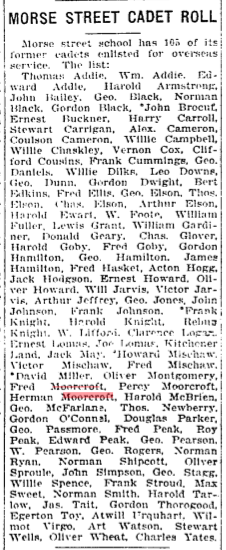
I'll close with these two clippings from the Toronto Star in 1917. The Morse Street and Leslie Street Schools remember the Moorecroft boys and so do we on Remembrance Day 100 years later.


Tuesday, 30 January 2018

Elizabeth Cowie Nicholls - exhaustion from melancholia

Mental health has become a popular topic lately.  People suffering from depression and other issues are becoming less stigmatized that they used to be. But this is a fairly recent phenomenon. One hundred years ago things were very different.

Elizabeth Jane Cowie was born on 24 September 1869 to John Cowie and Lucinda Dixon in Mara Township Ontario.  She was the second youngest of nine children. On 4 January 1893 she married Albert Nicholls in Thorah Ontario. Albert was a farmer and the couple settled on his section of the family property, Lot 22 on South Portage Road just outside Bolsover Ontario. The couple had 6 children – 5 daughters (Bertha, Gertrude, Adeline, Ruth and Alberta) and finally one son Carl. 


1911 Canadian Census, Library and Archives Canada


I don’t know a lot about their life but this map shows where they farmed in Eldon Township, Lot 22, south of Portage Road.

Township of Eldon 1916, Drawn & Published by A. E. Guidal


When Albert’s father John died in 1909 he left the property to Albert.

Tragically, Albert died young, passing away on 14 August 1913 due to Primary Lateral Sclerosis, a rare disease similar to what we know as Lou Gehrig’s disease today. This neuromuscular disease would have been a disastrous illness for a farmer. He and his family suffered for 17 months before he passed away. 

Archives of Ontario RG22-279, MS-1519


Albert died intestate but according to probate records he left his property to his widow Elizabeth to care for her minor children. 


From there, things went horribly wrong for the family. Imagine how difficult this situation was for a young widow, with no grown sons to help farm.


A handwritten note on the initial probate note that it was revoked. Elizabeth had intermeddled in the estate (acted as executor) but it appears that she was overwhelmed. The property was subsequently turned over to Willard Walton Dunlop, Inspector of Prisons and Public Charities for the Province of Ontario.


There was a reason for this - on 17 March 1914 Elizabeth was admitted to the Mimico Hospital for the Insane. Unfortunately, the records for this Hospital were not preserved so I have very little information about Elizabeth’s stay besides what was found in the admission register. She was patient #3161 and the 1526th female admitted. She was a 44-year-old widow with her occupation noted as House Keeper.

Archives of Ontario RG 10-299


Contemporary postcard, picture taken at the Lakeshore Grounds

The Mimico Hospital was abandoned after it closed in 1979. Recently Humber College took over the property and restored the buildings and grounds for use as an educational facility. I had the opportunity to tour the grounds last summer. I don’t know which cottage Elizabeth was assigned to but it would have been a building such as this.


Picture taken by the writer 2017

Elizabeth was diagnosed with manic depression mixed -  this syndrome had features unique to both depression and mania – despair, fatigue, morbid or suicidal ideation, racing thoughts, pressure of activity and heightened irritability. In other words, she was bipolar.  This appeared to be a common diagnosis – most of the entries in the death register are some form of manic depression. Treatment was not what we would expect today. It could include immersing the patient in an ice-cold bath or electroshock therapy.


Electroshock machine. Picture taken by the writer 2017

I reviewed some case files at the Archives of Ontario that documented other cases of female patients. In most files there is mention that they are loud and abrasive and excited, with swearing being mentioned. Being quiet and submissive is obviously a good thing. The cause of their admissions varies, from being jealous of a 15 year old daughter having been impregnated by her own father (jealousy is not the way I’d describe this) to not recovering from the birth of a first child.

Archives of Ontario RG 10-299


Ancestry, Ontario Deaths, 1869-1936
On December 31st 1918 Elizabeth died in the Mimico Hospital. Her admission had lasted 4 years, 9 months and 14 days. The cause of death was noted as exhaustion of melancholia. We know melancholia now as depression. It’s hard to imagine dying from depression. Without Elizabeth’s file we can’t know if she had an underlying health issue that caused her death. Perhaps she was so overwhelmed by her issues she simply lost the will to live. 

The death register notes that she was buried by friends. She was lucky. Many residents of the hospital were abandoned by their families and were buried in the hospital cemetery. There are many unmarked graves in this cemetery. It is a sad and poignant place.


Picture taken by writer 2017


Elizabeth was brought home and buried next to her husband in Bolsover.


Bolsover Cemetery, picture taken by writer 2016

All of the Nicholls children eventually moved to Toronto. In 1915 Adeline was the first when she arrived in the city at the age of 17. The 1916 City Directory shows her rooming on Jarvis Street. She was joined the next year by her sister Gertrude; both girls worked at Eaton’s. 


Toronto City Directory, Toronto Public Library


I wonder if they ever visited their mother and if that was the motivation to move to Toronto? Cabbagetown was a long way from Mimico and the trip by streetcar would have taken a long time. 

I also wonder who looked after the children when Elizabeth was admitted to the hospital. The eldest Bertha was 20, the youngest Carl was 7. Both Elizabeth and Albert came from large families so no doubt their siblings stepped in. 

Elizabeth Jane Cowie Nicholls was my spouse’s great-grand mother and we honour her struggles. Life was difficult for our ancestors and sometimes unbearable.