Arthur Davis Moorecroft came to Canada from Ireland as a child in 1873. By 1886 he had married Agnes White, a Markham girl and began raising their family of 8 children. In the 1911 census we find them living at 60 Galt Avenue in the Gerrard and Jones area of Toronto.

This house would be the family home for many years. According to the census eldest daughter Ethel had married and left the home. Second daughter Alma had died at less than a year old in 1889. Remaining at home were the five Moorecroft boys: Arthur Albert born in 1889, Robert Herman born in 1891, Frederick Alexander born in 1893, Percy Lorenzo born in 1895 and Albert Shedden born in 1902. Last but not least was the youngest daughter Madeleine (who would die at the age of 7 in 1915).

Life for the Moorecroft would change with the start of World War One. Within 8 months the four eldest Moorecroft sons had joined the Canadian Expeditionary Force:
Fred enlisted August 13th1915 at the age of 22
Percy enlisted August 14th1915 at the age of 18
Herman enlisted October 7th1915 at the age of 23
Arthur enlisted April 8th1916 at the age of 26.
All promptly shipped out to France.
PERCY LORENZO MOORECROFT 1895-1924

Some patients stayed for many years but Percy's stay was brief as his Casualty Record outlines. He died on April 12th 1924

 Percy's lung disease was deemed to be caused by his war service. The family declined the official military tombstone. Despite the note on the record the family never did erect a tombstone at St John's
ROBERT HERMAN MOORECROFT 1891-1975
Herman enlisted in the 18th Battalion Canadian Infantry.
PERCY LORENZO MOORECROFT 1895-1924
Percy enlisted in the 15th Battalion, 1st Canadian Division. His unit sailed on May 20th 1916, the same day as his brother Fred – I wonder if the brothers spent any time together on the ship. Percy was in and out of hospital during his tour of duty. He is treated in France in 1918 for Disordered Action of the Heart (DAH) a condition brought on by stress or fatigue, Pyrexia of Unknown Origin (PUO) or Trench Fever and Bronchitis.

 | Percy sailed for home on the Empress Britain and arrived in Halifax February 25th 1919. He was discharged as Medically Unfit on March 25th 1919. His medical file stated that he would not be able to return to his pre-war job as a plumber. According to the 1920 and 1921 Toronto City Directory he is living again at 60 Galt Street and working as an electrician. But by the time the 1922 Directory he is no longer living at home. Percy has taken up residence in the Mountain Sanatorium in Hamilton. The hospital was opened in 1906 to care for patients suffering from tuberculosis, a highly contagious disease. Patients came from all across Canada to be provided with bed rest, fresh air and good food. Here is a picture of the Sanatorium that I took before it was torn down in 2014.  |


ROBERT HERMAN MOORECROFT 1891-1975
Herman enlisted in the 18th Battalion Canadian Infantry.

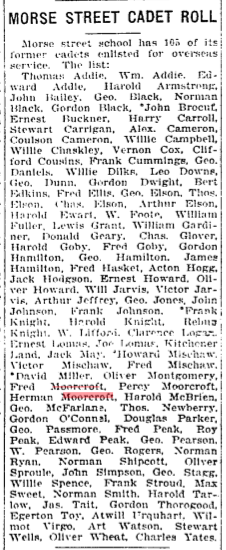
This patriotic event was noted in the Toronto Star on October 9th 1915. He sailed for England on March 29th 1916 on the S.S. Olympic and headed to France on September 27th 2016.
Earlier Herman had spent 3 years in the 2nd Canadian Engineers so he was transferred to the Canadian Mounted Rifles as a Sapper. A sapper performed military engineering duties such as bridge building, laying minefields and working on road repairs, dangerous work indeed.
Herman experienced health issues as well during his tour of duty in France. He was in and out of hospital for pleurisy (inflammation of the lungs and chest which causes pain while breathing) and was tested for tuberculosis. Unlike his brother Percy, Herman did not contract TB. The chest pain appears to have been caused by a wall falling on him, likely as he performed his sapper duties. He also was treated for digestive issues (no doubt due to stress) and rheumatism (likely from the dampness in the trenches).

Herman returned to civilian life and his home at 60 Galt Street. The 1921 City Directory lists his employment as a fireman. I found this awesome picture of Herman in the October 10th 1921 Toronto Star.


Herman moved around a bit in the 1920s and applied for naturalization in the US in 1926 but by the mid 1930s he returned to Toronto. Another gem from the Toronto Star, February 22nd 1937.
Herman never married. It appears he looked after his parents in their old age then remained in the Galt Street home until he died in 1975. He is buried beside his brother Percy in St. John's Norway

ARTHUR ALBERT MOORECROFT 1889-1918
Arthur enlisted in the 3rd Canadian Battalion on April 5th 1916. At the time of enlistment he was single but that changed before he left Canada on March 26th 1917 - on January 4th 1917 he married his sweetheart Ada Fraser. Here is Arthur in his uniform:

Arthur arrived in France on April 8th 1917. There is nothing remarkable in his service file until a skirmish on September 27th 1918 when he sustained a gunshot wound to the head. He died the next day.


Ada received a Special Pension Bonus of $80 for the loss of her husband. Albert is remembered in the Book of Remembrance housed in the Canadian Parliament in Ottawa.

The Moorecroft family's experiences were no different than that of any other Canadian family during World War One. Two sons dead from war related injuries, one permanently disabled from his war wounds and one seemingly untouched but no doubt mentally scarred by his experiences.
I'll close with these two clippings from the Toronto Star in 1917. The Morse Street and Leslie Street Schools remember the Moorecroft boys and so do we on Remembrance Day 100 years later.
 |  |


