Friday, 25 February 2022

Branching Out: The Beslers of Landestreu

Heimat Galizien im Bild,  Hilfskomitee der Galiziendeutschen 

I've been researching my grandfather’s family in Galicia lately which is a perfect lead in for this month’s topic. The picture above is Landestreu, Galicia. My grandfather Jacob Besler left his home there in 1902 at the age of 18 to emigrate to Canada. He never returned to his homeland and never again saw most of his family. I don’t know if he exchanged letters with his family. If he did the letters have not survived. He was busy raising his own family and trying to survive in the harsh climate of Saskatchewan but he must have thought of his parents and siblings and wondered what became of them. Here’s what I discovered.


My grandfather was the 8th of 10 children born to Johann Heinrich Besler and Maria Barbara Baumung as well as the youngest son. Large families were common in the village of Landestreu and land was scarce. Most of the inhabitants of the village were described as Grundwirts or Landwirts which translates to farmer in English. A promising future was not in store for young Jacob so his decision to emigrate to Canada made sense. You can read my earlier blog post about his journey here


Survival into adulthood was difficult. Many children in these large families did not make it past their first year. Heinrich and Barbara’s first child Johann Christian was born in 1868. Their next four children died young: Katharina Elisabeth born in 1871 lived 2 1/2 months and died of Schwäche (weakness), Johann Philipp born in 1872 lived 8 months and died of Zahnen (teething), Jakob Adolf born in 1874 lived to 6 1/2 and died of Auszehrung (weakness/emaciation, possibly tuberculosis) and Maria Katharina born in 1876 lived just 3 weeks before succumbing to fraise (infant spasms). In other families masern (measles), keuchhusten (whooping cough) and rachitis (rickets) claimed many children, causes of infant mortality that we don’t see any more. Luckily for the Beslers their last 5 children were healthy and lived well into adulthood.


Heinrich died on 28 Nov 1912 at the age of 69 from some sort of cranial issue, perhaps a stroke? (Gehirnenig). Barbara died on 26 Oct 1920 at the age of 73 of Alterschwäche (old age). When Jacob married in 1915 he noted that both his parents were dead which leads me to believe that he did not receive letters from his family once he settled in Canada. Perhaps mail wasn’t coming through during WWI leading him to guess that they were dead. 


Record book of deaths. Ugartsthal-Landestreu commune agad.gov.pl

Once the senior Beslers died their oldest son Christian took over the family residence House #7. He had married Eleonora Löwenberger in 1895 and was listed as a Grundwirt or Landmann.


Record book of Weddings, Ugartsthal-Landestreu commune, agad.gov.pl


The couple had 8 children that I know of. I don’t know when or where Christian or Eleonora died nor the fate of 4 of their children.  Fred and his wife Minnie emigrated to Canada, settling in Winnipeg. My mother was close to their daughter Eleanor. Minnie and her husband Wilhelm Schick settled in Toronto. John settled in Toronto as well. 


I wasn’t able to determine the fate of Johann Georg Besler born in 1878. Perhaps he died young or moved to another village in Galicia.


Eleonora Besler married Johann Friedrich Lowenberger in 1896 and had 9 children that I know of. Friedrich died in 1920 of the Spanish Flu, one of a number of relatives that succumbed to the deadly virus. I don’t know of Eleanor’s fate but she remained in Europe. Two of the 9 children emigrated to Canada: Fred and his wife Hedwig and George and his wife Irma settled in Toronto.


Katharina Besler married Johann Reihl in 1913. They had one child that I am aware of. I do not know their fate.


Finally Dorothea Besler married Rudolf Kandel in 1906. This is the only sibling that my grandfather even saw again. First Rudy then Dorothy emigrated to Canada in 1912 with their two eldest children. They settled in Brandon Manitoba. My mother has fond memories of her Aunt Dorothy and stayed in touch with her cousins even when she moved to Toronto.


Hamburg Passenger Lists 1850-1934, ancestry.ca

Jacob and Dorothy were the lucky ones as they left Galicia before the first World War. The inhabitants suffered greatly but many residents remained even after the territory was divided after the War. Things improved in the inter war years but little did they know that the worst was yet to come in the form of World War Two. 


In 1939 Poland was divided between Germany and the Soviet Union as a result of the Ribbentrop-Molotov agreement. One of the terms of this agreement was that those of German ethnic background were to be relocated from the Russian area to the German area. So the residents of Landestreu had to leave; likely they did not want to stay in Russian controlled territories though it was a difficult decision to leave their homeland. Always particular, the Nazis created Einwandererzentralstelle forms, translated as Immigration Centre documents. The documents were stored in the Berlin Document Centre and captured by the American army at the end of the war. Starting in 1939 hundreds of thousands of people were recorded as they packed up to leave their homes. 


In English Landestreu means “faithful land” and the Beslers were indeed faithful to their land. The family moved to Landestreu from Biedesheim in the Rheinland Palatinate in the late 1700s. The village was founded in 1783 and my 4x great grandfather Konrad Besler was listed on the first census of residents taken in 1788.   


Ludwig Schneider, Das Kolonisationswert Josefs II in Galizien


This was the only home they had ever known. Despite speaking German and worshipping in the Lutheran church their ties to German were very weak. They were moved to camps in German controlled territories in Poland and often into farms that were cleared of their original Polish inhabitants. The intent was that they would produce food and provide other services to support Germany and the Nazi war machine. 


The Galizien German Descendants has indexed many of the EWZ forms relating to Galizien residents.  The forms from 1940-1941 are available on Family Search to view. I was not able to find my great Uncles and Aunts though I did find a variety of more distant cousins. Then, by chance I realized I was looking at one of my mother’s cousins. Her record had not been indexed and I found it as I browsed the records looking for someone else.


Eleonora Besler was born on 13 May 1900, the second daughter and third child to Johann Christian Besler and Eleonora Löwenberger. Her birth record is not yet available but I located the record of her marriage to Jakob Weiss on 15 February 1920. 


Record book of Weddings, Ugartsthal-Landestreu commune, agad.gov.pl


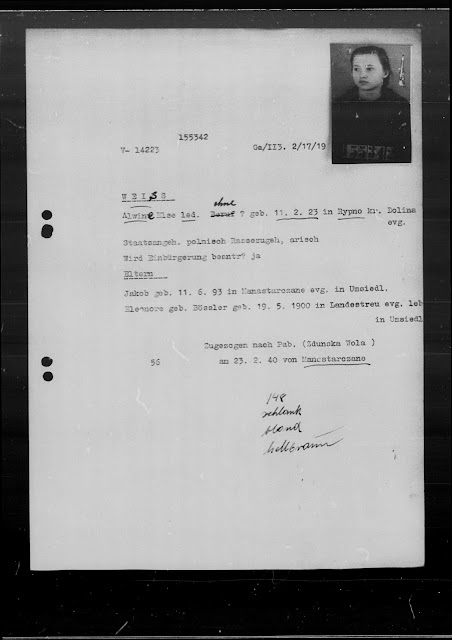
After her marriage she lived a quiet life in Landestreu, until she presented herself and her 17 year old daughter Alwine to authorities in Pabianice on 23 February 1940. They had been moved from their home in Landestreu to nearby Manasterczany then to Zdunska Wola, near Łodz for processing. Today this is a 10 hour drive. Eleonora and Alwine likely spent many more hours on a train to get to the relocation camp. The photos are poignant. They look apprehensive and rightly so. They were headed to an unknown future in a new town. They were separated from Jakob who had apparently already been relocated. The form notes that they are of Polish nationality, the Evangelisch (Lutheran) religion and of the Aryan race (not likely that anyone would say otherwise to this question!). They both wished to apply for German citizenship. At the bottom a physical description is added by hand. Eleonora is 156 cm tall, slim with blond hair and blue eyes. Alwine is 148 cm tall, slim with blond hair and light brown eyes.


Stamblätter 1940-1941, Deutschland Einwandererzentralstelle FamilySearch.org    


Their post-war fate is unknown but likely tragic given their location in the path of the advancing Soviet army.  It was a sad end to what began as hopeful emigration and emphasizes how fortuitous my grandfather’s decision to emigrate was.  


To conclude here is a German newsreel clip from early in 1940 showing Galician emigrants in the course of their journey. 


No names are provided but likely some of the people in this film were my family members. The enthusiastic greeting by the Nazis was no doubt put on for the camera - I’ve seen anecdotal evidence that their possessions were stolen and compensation for the loss of their lands never provided. Today Landestreu is in western Ukraine and has been renamed Zelenyi Yar. The fate of this area of the world is once again uncertain.


Sunday, 9 January 2022

Foundations - Archibald Thomson

This year I've decided to participate in the 52 Ancestors in 52 Weeks project. The topic for week 1 is Foundations. The word foundation applies to my 5x great grandfather Archibald Thomson in so many ways.


He’s the foundation of my family in Canada and indeed North America. Archibald was born in Westerkirk, Dumfriesshire, Scotland on 22 Jan 1747. He initially settled in New York State, emigrating from Scotland in 1773. I’ve written about his decision to stay loyal to the British crown in an earlier post, you can read this story here. He first petitioned for land in Kingston in 1790, becoming the earliest settler in Canada in my family. 


Library and Archives Canada, Upper Canada Land Petitions "T" Bundle Misc. RG 1 L3 Vol 511

While in Kingston Archibald was a model citizen, part of the foundation of this young community. He was granted town lots 34 and 35 in Kingston and subsequently was granted a water lot to build a wharf. In 1791 he is mentioned by the Upper Canada Land Board in regards to the land petition of John Catin who was previously refused land on the suspicion of his being a disorderly character. On 14 Dec 1791 the board heard that he had been in the employ of Archibald for a year and had behaved in an orderly, sober and industrious manner. Archibald also engaged to put of a house for him on the lot. The land was granted him accordingly.


Library and Archives Canada, Upper Canada Land Board Dec 14 1791 p.333 Vol. 7

 And this brings to another way in which Archibald is a foundation - he was a master carpenter. He was involved in other projects besides helping Mr. Catin and erected a wharf. His biggest endeavour was to act as the general contractor and carpenter on the first church in Kingston - Old St. George’s, erected in 1792. This was the oldest Anglican parish in Ontario founded in 1785.  According to "The Parish Register of Kingston Upper Canada 1785-1811" on January 9 1792 Archibald was retained to construct the church. His account totalled £113, 7, 3.


The Parish Register of Kingston Upper Canada 1785-1811 A.H.Young 1921


Not only did Archibald build the church, but his family attended the church and he served as vestry man and warden. Archibald also was a benefactor donating £2 to the church. It is worth noting that the Thomson family were staunch Presbyterians. However, at this point in time only Anglican churches were available. The Reverend John Stuart was the minister at the Kingston church and a fellow Loyalist. It is possible they were acquainted during their time in NY state and involvement with the Mohawk nation. In 1825 construction began on a new church. I haven’t been able to determine what happened to the original church; it was likely demolished. 


The Thomsons owned property and resided in Fredericksburg Township and the town of Newark (now Niagara on the Lake) before moving to the town of York. There they would have encountered Reverend Stuart’s son George Okill Stuart who had been appointed  minister of St. James Church.  He was appointed in 1801 and the original church was begun in 1807 and completed in 1809. There he married Archibald’s daughter Elizabeth in 1806 and baptized her daughter Mary in 1808.


Finally Archibald was the foundation of the Thomson family in Canada. Archibald was the second oldest of 8 children born to Andrew Thomson and Jannet Scott. His older brother William remained in Westerkirk but Archibald was followed to North American by his younger brothers Andrew and David. In 1796 he petitioned the Crown for land for his brothers as he had become accomplished in the process. The Petition notes that the family is on their way from Britain


Library and Archives Canada Upper Canada Land Petitions "T" Bundle 2 1796-1797 RG1 L 3 Volume 495


The brothers initially settled in the town of York then moved further east to settle in the new area of Scarborough. David and his family became the first family to settle in Scarborough and he and his wife Mary are commonly known as the mother and father of Scarborough. Once the Thomsons settled in Scarborough they donated land on which St. Andrew’s Church was erected in 1818, the first Presbyterian Church erected in Scarborough. Archibald died in 1819 and is buried at St. Andrews with his wife Elizabeth and his brothers.


Sunday, 20 June 2021

Becoming a Teacher


While looking through my father’s papers I found a newspaper clipping from the Globe and Mail dated June 28th 1951. It was entitled  “Results of 1951 Examinations of Ontario of Education Are Announced. In the first paragraph was a familiar name: Gordon Russell Brooks, who was a successful candidate in the High School Assistants, Type A, Intramural examinations for Vocal and Instrumental Music. Interesting, I thought. Obviously I knew that my father was a teacher but what exactly was a High School Assistant, Type A and how did one become one?


My dad’s journey to becoming a teacher started much earlier. I had written earlier about how he obtained his Bachelor of Music degree thanks to the Veteran’s Charter. Russ loved music and had always dreamed of becoming a teacher. He enrolled in the new School Music program at the University of Toronto in 1947 after returning from service in Europe in 1946. 


The class was a small, select group of 21 students with 5 professors and 3 lecturers. The program was rigorous. In his 3rd year Russ would have studied the History of Music, Keyboard Harmony. Arranging, Choral Technique, Band and Orchestral Technique, Conducting and more. Students were also given “general instruction in programme planning and musical aptitude and achievement testing” to prepare them for their future teaching career. English and Physics were also required, the latter for acoustics. Fees of $210 were charged with an incidental fee of $39 which covered Hart House access, health services and the cost of the degree itself.

By the time he entered the Ontario College of Education in the fall of 1950 Russ was well positioned to become a teacher. He had met the qualifications for admission to the music teacher’s program by completing his Bachelor of Music degree. The fees for the year program were $125 for academic including the examination and $26 for incidentals including Hart House access, health service and the medical examination for admission to the College. The Faculty of Education was located in the building that now house UTS on Bloor Street West between Spadina and Huron. 


City of Toronto Archives, Fonds 1244, Item 3256


There were two streams for the Interim High School Assistant Type A certificate. the first covered Agriculture, Classics, English and French, English and Latin, English, Geography, History, French and German, French and Italian, French and Spanish, Latin and French, Latin and Greek, Mathematics, Mathematics and Physics, Science,  Physics and Chemistry, Physics and Biology, Chemistry and Biology, and Home Economics. The second stream including Physical Education, Arts and Crafts, Instrumental Music and Vocal music. This is the stream that my dad entered.  Examinations for the music stream were to be held as follows: 


Russ was successful in his studies and quickly obtained a job at Uxbridge and Port Perry High Schools


Schools and teachers in the Province of Ontario. Ontario Department of Education 1951. Internet Archive  


Interesting how the directory lists the teachers’ salaries. Russ earned the princely sum of $2,800 which works out to $29,000 in today’s money. Teachers did not earn high salaries in those pre union days. My parents rented an apartment on Brock Street in Uxbridge, a 5 minute drive to Uxbridge Secondary School on Planks Lane


and a 15 minute drive to Port Perry High School on Rosa Street in Port Perry.


Both schools had been erected in the 1920s and would soon have additions built to accommodate the baby boomer generation. But in 1951 the student body was a modest size, both around 200, and the faculty small. Both schools had 11 teachers including the principal.


Uxbridge staff 1951-52


It was at the Port Perry High School that my dad first staged one of his beloved Gilbert and Sullivan operettas starting a tradition that lasted throughout his career.


Russ worked at the two schools for 3 years until 1954 when he moved to Oakville to teach at Oakville Trafalgar High School. He then moved on to Newmarket High School where he finished his career as a music teacher.


So what was a High School Assistant, Type A, Intramural? The difference between Intramural and extramural isn’t defined in the calendar but it appears to refer to students completing their studies in class at U of T and those studying off campus. The definition of the certificates is noted here:


Sure enough, when I next find Russ in a teacher directory he is teaching at Oakville Trafalgar High School in 1956. He is described at a HSS (High School Specialist) with special certificate in Interim and Art and earning $4,800.


Mystery solved and congratulations to my dad on this major achievement, 70 years ago!

Tuesday, 27 October 2020

Convocation 1950

On this day 70 years ago my father marched across the back campus into Convocation Hall and received his Bachelor of Music degree from the University of Toronto. His degree was much valued and hard fought for.

Russ' elementary years were spent at Hartman Jones memorial School on Carlaw Avenue in East York. He moved on to East York Collegiate where he completed grade 12 or Junior Matriculation in 1939. It was there that Russ' formal education came to a screeching halt. His dream had always been to study music at the University of Toronto. He had prepared for this by engaging in years of study at the the Royal Conservatory of Music. At the time the RCM was located at the corner of College Street and University Avenue in downtown Toronto.

Taken in March 1920, Toronto Public Library, Baldwin Collection

Russ got his love of music from his mother Gertie who was an accomplished musician. He inherited her Heintzmann piano which still holds a place of honour in my mother’s home. Russ followed Gertie’s footsteps in becoming a skilled pianist. Unfortunately we do not have records of his achievements at the Conservatory but according to his was file he completed Grade Ten piano, Grade 4 Theory and the Teacher's Written examination qualifying for ATCM.


Post secondary education in music in Toronto at the time was coordinated by the Royal Conservatory of Music in conjunction with the University of Toronto, both headed by Sir Ernest McMillan. In 1946 the Faculty of Music intiated the MusBac, a 3 year school music program which would prepare students for teaching instrumental and vocal music at high school level. In its first year 21 students enrolled in the program. With help from the Department of Veteran's Affairs Russ began his studies in 1947. Students studied string, woodwinds and brass, conducting, choral music, music theory and history (Russ is on clarinet).


University calendars had a lot of personal information back in the day. The full class is listed in the 1949-1950 Academic Division Calendar


Further information on Russ' studies was found in 1950 Torontonensis yearbook


Russ completed his degree in the spring of 1950. Convocation was held on October 27th 1950. My mom and grandparents attended


The class was impressive and so is the diploma itself. I was quite jealous when I discovered that my diploma from U of T was not in Latin!

I believe my dad was the first person in his close family to complete a university program.  It was a major accomplishment 70 years ago as higher education was usually out of the reach of the average Canadian. I was proud to follow in his footsteps 31 years later. 

Friday, 21 February 2020

Archibald Thomson - A Canadian Success Story

This is Heritage Week and I thought it would be the perfect opportunity to write about my ancestor Archibald Thomson. Archibald's story is important not only to my personal heritage but also to that of the province of Ontario.

Archibald was born in the small town of Westerkirk in Dumfries Scotland in 1749, one of 8 children born to Andrew and Jannet Thomson. He was baptized in the parish church On May 7th.


Scotland's People Old Parish Registers. Westerkirk 854/00 0010 0057

In 1773 he crossed the ocean in search of a better life, settling in Harpersfield in Tryon County, New York State. He farmed with other young Scots, James Park, Daniel Rose and John Chisholm. In 1775 "his attachment to his sovereign caused him to leave what little property he had acquired (12 acres of land) behind him" siding with the British in the American Revolution. He ultimately filed 16 Land Petitions that provided me with details of his service to the Crown. Archibald was a carpenter by trade and initially completed repairs at Fort Oswegatchie and Niagara. He was later appointed Master Carpenter by Governor Abbott. In 1777 he served under Captain John MacDonnell in the Second Battalion of the King's Royal Regiment of New York. In 1778 Archibald joined Captain Joseph Brant and was allegedly arrested by the Rebels for detecting and defeating conspiracies. There he was placed "under sentence of death for joining the Indians and escaped the Americans". I hope to find more about this interesting part of Archibald's story! He and his colleagues served without pay for seven years until the end of the war and "suffered every extremity of distress" and "engaged in the most dangerous of enterprises" under the command of Captain Brant, serving with "all the Zeal and Bravery of Britons". He was ultimately granted a Lieutenant's commission by Lord Dorchester.

On 27 July 1781 Archibald married Elizabeth McKay in Quebec City. Elizabeth was the daughter of Hugh McKay another Scottish refugee from New York State who became the High Constable of Quebec.


Quebec Gazette 2 August 1781, page 2

The couple moved about the province acquiring and selling land in various areas that was acquired by their successful land petitions to the Crown. 

Ontario Archives RG 1-58 Township Papers, Scarborough MS 658 Reel 436

Elizabeth acquired land due to her status as a daughter and wife of a Loyalist. Archibald acquired a town lot in Kingston in 1790. He ran a timber yard, wharf and store from this property. In the same time period he also acquired land in Fredericksburg Township as well as in Thurlow Township. In 1793 he also acquired a town lot in Newark (later Niagara on the Lake)and property in Stamford Township. By 1797 he owned a coveted town lot in York (later Toronto) near the St. Lawrence Market. As you can see from this detail from a map from the time his neighbours included his brothers David and Andrew


Detail from the Peter Russell 1797 map of Toronto, Toronto Public Library

And here's where Archibald's importance to the province lies - in 1796 he had petitioned the crown for 400 acres of land for his brothers who wished to join him in Canada and settle in Scarborough. He was successful and the rest is history. His brother David and David's wife Mary were the first settlers in Scarborough.

By 1799 Archibald himself joined his siblings in Scarborough purchasing and leasing 4 plots of land. He ran a "house of entertainment" and a grist mill while farming and also acting as a Justice of the Peace. In 1815 he certified his son Edward's land petition. Here's his signature. I found it to be consistent on the various documents over the years.


Upper Canada Land Petitions, Library and Archives Canada RG 1, L 3, Volume 497 "T" Bundle 10

Archibald died on 22 January 1819. Elizabeth had died two years earlier and I believe the couple were originally buried on the family farm. They were reinterred at St. Andrew's Presbyterian Church in Scarborough, the first Presbyterian Church in Scarborough, erected on land donated by the Thomson family. The inscription is difficult to decipher but reads: "Their remains moved to this place on June 3 1854 by their descendants numbering 231".


Picture taken by the writer

Archibald's demise was noted in the Upper Canada Gazette on the 28th of January 1819. He received a fine tribute:


Upper Canada Gazette, 28 January 1819, page 2


Archibald had packed a lot into his 70 years probably beyond what he expected as a young boy in Dumfries. He left behind a legacy that was build on by his many descendants. Archibald and Elizabeth had 12 children all of whom lived to adulthood. Two of his sons Hugh Christopher Thomson (1791-1834) and Colonel Edward William Thomson (1794-1865) have entries in the Dictionary of Canadian Biography. Roy Thomson, Lord Thomson of Fleet, and his son Ken are descended from Archibald's youngest child George. Actress Norman Shearer (descended from Colonel Edward) and writer Farley Mowat (descended from Hugh) are also Thomsons. 

And I'm a Thomson too! I'm descended from Archibald's fifth child Elizabeth McKay Thomson who married Thomas Forfar in 1806. I was pleased this year to be able to prove my descent from Archibald and receive my certification from the United Empire Loyalist's Association of Canada. Here's the back of Elizabeth's Land Petition referencing her father's UEL status:

Upper Canada Land Petitions, Library and Archives Canada RG 1, L 3, Volume 187 "F" Bundle 8

Archibald was recognized as a United Empire Loyalist as he demonstrated Loyalty to the Crown. In recognition of his service in defence of "Unity of Empire" I can now use the letters UE after my name. Archibald Thomson rose from a refugee to a founding member of Upper Canada due to his perseverance and hard work.