Showing posts with label Scarborough. Show all posts

Sunday, 6 July 2025

My Father's Loom

An object might seem to be just an object but the same object can have a story to tell.  A diamond ring might tell the story of love and marriage. A christening gown could tell the story of the multiple babies who wore it. But what kind of story can a loom tell? As it turns out an interesting one with a personal twist to it! Here is the loom and here is its story.

In 1946 my father Sergeant Gordon Russell Brooks was demobilized from the Canadian Armed Forces. After four years in Europe serving first in the Medical and then the Provost Corps, Russ was eager to return to Toronto to get on with his life. Never robust, he miraculously managed to survive his service without injury, but upon his return home developed severe problems in his right knee. As a veteran, he first was treated in the old Christie Street Hospital which was still in operation when the first soldiers returned from Europe. He was subsequently transferred to the spanking new Sunnybrook Medical Centre where he underwent surgery (he was one of the first 100 patients to be admitted). Recovering from surgery, Russ was bedridden for some time. The Sunnybrook occupational therapist team devised a treatment plan to keep his hands busy and his spirits up. He was prescribed a Guildcraft-Thackeray Loom, produced by the Guild of All Arts in Scarborough.


The Guild of All Arts was founded by Rosa and Spencer Clark as an artists’ co-operative and centre promoting the Arts and Home Crafts Industries movement in Canada. It was situated on the grounds of the Bickford Estate, a property purchased by the widowed Rosa Breithaupt Hewetson in 1932 just before her marriage to Spencer Clark.

Bickford Estate 1944 photo TPL Digital Archives


Rosa and her three daughters from her first marriage enjoyed working with looms so it was no surprise that the first studio established at the Guild in 1932 was hand-loom weaving. Other crafts soon followed - pottery, wrought iron working, sculpture, painting, and cabinet making, among others. Workshops were set up on the Clark’s property, staffed with professional crafts people who lived on site and would demonstrate their particular craft to the public. Quality pieces produced by the artists would be sold on site or at the Guild of All Arts Shop on 44 Bloor Street West. This postcard, purchased and sent home by one visitor in 1940, shows the popularity of the weaving studio.This particular visitor was from New Jersey - visitors came from near and far to visit.


The first looms produced and used in the weaving studio were huge, noisy and complicated. The Guild’s 100” wide loom, billed as the largest hand-loom in Canada, was set up at the CNE for visitors to marvel at. The Clarks soon began to look for a smaller loom that could be manufactured and sold to customers who wanted to learn the craft. The Clarks learned of a unique light and portable loom that had been created by Captain Henry James Thackeray, a member of the British Arts and Crafts movement, and a 3rd cousin of author William Makepeace Thackeray. The Captain had  died in 1926 but his widow continued on with his work of promoting the loom.  


In the July 11 1931 edition of the Yarmouth Independent Margaret 

Thackeray spoke of “efforts being made at Elsing to revive the old village  industry of weaving by means of a simple loom invented by her husband, the late Captain Thackeray. Its use was deftly demonstrated upon the terrace overlooking the lily-starred moat, and fabrics so made were much admired”. In the mid 1930s Rosa and Spencer visited England and stayed with Margaret at Elsing Hall, the family estate located in Norfolk. The Clarks were successful in securing the North American as well as the British patent and design rights to the loom. Despite the fact that she no longer controlled sales of the loom Margaret continued to promote it. In the 1939 Register of England she described herself as “Estate Owner and Seller of Thackeray Loom”.  


Back in Canada production of the Guildcraft-Thackeray Utility Loom was soon underway in the Guild's wood-working shop supervised by Herman Riedl. Assistance was provided by the metal-working shop. The loom proved incredibly popular and was marketed to schools, camps and rehabilitation hospitals, as well as the enterprising home weaver. The loom was light, portable, and small enough to be used by a seated patient such as my father. It was reasonably priced and many were sold by mail order. Potential weavers could visit the Guild of All Arts Shop on the 6th floor of Simpsons for a free demonstration. 


The loom could be purchased on a “Home Lovers Plan” for only $2.50 now and $2.50 monthly. Customers were encouraged to take the loom to the cottage as “During the holidays you can readily weave smart materials for suitings, hand bags, scarfs, table runners, and many gifts for Christmas” (Toronto Star June 14 1935). It became a major source of revenue for the Guild with more than 30,000 shipped worldwide, The Globe and Mail and Toronto Star were filled with ads touting the benefits of the loom and  news articles featuring Rosa and her daughters modelling clothing made from cloth they wove themselves.

Globe and Mail February 2 1938

The Canadian magazine published a glowing report about the Guild’s looms in its November 1937 article. “The Guildcraft and Thackeray looms are the biggest news the weaving world has had for centuries” as “The very smartest Parisian women and the most advanced Americans have seized on the brand-new vogue for hand-weaving with such glee that The Canadian would like to wager that you will find yourself plunged into the craze for hand-weaving before you know what has happened to you”.


The instruction book for the Loom noted that “Guildcraft Looms have revolutionized home weaving until it is now one of the easiest and simplest of home occupations. Study your loom and your work with patience and care. You will be an expert before you realize it”. The booklet featured a picture of the Hewetson girls at work on their looms on the grounds of the Guild.  

My father was extremely creative and he enjoyed using the loom to make various projects. I still have a wee blanket and a placemat/napkin set. He must have made more woven items and given them as presents as he had labels created. I don’t ever remember my father using the loom but he kept it safe through his life. It remains a reminder of a difficult but rewarding time in my dad’s life and an interesting connection to my current home in Guildwood Village.


The Guild of All Arts is no longer in operation but the site still exists though in a different form. The property has recently been renovated and turned into an event venue. The City of Toronto took over the property in 1978 and the park is open to the public. Of interest is the open air art gallery. In the1950s and 60s many older buildings in Toronto were razed for new development. The Clarks collected the decorative stonework from many of these buildings. Relics from over 50 buildings can be seen in the park.  


This is the facade from the Royal Conservatory of Music formerly located at the corner of University Avenue and College Street in Toronto. My dad studied at the Conservatory and later at the Faculty of Music located in the same building. The facade features a portrait of Sir Ernest MacMillan, dean of the Faculty when my father studied there. Sir Ernest was apparently an occasional guest at the Guild of All Arts taking the time away from his day to day activities to write music. A nice reminder of my dad’s music studies close to my home.

Wednesday, 12 July 2023

Adventures in the 1931 Census Part 1: Those Who Were Where They Were Supposed to Be

June 1st 2023 was a day of great excitement in the home of many a genealogist, including mine. It was the day the 1931 Census was released! I jumped right in, ready to browse away. I had particular goals with this census release as it marked the first appearance of both of my parents.

Let’s start with my mom. My grandfather arrived in Canada in 1902 and headed directly for Saskatchewan and what soon became the family farm: Section 24, Township 25, Range 30, West of the 1st Meridian, Calder. I found him there in the 1906, 1911, 1916, 1921 and 1926 censuses with his growing family. I was disappointed that the 1926 census was taken on June 1st as my mother was born in September, just missing out on her first appearance! Though I am appreciative that the decision was made to add the additional western censuses on the ‘6’s’.

Library and Archives Canada Seventh Census of Canada 1931

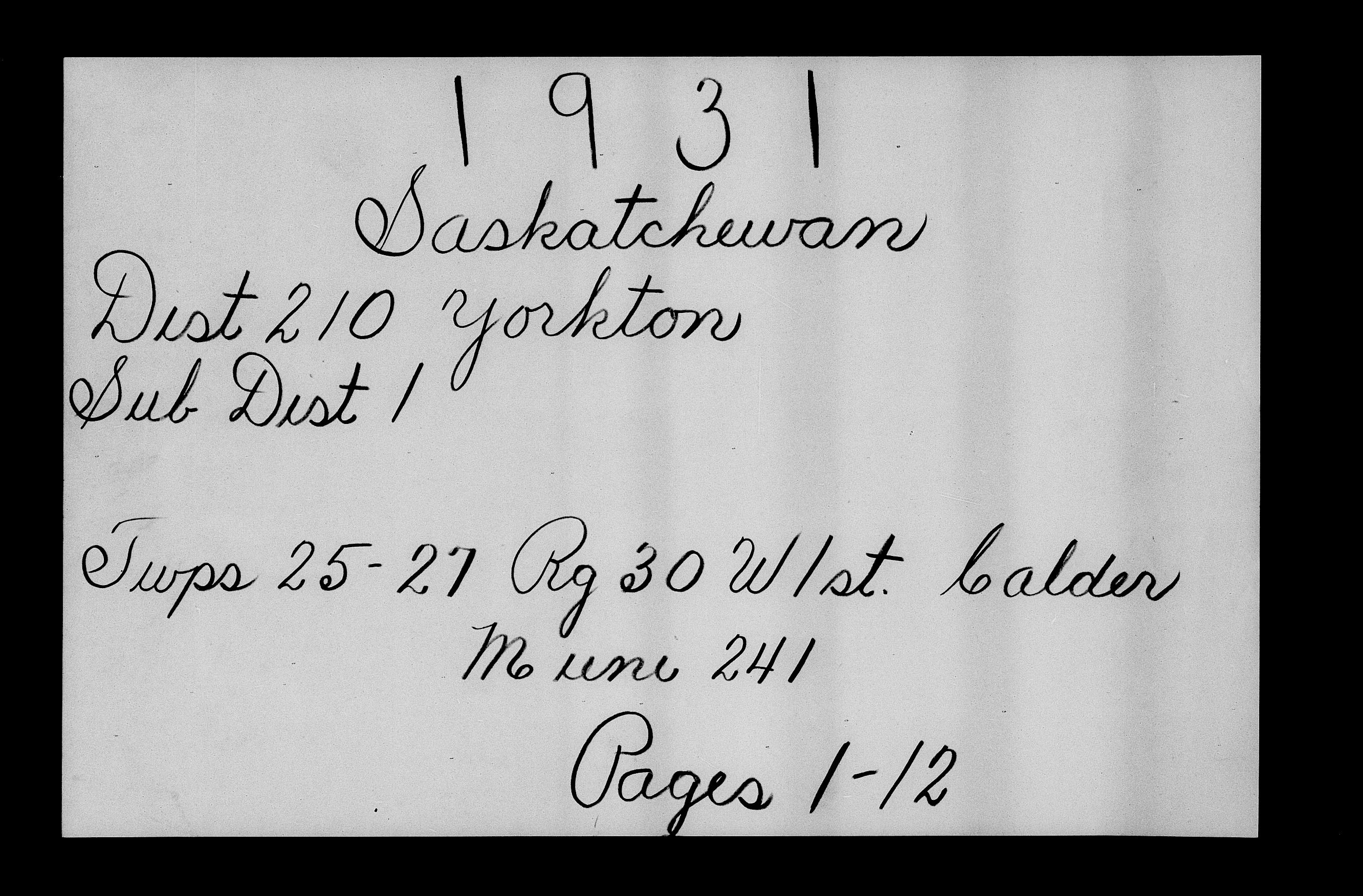
Many people experienced great levels of frustration on the first day of the release due to the huge demand for the records. But for some reason I was easily able to find the record I wanted (though my luck disappeared for the rest of the day). Calder was a sub-district in the district of Yorkton in the 1926 census so I pulled up District 210 Yorkton, Sub district 1 Twps 25-27., Rg 30 W 1st Calder Muni 241. Hmm, this sounds familiar! And just like that there they were, surrounded by family members by the name of Faustmann and Baumung. 


Library and Archives Canada Seventh Census of Canada 1931 Yorkton Calder Saskatchewan


It was fun showing my mother her family. Not many people can say they appear on this census.


My grandmother’s two younger sisters were nearby - Carolena and her husband Ferdinand Mundt farmed in a neigbouring section and Christina and her husband John Schneider lived in the thriving village of MacNutt. 


The village’s census is populated with teachers, merchants, cooks, garage repair men, the postmaster and the pastor. My great grandfather is still employed in running his shoe repair shop. It’s interesting to note that the census in the village was completed on June 2 and 3. it likely took a fair amount of time to visit all the neighbourhood farms on June 1 leaving no time for the rest of the area population.


Library and Archives Canada Seventh Census of Canada 1931 Melville MacNutt Village

Downtown MacNutt where my great-grandfather's shop and residence was located, in 2019

The next day, June 2, I was able to find my father and his family. However,  there are a few twists to their story. We last saw the Brooks family in Toronto in 1922 at the time of my father’s birth. You can read that story here. I knew that the family left Toronto to reside in Brantford and Owen Sound based on correspondence that I found in my grandmother’s possession. I did a bit of research to find out why they moved and when. The City of Toronto directories showed the family living on Sparkhall Avenue until 1929. Bill had changed jobs leaving his position at the John Hillock Co and moving to the E L Ruddy Company which was located at 317 Spadina Avenue. At both companies he was a salesman. The Hillock company was no longer listed in the 1928 directory so it may have ceased operations leading to a change in employment. 


Brantford Refrigerators by Ruddy 1930 Toronto Public Library Digital Archives

I was able to find some information about the Ruddy Company.  It was listed in the Toronto directory through 1931 but the head office was always located in Brantford. A 1930 prospectus described the company as “The Largest Refrigerator Manufacturers in the British Empire”, proudly owned and operated by Canadians. Apparently "Our employees are all Britishers, many of whom came out from the British Isles, the rest being Canadians of British descent"!!. A selling feature at that time I suppose. Apparently the refrigerator would be mounted in the wall of the house so the ice chamber could be accessed from the outside by the ice man, though most models could be converted to electricity. The Toronto Public Library’s digital archives contained a number of brochures produced by the company.


Brantford Refrigerators by Ruddy Toronto Public Library Digital Archives

Vernon City Directory Brantford 1932 FamilySearch


I had luck finding the family in the Brantford City Directory. In 1930 and 1931 the family resided at 278 Marlborough Street with Bill listed as a clerk at the Ruddy Mfg Co. 


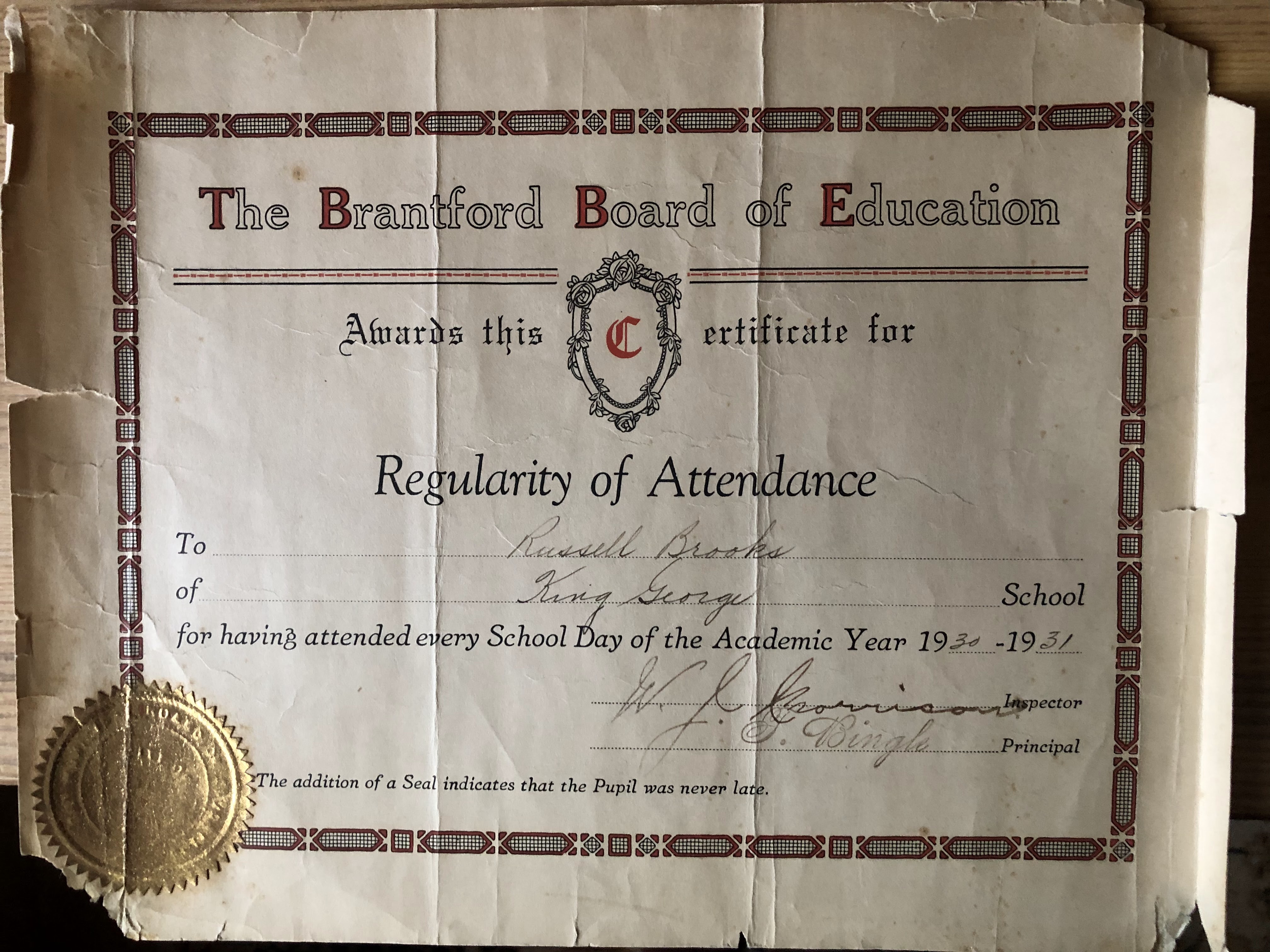
In the 1932 and 1933 directory the family lived at 154 Elgin Street. The Ruddy plant was located on Elgin Street (the building is long gone) so Bill would have been able to walk to work. The kids settled in,  attending King George School, where Russ had perfect attendance in the 1930-31 school year (and was never late!).


Bill is listed as an estimator of kitchen equipment. I imagine he took measurements in preparation for the installation of the fridge. He made the princely sum of $1,500 a year, worth about $24,838.97 in today’s dollars. The Brooks family paid $30/month to rent a brick home with 6 rooms - this works out to less than $500/month in today’s money for a nice looking two story home, comparable to the Sparkhall property. Also, they were the only family I located in the 1931 census that owned a radio. 

Library and Archives Canada Seventh Census of Canada 1931 Brantford City Ward 3


The family was found in the 1933 Brantford Directory but they moved on that year. It’s not clear if the move was voluntary or not but Bill was next employed by the Eureka Refrigerator Company in Owen Sound in 1933. Shortly after he lost his job and the family returned to Toronto. Only the 1938 Owen Sound directory was available so I do not have their address for their residence in that town. In 1935 they had returned to Toronto and were listed on the voter’s list at 177 Queensdale Avenue East York. Bill was able to find work with the Town of East York and he and Gertie remained there for the rest of their lives.


Finally, I was able to find the rest of the Brooks family in Scarborough. It was interesting to see that John Brooks senior was actually the enumerator for Malvern Village, I recognized his signature from correspondence I have. As a lifelong Scarborough resident he no doubt knew everyone in the vicinity and enjoyed chatting as he completed his returns. Son John and his family lived on the same property and helped with the farm; son George lived nearby.


Library and Archives Canada Seventh Census of Canada 1931York South Malvern Village


So the Brooks and Beslers cooperated and were where they were supposed to be. But not all my ancestors were so cooperative. Part II will follow - the elusive hidden Kingswells.

Sunday, 9 January 2022

Foundations - Archibald Thomson

This year I've decided to participate in the 52 Ancestors in 52 Weeks project. The topic for week 1 is Foundations. The word foundation applies to my 5x great grandfather Archibald Thomson in so many ways.


He’s the foundation of my family in Canada and indeed North America. Archibald was born in Westerkirk, Dumfriesshire, Scotland on 22 Jan 1747. He initially settled in New York State, emigrating from Scotland in 1773. I’ve written about his decision to stay loyal to the British crown in an earlier post, you can read this story here. He first petitioned for land in Kingston in 1790, becoming the earliest settler in Canada in my family. 


Library and Archives Canada, Upper Canada Land Petitions "T" Bundle Misc. RG 1 L3 Vol 511

While in Kingston Archibald was a model citizen, part of the foundation of this young community. He was granted town lots 34 and 35 in Kingston and subsequently was granted a water lot to build a wharf. In 1791 he is mentioned by the Upper Canada Land Board in regards to the land petition of John Catin who was previously refused land on the suspicion of his being a disorderly character. On 14 Dec 1791 the board heard that he had been in the employ of Archibald for a year and had behaved in an orderly, sober and industrious manner. Archibald also engaged to put of a house for him on the lot. The land was granted him accordingly.


Library and Archives Canada, Upper Canada Land Board Dec 14 1791 p.333 Vol. 7

 And this brings to another way in which Archibald is a foundation - he was a master carpenter. He was involved in other projects besides helping Mr. Catin and erected a wharf. His biggest endeavour was to act as the general contractor and carpenter on the first church in Kingston - Old St. George’s, erected in 1792. This was the oldest Anglican parish in Ontario founded in 1785.  According to "The Parish Register of Kingston Upper Canada 1785-1811" on January 9 1792 Archibald was retained to construct the church. His account totalled £113, 7, 3.


The Parish Register of Kingston Upper Canada 1785-1811 A.H.Young 1921


Not only did Archibald build the church, but his family attended the church and he served as vestry man and warden. Archibald also was a benefactor donating £2 to the church. It is worth noting that the Thomson family were staunch Presbyterians. However, at this point in time only Anglican churches were available. The Reverend John Stuart was the minister at the Kingston church and a fellow Loyalist. It is possible they were acquainted during their time in NY state and involvement with the Mohawk nation. In 1825 construction began on a new church. I haven’t been able to determine what happened to the original church; it was likely demolished. 


The Thomsons owned property and resided in Fredericksburg Township and the town of Newark (now Niagara on the Lake) before moving to the town of York. There they would have encountered Reverend Stuart’s son George Okill Stuart who had been appointed  minister of St. James Church.  He was appointed in 1801 and the original church was begun in 1807 and completed in 1809. There he married Archibald’s daughter Elizabeth in 1806 and baptized her daughter Mary in 1808.


Finally Archibald was the foundation of the Thomson family in Canada. Archibald was the second oldest of 8 children born to Andrew Thomson and Jannet Scott. His older brother William remained in Westerkirk but Archibald was followed to North American by his younger brothers Andrew and David. In 1796 he petitioned the Crown for land for his brothers as he had become accomplished in the process. The Petition notes that the family is on their way from Britain


Library and Archives Canada Upper Canada Land Petitions "T" Bundle 2 1796-1797 RG1 L 3 Volume 495


The brothers initially settled in the town of York then moved further east to settle in the new area of Scarborough. David and his family became the first family to settle in Scarborough and he and his wife Mary are commonly known as the mother and father of Scarborough. Once the Thomsons settled in Scarborough they donated land on which St. Andrew’s Church was erected in 1818, the first Presbyterian Church erected in Scarborough. Archibald died in 1819 and is buried at St. Andrews with his wife Elizabeth and his brothers.


Friday, 21 February 2020

Archibald Thomson - A Canadian Success Story

This is Heritage Week and I thought it would be the perfect opportunity to write about my ancestor Archibald Thomson. Archibald's story is important not only to my personal heritage but also to that of the province of Ontario.

Archibald was born in the small town of Westerkirk in Dumfries Scotland in 1749, one of 8 children born to Andrew and Jannet Thomson. He was baptized in the parish church On May 7th.


Scotland's People Old Parish Registers. Westerkirk 854/00 0010 0057

In 1773 he crossed the ocean in search of a better life, settling in Harpersfield in Tryon County, New York State. He farmed with other young Scots, James Park, Daniel Rose and John Chisholm. In 1775 "his attachment to his sovereign caused him to leave what little property he had acquired (12 acres of land) behind him" siding with the British in the American Revolution. He ultimately filed 16 Land Petitions that provided me with details of his service to the Crown. Archibald was a carpenter by trade and initially completed repairs at Fort Oswegatchie and Niagara. He was later appointed Master Carpenter by Governor Abbott. In 1777 he served under Captain John MacDonnell in the Second Battalion of the King's Royal Regiment of New York. In 1778 Archibald joined Captain Joseph Brant and was allegedly arrested by the Rebels for detecting and defeating conspiracies. There he was placed "under sentence of death for joining the Indians and escaped the Americans". I hope to find more about this interesting part of Archibald's story! He and his colleagues served without pay for seven years until the end of the war and "suffered every extremity of distress" and "engaged in the most dangerous of enterprises" under the command of Captain Brant, serving with "all the Zeal and Bravery of Britons". He was ultimately granted a Lieutenant's commission by Lord Dorchester.

On 27 July 1781 Archibald married Elizabeth McKay in Quebec City. Elizabeth was the daughter of Hugh McKay another Scottish refugee from New York State who became the High Constable of Quebec.


Quebec Gazette 2 August 1781, page 2

The couple moved about the province acquiring and selling land in various areas that was acquired by their successful land petitions to the Crown. 

Ontario Archives RG 1-58 Township Papers, Scarborough MS 658 Reel 436

Elizabeth acquired land due to her status as a daughter and wife of a Loyalist. Archibald acquired a town lot in Kingston in 1790. He ran a timber yard, wharf and store from this property. In the same time period he also acquired land in Fredericksburg Township as well as in Thurlow Township. In 1793 he also acquired a town lot in Newark (later Niagara on the Lake)and property in Stamford Township. By 1797 he owned a coveted town lot in York (later Toronto) near the St. Lawrence Market. As you can see from this detail from a map from the time his neighbours included his brothers David and Andrew


Detail from the Peter Russell 1797 map of Toronto, Toronto Public Library

And here's where Archibald's importance to the province lies - in 1796 he had petitioned the crown for 400 acres of land for his brothers who wished to join him in Canada and settle in Scarborough. He was successful and the rest is history. His brother David and David's wife Mary were the first settlers in Scarborough.

By 1799 Archibald himself joined his siblings in Scarborough purchasing and leasing 4 plots of land. He ran a "house of entertainment" and a grist mill while farming and also acting as a Justice of the Peace. In 1815 he certified his son Edward's land petition. Here's his signature. I found it to be consistent on the various documents over the years.


Upper Canada Land Petitions, Library and Archives Canada RG 1, L 3, Volume 497 "T" Bundle 10

Archibald died on 22 January 1819. Elizabeth had died two years earlier and I believe the couple were originally buried on the family farm. They were reinterred at St. Andrew's Presbyterian Church in Scarborough, the first Presbyterian Church in Scarborough, erected on land donated by the Thomson family. The inscription is difficult to decipher but reads: "Their remains moved to this place on June 3 1854 by their descendants numbering 231".


Picture taken by the writer

Archibald's demise was noted in the Upper Canada Gazette on the 28th of January 1819. He received a fine tribute:


Upper Canada Gazette, 28 January 1819, page 2


Archibald had packed a lot into his 70 years probably beyond what he expected as a young boy in Dumfries. He left behind a legacy that was build on by his many descendants. Archibald and Elizabeth had 12 children all of whom lived to adulthood. Two of his sons Hugh Christopher Thomson (1791-1834) and Colonel Edward William Thomson (1794-1865) have entries in the Dictionary of Canadian Biography. Roy Thomson, Lord Thomson of Fleet, and his son Ken are descended from Archibald's youngest child George. Actress Norman Shearer (descended from Colonel Edward) and writer Farley Mowat (descended from Hugh) are also Thomsons. 

And I'm a Thomson too! I'm descended from Archibald's fifth child Elizabeth McKay Thomson who married Thomas Forfar in 1806. I was pleased this year to be able to prove my descent from Archibald and receive my certification from the United Empire Loyalist's Association of Canada. Here's the back of Elizabeth's Land Petition referencing her father's UEL status:

Upper Canada Land Petitions, Library and Archives Canada RG 1, L 3, Volume 187 "F" Bundle 8

Archibald was recognized as a United Empire Loyalist as he demonstrated Loyalty to the Crown. In recognition of his service in defence of "Unity of Empire" I can now use the letters UE after my name. Archibald Thomson rose from a refugee to a founding member of Upper Canada due to his perseverance and hard work. 


Thursday, 16 May 2019

Coming Home 1919

On November 11th 1918 the First World War was officially over when Armistice was signed. However, the war continued well into 1919 for many Canadian soldiers. At the end of the war there were approximately 300,000 Canadians in Britain and Europe. Bringing everyone home was a huge endeavour. One this date 100 years ago my grandfather William Thomas Brooks was one of these Canadians anxiously waiting to come home. Here is his official service photo. 


I had written about his war service in an early blog post: click here to read Bill had spent the war in the Canadian Service Corps using his skills as a stenographer. On Armistice Day he was stationed in France at the CASC Depot at Beaurainville He finished the war with the rank of Corporal with his promotion going through on March 24 1919. 


He returned to England and was assigned to General Head Quarters. He celebrated Easter there on April 20th 1919.

Shortly after, in May, he was transferred to Rhyl, located on the north shore of Wales. There he worked as a Clerk.

The Town of Rhyl did its best to deal with the troops while they were stationed there. Due to shortage of large ships and post war strikes by working class Britons it took some time to ship the Canadians home. Rhyl experienced rioting in March 1919 before Bill's arrival. A mutiny at a camp for Canadian soldiers resulted in several deaths. 


From 2019 exhibit at the Canadian War Museum


Here are some adverts for entertainment that took place during Bill's stay in May of 1919. Since he kept these flyers he likely attended at least some of these events!


On June 2nd 1919 it was Bill's turn to return home:


This is the ship he sailed on, S.S. Lapland. When she returned to being a passenger ship after the war she could carry roughly 2000 first, second and third class passengers. As a troop ship she would have carried about the same number. On this voyage the Lapland carried 79 regular passengers and the remainder of the ship was filled with returning soldiers. 

From 2019 exhibit at the Canadian War Museum

On the page listing Corporal Brooks there were 178 soldiers listed so the ship was overflowing. Unfortunately the list with my grandfather's name is covered with another page but I spotted his number 510813: 


The Lapland docked in Halifax on June 6th 1919 and Bill was home. He was discharged on June 11th 1919. 


Bill was one of the lucky ones - he made it home without sustaining major injuries, though the experience was still likely difficult. Others were not so lucky - you can read about the experiences of Frederick Moorecroft 


       From 2019 exhibit at the Canadian War Museum

and Percival, Arthur and Herman Moorecroft  

From 2019 exhibit at the Canadian War Museum

There were welcome home parades and a lot of excitement at the return of the soldiers.

From 2019 exhibit at the Canadian War Museum


These photos were taken by my grandmother Gertrude Kingswell at a welcome home parade in her hometown Kingston Ontario, exact date unknown.


In Toronto the celebrations continued into the summer with the CNE celebrating both Victory and a 40 year anniversary


But once all the parades were over it was time to try and return to normal life. The former soldiers were provided with assistance. This pamphlet, published by local churches, provided useful information:


And local businesses offered discounts:


It's possible that my grandfather took advantage of Mr. Walker's offer. He quickly found work and a place to live. The 1920 Toronto City Directory (which was compiled in 1919) listed him


My grandfather's war ended well with a job, and soon after a wife and family. He might not have spoken about his experiences during the Great War but no doubt they shaped the rest of his life. One hundred years later I'm glad that he returned home safely.