Showing posts with label Brooks family Toronto. Show all posts

Tuesday, 21 October 2025

The Kingswells in Kingston


My great-grandparents Charles and Frances Kingswell left England in 1885, arriving in Quebec City on July 3. From there they headed to Ontario where they settled in Kingston, at the time a city of approximately 16,000 inhabitants.
The 1887 City Directory described Kingston as "...being the soundest city financially, its merchants being considered the most prudent and safest men to deal with". Further, “The Limestone City, as it is sometimes called, is also the cleanest and healthiest city in Ontario, being built on solid rock”.
The city must have been welcoming to English emigrants with a newspaper named The British WhigThe nearby village of Portsmouth (home to the Kingston Penitentiary) would have reminded Charles of the Isle of Wight where he was born and raised. The Kingswells settled in the working class neighbourhood of Williamsville. 


Newspapers helped me get a fuller picture of the lives of the Kingswells. One of the first articles I found was in The Kingston Whig-Standard’s 26 December 1888 issue: 


This was actually Charles'older brother Edward who sailed from Liverpool in 1874, landing in Quebec City on 21 May with a destination of Quebec. 


I wasn’t able to locate Edward in Kingston until he surfaced in the 1881 census so he may have remained in Quebec until that time. Edward hadn’t married and he must have been terribly lonely in this city far from home. There was only two years difference in age between Edward and Charles and they were likely close. It made sense that Edward encouraged his brother to relocate his young family to Kingston. This answers the question of why Charles and Fanny emigrated to Canada though we may never know what prompted Edward to leave his home. 


The 1887 Kingston Directory listed both brothers but the following year Edward returned to England, no doubt homesick for his family. 


Seven years later the following sad report appeared on 11 July 1895 in The Kingston Whig-Standard


Edward had been living his parents and working as a gardener. The coroner's inquest found the incident was a pure accident and that death resulted from a severe concussion. Membership in the Ancient Order of Foresters guaranteed Edward a proper burial. The Kingston piece exaggerates a bit. According to a piece in The Isle of Wight County Press Edward fell 14 feet and about 200 brethern attended the funeral.


This was just the start of a streak of bad luck for the Kingswell family. The following report appeared in the 22 February 1896 Kingston Daily News


I was surprised to find out that a disease like diphtheria was still common almost at the turn of the 20th century. In the late 1880s a new 120 foot steel water tower had been constructed in Williamsville, new iron pipes had been laid and new pumping stations built in an effort to improve working class living conditions. Unfortunately these provisions weren’t enough to save the Kingswells as the highly communicative disease spread through their home. The first to fall to the disease was young George, the eldest Kingswell child who had made the trip from the Isle of Wight.


He was only 11 years old. William (9), Ernest (8), Lizzie (6) and Olive (2) survived the disease but young Charles aged 3 died on 25 February in Hotel Dieu after the article was published. To add to the stress Fanny was pregnant. She gave birth to a healthy baby boy on 8 March 1896 and named him George after his deceased brother. 


The family moved house yearly for the next few years no doubt trying to find a safe home for their growing family that they could afford on a working man’s salary, moving from Victoria Street, to Stanley Street, to Fifth Street finally settling at 783 Princess Street in 1898. 


This was the year the family made another dramatic appearance in the local papers captioned as “Trouble in Williamsville”


Henry Thomas Barnes was a local businessman who operated a blacksmith shop at 787 Princess Street and lived next door at 789 Princess Street according to the 1898 City Directory. This made him a close neighbour to the Kingswells. The first indication of the “Trouble” was reported in the October 28 issue of the Kingston Daily News. Mr. Barnes filed a complaint against young Willie Kingswell.  The following day Willie's mother marched down to the News office to deny the confrontation. Though she couldn’t prove or disprove the stone throwing incident she had witnesses to prove that Barnes pulled Willie from the streetcar and roughed him up so much that he had to be rescued by bystanders.  


The case came before the court on the following Monday, October 31. Witnesses claimed that Barnes dragged young Kingswell off the car striking and kicking him and dragging him through the mud. All agreed that the boy was “treated roughly”. Willie’s dad testified to seeing the boy’s bruises. Barnes admitted to seizing the boy but as the latter squirmed and kicked he had difficulty holding him. In the counter suit Willie denied throwing the stone. The Magistrate had no patience with the conflicting evidence given and dismissed both suits but not before chastising Barnes for his behaviour about which others had complained.


This incident was no doubt the talk of the neighbourhood for some time. Problems with neighbours is obviously nothing new! The Kingswells continued to move residences, sometimes on a yearly basis. From Princess Street they moved to Durham Street, Nelson Street, Stanley Street and Albert Street, all in Williamsville. They spent two years in Portsmouth before returning to Kingston in 1911 settling at 13 St. Lawrence Avenue. Hopefully their neighbours were more congenial than Mr. Barnes! 

 
Kingston Collegiate


 I found more mentions of the Kingswells after the Barnes incident but most were for happier reasons. There was some trouble. In 1901 William and his friend Harold Doyle were charged with stealing another young lad’s rooster. I couldn’t find a resolution for this matter, perhaps it was dismissed. In 1916 Alfred, who had “filled up on American Old Tom” was fined $15 for being drunk and interfering with the police. But no major problems.  All the Kingswell children did well in school, passing their exams and moving along to the Collegiate. They attended church picnics and outings, funerals and weddings.


My grandmother Gertie was mentioned a number of times in the papers. The first was a dog bite on 4 April 1912. Fortunately this incident had not impact on her lifelong love of dogs. Then an illness was reported on 1 November 1918. Wonder what she had? 


By the time my grandparents married in 1921 all the Kingswells had relocated from Kingston to either Toronto or Buffalo. My grandmother had fond memories of her childhood home though many of the locations she recalled were long gone by the time we visited when I was a child. I've plotted out the various landmarks on this map


Sunday, 6 July 2025

My Father's Loom

An object might seem to be just an object but the same object can have a story to tell.  A diamond ring might tell the story of love and marriage. A christening gown could tell the story of the multiple babies who wore it. But what kind of story can a loom tell? As it turns out an interesting one with a personal twist to it! Here is the loom and here is its story.

In 1946 my father Sergeant Gordon Russell Brooks was demobilized from the Canadian Armed Forces. After four years in Europe serving first in the Medical and then the Provost Corps, Russ was eager to return to Toronto to get on with his life. Never robust, he miraculously managed to survive his service without injury, but upon his return home developed severe problems in his right knee. As a veteran, he first was treated in the old Christie Street Hospital which was still in operation when the first soldiers returned from Europe. He was subsequently transferred to the spanking new Sunnybrook Medical Centre where he underwent surgery (he was one of the first 100 patients to be admitted). Recovering from surgery, Russ was bedridden for some time. The Sunnybrook occupational therapist team devised a treatment plan to keep his hands busy and his spirits up. He was prescribed a Guildcraft-Thackeray Loom, produced by the Guild of All Arts in Scarborough.


The Guild of All Arts was founded by Rosa and Spencer Clark as an artists’ co-operative and centre promoting the Arts and Home Crafts Industries movement in Canada. It was situated on the grounds of the Bickford Estate, a property purchased by the widowed Rosa Breithaupt Hewetson in 1932 just before her marriage to Spencer Clark.

Bickford Estate 1944 photo TPL Digital Archives


Rosa and her three daughters from her first marriage enjoyed working with looms so it was no surprise that the first studio established at the Guild in 1932 was hand-loom weaving. Other crafts soon followed - pottery, wrought iron working, sculpture, painting, and cabinet making, among others. Workshops were set up on the Clark’s property, staffed with professional crafts people who lived on site and would demonstrate their particular craft to the public. Quality pieces produced by the artists would be sold on site or at the Guild of All Arts Shop on 44 Bloor Street West. This postcard, purchased and sent home by one visitor in 1940, shows the popularity of the weaving studio.This particular visitor was from New Jersey - visitors came from near and far to visit.


The first looms produced and used in the weaving studio were huge, noisy and complicated. The Guild’s 100” wide loom, billed as the largest hand-loom in Canada, was set up at the CNE for visitors to marvel at. The Clarks soon began to look for a smaller loom that could be manufactured and sold to customers who wanted to learn the craft. The Clarks learned of a unique light and portable loom that had been created by Captain Henry James Thackeray, a member of the British Arts and Crafts movement, and a 3rd cousin of author William Makepeace Thackeray. The Captain had  died in 1926 but his widow continued on with his work of promoting the loom.  


In the July 11 1931 edition of the Yarmouth Independent Margaret 

Thackeray spoke of “efforts being made at Elsing to revive the old village  industry of weaving by means of a simple loom invented by her husband, the late Captain Thackeray. Its use was deftly demonstrated upon the terrace overlooking the lily-starred moat, and fabrics so made were much admired”. In the mid 1930s Rosa and Spencer visited England and stayed with Margaret at Elsing Hall, the family estate located in Norfolk. The Clarks were successful in securing the North American as well as the British patent and design rights to the loom. Despite the fact that she no longer controlled sales of the loom Margaret continued to promote it. In the 1939 Register of England she described herself as “Estate Owner and Seller of Thackeray Loom”.  


Back in Canada production of the Guildcraft-Thackeray Utility Loom was soon underway in the Guild's wood-working shop supervised by Herman Riedl. Assistance was provided by the metal-working shop. The loom proved incredibly popular and was marketed to schools, camps and rehabilitation hospitals, as well as the enterprising home weaver. The loom was light, portable, and small enough to be used by a seated patient such as my father. It was reasonably priced and many were sold by mail order. Potential weavers could visit the Guild of All Arts Shop on the 6th floor of Simpsons for a free demonstration. 


The loom could be purchased on a “Home Lovers Plan” for only $2.50 now and $2.50 monthly. Customers were encouraged to take the loom to the cottage as “During the holidays you can readily weave smart materials for suitings, hand bags, scarfs, table runners, and many gifts for Christmas” (Toronto Star June 14 1935). It became a major source of revenue for the Guild with more than 30,000 shipped worldwide, The Globe and Mail and Toronto Star were filled with ads touting the benefits of the loom and  news articles featuring Rosa and her daughters modelling clothing made from cloth they wove themselves.

Globe and Mail February 2 1938

The Canadian magazine published a glowing report about the Guild’s looms in its November 1937 article. “The Guildcraft and Thackeray looms are the biggest news the weaving world has had for centuries” as “The very smartest Parisian women and the most advanced Americans have seized on the brand-new vogue for hand-weaving with such glee that The Canadian would like to wager that you will find yourself plunged into the craze for hand-weaving before you know what has happened to you”.


The instruction book for the Loom noted that “Guildcraft Looms have revolutionized home weaving until it is now one of the easiest and simplest of home occupations. Study your loom and your work with patience and care. You will be an expert before you realize it”. The booklet featured a picture of the Hewetson girls at work on their looms on the grounds of the Guild.  

My father was extremely creative and he enjoyed using the loom to make various projects. I still have a wee blanket and a placemat/napkin set. He must have made more woven items and given them as presents as he had labels created. I don’t ever remember my father using the loom but he kept it safe through his life. It remains a reminder of a difficult but rewarding time in my dad’s life and an interesting connection to my current home in Guildwood Village.


The Guild of All Arts is no longer in operation but the site still exists though in a different form. The property has recently been renovated and turned into an event venue. The City of Toronto took over the property in 1978 and the park is open to the public. Of interest is the open air art gallery. In the1950s and 60s many older buildings in Toronto were razed for new development. The Clarks collected the decorative stonework from many of these buildings. Relics from over 50 buildings can be seen in the park.  


This is the facade from the Royal Conservatory of Music formerly located at the corner of University Avenue and College Street in Toronto. My dad studied at the Conservatory and later at the Faculty of Music located in the same building. The facade features a portrait of Sir Ernest MacMillan, dean of the Faculty when my father studied there. Sir Ernest was apparently an occasional guest at the Guild of All Arts taking the time away from his day to day activities to write music. A nice reminder of my dad’s music studies close to my home.

Wednesday, 12 July 2023

Adventures in the 1931 Census Part 1: Those Who Were Where They Were Supposed to Be

June 1st 2023 was a day of great excitement in the home of many a genealogist, including mine. It was the day the 1931 Census was released! I jumped right in, ready to browse away. I had particular goals with this census release as it marked the first appearance of both of my parents.

Let’s start with my mom. My grandfather arrived in Canada in 1902 and headed directly for Saskatchewan and what soon became the family farm: Section 24, Township 25, Range 30, West of the 1st Meridian, Calder. I found him there in the 1906, 1911, 1916, 1921 and 1926 censuses with his growing family. I was disappointed that the 1926 census was taken on June 1st as my mother was born in September, just missing out on her first appearance! Though I am appreciative that the decision was made to add the additional western censuses on the ‘6’s’.

Library and Archives Canada Seventh Census of Canada 1931

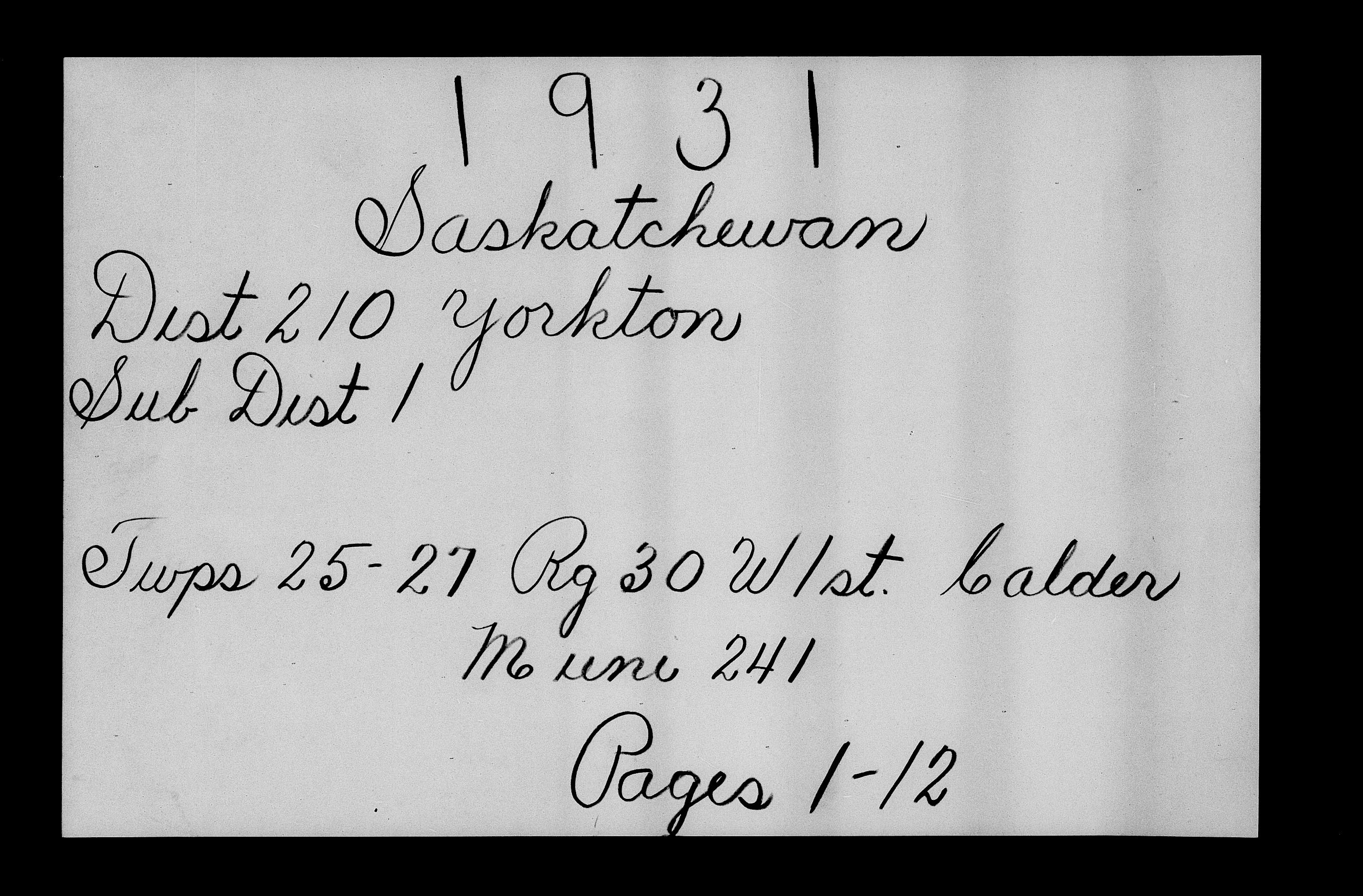
Many people experienced great levels of frustration on the first day of the release due to the huge demand for the records. But for some reason I was easily able to find the record I wanted (though my luck disappeared for the rest of the day). Calder was a sub-district in the district of Yorkton in the 1926 census so I pulled up District 210 Yorkton, Sub district 1 Twps 25-27., Rg 30 W 1st Calder Muni 241. Hmm, this sounds familiar! And just like that there they were, surrounded by family members by the name of Faustmann and Baumung. 


Library and Archives Canada Seventh Census of Canada 1931 Yorkton Calder Saskatchewan


It was fun showing my mother her family. Not many people can say they appear on this census.


My grandmother’s two younger sisters were nearby - Carolena and her husband Ferdinand Mundt farmed in a neigbouring section and Christina and her husband John Schneider lived in the thriving village of MacNutt. 


The village’s census is populated with teachers, merchants, cooks, garage repair men, the postmaster and the pastor. My great grandfather is still employed in running his shoe repair shop. It’s interesting to note that the census in the village was completed on June 2 and 3. it likely took a fair amount of time to visit all the neighbourhood farms on June 1 leaving no time for the rest of the area population.


Library and Archives Canada Seventh Census of Canada 1931 Melville MacNutt Village

Downtown MacNutt where my great-grandfather's shop and residence was located, in 2019

The next day, June 2, I was able to find my father and his family. However,  there are a few twists to their story. We last saw the Brooks family in Toronto in 1922 at the time of my father’s birth. You can read that story here. I knew that the family left Toronto to reside in Brantford and Owen Sound based on correspondence that I found in my grandmother’s possession. I did a bit of research to find out why they moved and when. The City of Toronto directories showed the family living on Sparkhall Avenue until 1929. Bill had changed jobs leaving his position at the John Hillock Co and moving to the E L Ruddy Company which was located at 317 Spadina Avenue. At both companies he was a salesman. The Hillock company was no longer listed in the 1928 directory so it may have ceased operations leading to a change in employment. 


Brantford Refrigerators by Ruddy 1930 Toronto Public Library Digital Archives

I was able to find some information about the Ruddy Company.  It was listed in the Toronto directory through 1931 but the head office was always located in Brantford. A 1930 prospectus described the company as “The Largest Refrigerator Manufacturers in the British Empire”, proudly owned and operated by Canadians. Apparently "Our employees are all Britishers, many of whom came out from the British Isles, the rest being Canadians of British descent"!!. A selling feature at that time I suppose. Apparently the refrigerator would be mounted in the wall of the house so the ice chamber could be accessed from the outside by the ice man, though most models could be converted to electricity. The Toronto Public Library’s digital archives contained a number of brochures produced by the company.


Brantford Refrigerators by Ruddy Toronto Public Library Digital Archives

Vernon City Directory Brantford 1932 FamilySearch


I had luck finding the family in the Brantford City Directory. In 1930 and 1931 the family resided at 278 Marlborough Street with Bill listed as a clerk at the Ruddy Mfg Co. 


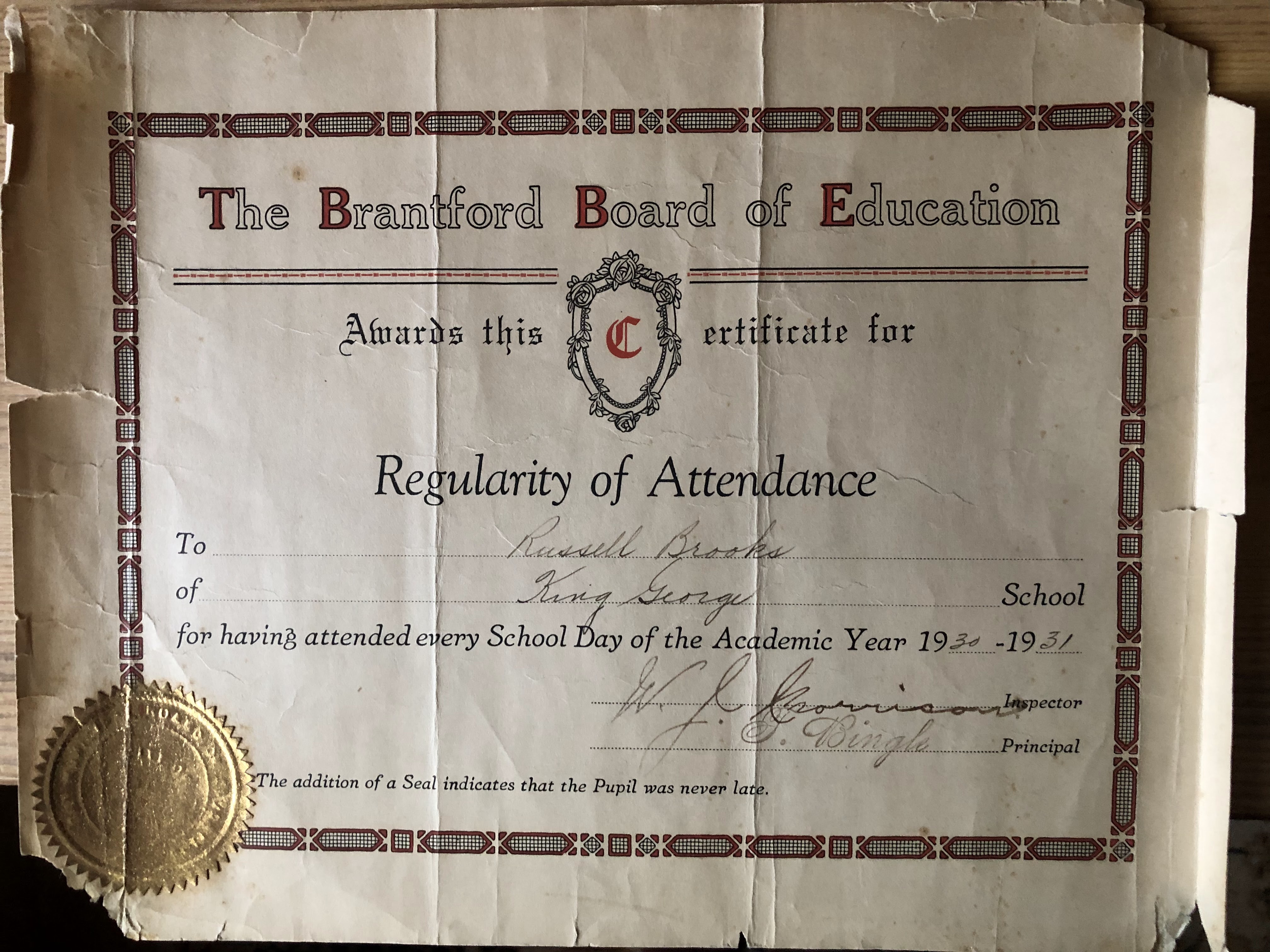
In the 1932 and 1933 directory the family lived at 154 Elgin Street. The Ruddy plant was located on Elgin Street (the building is long gone) so Bill would have been able to walk to work. The kids settled in,  attending King George School, where Russ had perfect attendance in the 1930-31 school year (and was never late!).


Bill is listed as an estimator of kitchen equipment. I imagine he took measurements in preparation for the installation of the fridge. He made the princely sum of $1,500 a year, worth about $24,838.97 in today’s dollars. The Brooks family paid $30/month to rent a brick home with 6 rooms - this works out to less than $500/month in today’s money for a nice looking two story home, comparable to the Sparkhall property. Also, they were the only family I located in the 1931 census that owned a radio. 

Library and Archives Canada Seventh Census of Canada 1931 Brantford City Ward 3


The family was found in the 1933 Brantford Directory but they moved on that year. It’s not clear if the move was voluntary or not but Bill was next employed by the Eureka Refrigerator Company in Owen Sound in 1933. Shortly after he lost his job and the family returned to Toronto. Only the 1938 Owen Sound directory was available so I do not have their address for their residence in that town. In 1935 they had returned to Toronto and were listed on the voter’s list at 177 Queensdale Avenue East York. Bill was able to find work with the Town of East York and he and Gertie remained there for the rest of their lives.


Finally, I was able to find the rest of the Brooks family in Scarborough. It was interesting to see that John Brooks senior was actually the enumerator for Malvern Village, I recognized his signature from correspondence I have. As a lifelong Scarborough resident he no doubt knew everyone in the vicinity and enjoyed chatting as he completed his returns. Son John and his family lived on the same property and helped with the farm; son George lived nearby.


Library and Archives Canada Seventh Census of Canada 1931York South Malvern Village


So the Brooks and Beslers cooperated and were where they were supposed to be. But not all my ancestors were so cooperative. Part II will follow - the elusive hidden Kingswells.