Showing posts with label World War Two. Show all posts

Friday, 25 February 2022

Branching Out: The Beslers of Landestreu

Heimat Galizien im Bild,  Hilfskomitee der Galiziendeutschen 

I've been researching my grandfather’s family in Galicia lately which is a perfect lead in for this month’s topic. The picture above is Landestreu, Galicia. My grandfather Jacob Besler left his home there in 1902 at the age of 18 to emigrate to Canada. He never returned to his homeland and never again saw most of his family. I don’t know if he exchanged letters with his family. If he did the letters have not survived. He was busy raising his own family and trying to survive in the harsh climate of Saskatchewan but he must have thought of his parents and siblings and wondered what became of them. Here’s what I discovered.


My grandfather was the 8th of 10 children born to Johann Heinrich Besler and Maria Barbara Baumung as well as the youngest son. Large families were common in the village of Landestreu and land was scarce. Most of the inhabitants of the village were described as Grundwirts or Landwirts which translates to farmer in English. A promising future was not in store for young Jacob so his decision to emigrate to Canada made sense. You can read my earlier blog post about his journey here


Survival into adulthood was difficult. Many children in these large families did not make it past their first year. Heinrich and Barbara’s first child Johann Christian was born in 1868. Their next four children died young: Katharina Elisabeth born in 1871 lived 2 1/2 months and died of Schwäche (weakness), Johann Philipp born in 1872 lived 8 months and died of Zahnen (teething), Jakob Adolf born in 1874 lived to 6 1/2 and died of Auszehrung (weakness/emaciation, possibly tuberculosis) and Maria Katharina born in 1876 lived just 3 weeks before succumbing to fraise (infant spasms). In other families masern (measles), keuchhusten (whooping cough) and rachitis (rickets) claimed many children, causes of infant mortality that we don’t see any more. Luckily for the Beslers their last 5 children were healthy and lived well into adulthood.


Heinrich died on 28 Nov 1912 at the age of 69 from some sort of cranial issue, perhaps a stroke? (Gehirnenig). Barbara died on 26 Oct 1920 at the age of 73 of Alterschwäche (old age). When Jacob married in 1915 he noted that both his parents were dead which leads me to believe that he did not receive letters from his family once he settled in Canada. Perhaps mail wasn’t coming through during WWI leading him to guess that they were dead. 


Record book of deaths. Ugartsthal-Landestreu commune agad.gov.pl

Once the senior Beslers died their oldest son Christian took over the family residence House #7. He had married Eleonora Löwenberger in 1895 and was listed as a Grundwirt or Landmann.


Record book of Weddings, Ugartsthal-Landestreu commune, agad.gov.pl


The couple had 8 children that I know of. I don’t know when or where Christian or Eleonora died nor the fate of 4 of their children.  Fred and his wife Minnie emigrated to Canada, settling in Winnipeg. My mother was close to their daughter Eleanor. Minnie and her husband Wilhelm Schick settled in Toronto. John settled in Toronto as well. 


I wasn’t able to determine the fate of Johann Georg Besler born in 1878. Perhaps he died young or moved to another village in Galicia.


Eleonora Besler married Johann Friedrich Lowenberger in 1896 and had 9 children that I know of. Friedrich died in 1920 of the Spanish Flu, one of a number of relatives that succumbed to the deadly virus. I don’t know of Eleanor’s fate but she remained in Europe. Two of the 9 children emigrated to Canada: Fred and his wife Hedwig and George and his wife Irma settled in Toronto.


Katharina Besler married Johann Reihl in 1913. They had one child that I am aware of. I do not know their fate.


Finally Dorothea Besler married Rudolf Kandel in 1906. This is the only sibling that my grandfather even saw again. First Rudy then Dorothy emigrated to Canada in 1912 with their two eldest children. They settled in Brandon Manitoba. My mother has fond memories of her Aunt Dorothy and stayed in touch with her cousins even when she moved to Toronto.


Hamburg Passenger Lists 1850-1934, ancestry.ca

Jacob and Dorothy were the lucky ones as they left Galicia before the first World War. The inhabitants suffered greatly but many residents remained even after the territory was divided after the War. Things improved in the inter war years but little did they know that the worst was yet to come in the form of World War Two. 


In 1939 Poland was divided between Germany and the Soviet Union as a result of the Ribbentrop-Molotov agreement. One of the terms of this agreement was that those of German ethnic background were to be relocated from the Russian area to the German area. So the residents of Landestreu had to leave; likely they did not want to stay in Russian controlled territories though it was a difficult decision to leave their homeland. Always particular, the Nazis created Einwandererzentralstelle forms, translated as Immigration Centre documents. The documents were stored in the Berlin Document Centre and captured by the American army at the end of the war. Starting in 1939 hundreds of thousands of people were recorded as they packed up to leave their homes. 


In English Landestreu means “faithful land” and the Beslers were indeed faithful to their land. The family moved to Landestreu from Biedesheim in the Rheinland Palatinate in the late 1700s. The village was founded in 1783 and my 4x great grandfather Konrad Besler was listed on the first census of residents taken in 1788.   


Ludwig Schneider, Das Kolonisationswert Josefs II in Galizien


This was the only home they had ever known. Despite speaking German and worshipping in the Lutheran church their ties to German were very weak. They were moved to camps in German controlled territories in Poland and often into farms that were cleared of their original Polish inhabitants. The intent was that they would produce food and provide other services to support Germany and the Nazi war machine. 


The Galizien German Descendants has indexed many of the EWZ forms relating to Galizien residents.  The forms from 1940-1941 are available on Family Search to view. I was not able to find my great Uncles and Aunts though I did find a variety of more distant cousins. Then, by chance I realized I was looking at one of my mother’s cousins. Her record had not been indexed and I found it as I browsed the records looking for someone else.


Eleonora Besler was born on 13 May 1900, the second daughter and third child to Johann Christian Besler and Eleonora Löwenberger. Her birth record is not yet available but I located the record of her marriage to Jakob Weiss on 15 February 1920. 


Record book of Weddings, Ugartsthal-Landestreu commune, agad.gov.pl


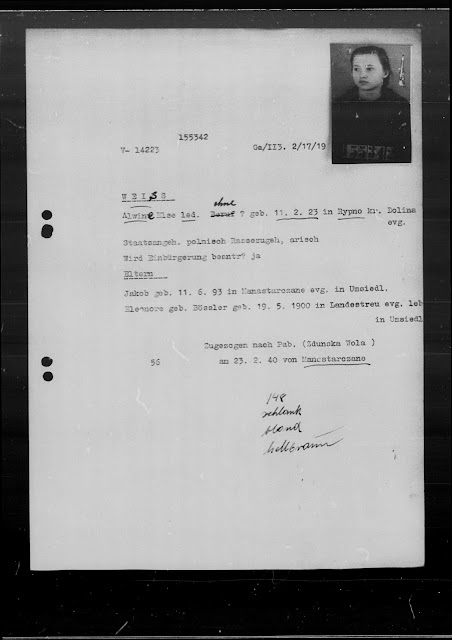
After her marriage she lived a quiet life in Landestreu, until she presented herself and her 17 year old daughter Alwine to authorities in Pabianice on 23 February 1940. They had been moved from their home in Landestreu to nearby Manasterczany then to Zdunska Wola, near Łodz for processing. Today this is a 10 hour drive. Eleonora and Alwine likely spent many more hours on a train to get to the relocation camp. The photos are poignant. They look apprehensive and rightly so. They were headed to an unknown future in a new town. They were separated from Jakob who had apparently already been relocated. The form notes that they are of Polish nationality, the Evangelisch (Lutheran) religion and of the Aryan race (not likely that anyone would say otherwise to this question!). They both wished to apply for German citizenship. At the bottom a physical description is added by hand. Eleonora is 156 cm tall, slim with blond hair and blue eyes. Alwine is 148 cm tall, slim with blond hair and light brown eyes.


Stamblätter 1940-1941, Deutschland Einwandererzentralstelle FamilySearch.org    


Their post-war fate is unknown but likely tragic given their location in the path of the advancing Soviet army.  It was a sad end to what began as hopeful emigration and emphasizes how fortuitous my grandfather’s decision to emigrate was.  


To conclude here is a German newsreel clip from early in 1940 showing Galician emigrants in the course of their journey. 


No names are provided but likely some of the people in this film were my family members. The enthusiastic greeting by the Nazis was no doubt put on for the camera - I’ve seen anecdotal evidence that their possessions were stolen and compensation for the loss of their lands never provided. Today Landestreu is in western Ukraine and has been renamed Zelenyi Yar. The fate of this area of the world is once again uncertain.


Tuesday, 27 October 2020

Convocation 1950

On this day 70 years ago my father marched across the back campus into Convocation Hall and received his Bachelor of Music degree from the University of Toronto. His degree was much valued and hard fought for.

Russ' elementary years were spent at Hartman Jones memorial School on Carlaw Avenue in East York. He moved on to East York Collegiate where he completed grade 12 or Junior Matriculation in 1939. It was there that Russ' formal education came to a screeching halt. His dream had always been to study music at the University of Toronto. He had prepared for this by engaging in years of study at the the Royal Conservatory of Music. At the time the RCM was located at the corner of College Street and University Avenue in downtown Toronto.

Taken in March 1920, Toronto Public Library, Baldwin Collection

Russ got his love of music from his mother Gertie who was an accomplished musician. He inherited her Heintzmann piano which still holds a place of honour in my mother’s home. Russ followed Gertie’s footsteps in becoming a skilled pianist. Unfortunately we do not have records of his achievements at the Conservatory but according to his was file he completed Grade Ten piano, Grade 4 Theory and the Teacher's Written examination qualifying for ATCM.


Post secondary education in music in Toronto at the time was coordinated by the Royal Conservatory of Music in conjunction with the University of Toronto, both headed by Sir Ernest McMillan. In 1946 the Faculty of Music intiated the MusBac, a 3 year school music program which would prepare students for teaching instrumental and vocal music at high school level. In its first year 21 students enrolled in the program. With help from the Department of Veteran's Affairs Russ began his studies in 1947. Students studied string, woodwinds and brass, conducting, choral music, music theory and history (Russ is on clarinet).


University calendars had a lot of personal information back in the day. The full class is listed in the 1949-1950 Academic Division Calendar


Further information on Russ' studies was found in 1950 Torontonensis yearbook


Russ completed his degree in the spring of 1950. Convocation was held on October 27th 1950. My mom and grandparents attended


The class was impressive and so is the diploma itself. I was quite jealous when I discovered that my diploma from U of T was not in Latin!

I believe my dad was the first person in his close family to complete a university program.  It was a major accomplishment 70 years ago as higher education was usually out of the reach of the average Canadian. I was proud to follow in his footsteps 31 years later. 

Monday, 9 April 2018

National Sibling Day

April 10th is National Sibling Day. Most people have siblings, though not as many as in earlier times. My 4x great-grandmother Elizabeth McKay Thomson was one of eleven siblings, all of whom survived to adulthood. She had nine children herself, and most of her siblings had families of the same size.

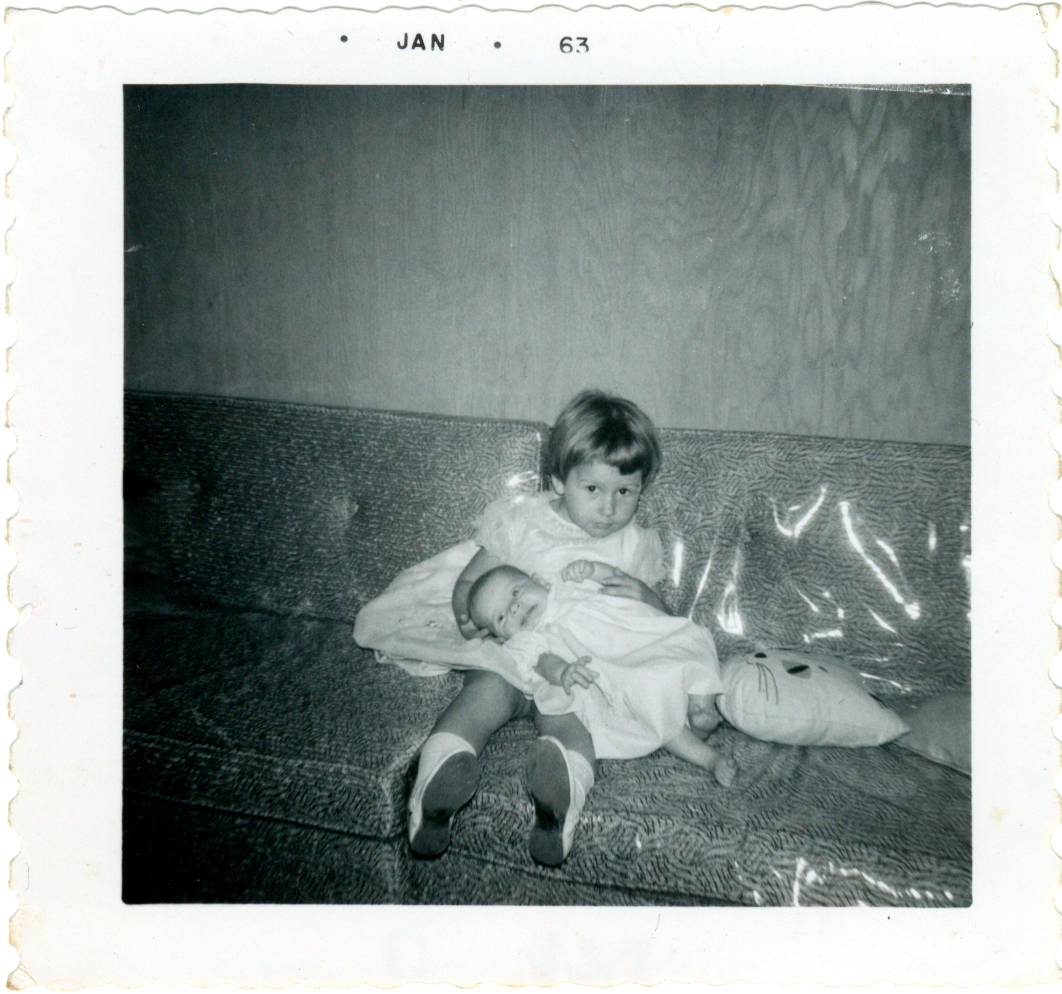
I have one younger sister. Here's a picture of us from a few years back - she's the little blonde:


She's ok though she insists I tried to kill her when she was a baby. My story is that I was just looking into the crib to see what they brought home when it tipped over. She survived.


My father liked to joke.


Speaking of my father, he also had a younger sibling. My dad and his brother Mel were close. They were two and a half years apart in age.


My dad on the left, my uncle on the right
Jones Falls, 1938
They remained close into adulthood. My mother recently shared a lovely story about the brothers. Upon his return from WWII my dad underwent major surgery on his leg which left him with a permanent limp. After his discharge from Sunnybrook Hospital he needed to use crutches for a period  of time. At the same time he had fulfilled his lifelong dream of attending the University of Toronto and studying music. Travelling from East York to downtown Toronto by streetcar on crutches would have been a nightmare. My uncle volunteered to drive my dad to class then pick him up later to bring   
him home. This would have been on top of holding down a full time job. 


My grandma Gertie was Russ and Mel's mother. She was one of twelve children, eight of whom survived to adulthood. The Kingswell clan was a close one. My grandmother's photo album is filled with pictures of her sisters and brothers. 


The family moved from Kingston to Toronto, and most of the family remained in the Toronto area. The exception was my great uncle Alf who moved to Buffalo. He was only a year older than Gertie and they remained close with many visits between the families over the years, even during war times. 


Gertie was also close with her younger sister Chrissie, the baby of the family. Chrissie spent lots of time with Gertie's family when the boys were young. My dad had fond memories of going to the movies with his aunt before the war. Gertie was close with her other two sisters Ollie and Liz as well.


So not a lot of heavy research in this post, just a bunch of fun pictures and memories of some of the siblings in my family.

Saturday, 5 November 2016

In honour of my father on Remembrance Day

From the writer's collection


Remembrance Day is very important to me. I am the daughter and grand daughter of men who served in both World Wars. Their service and sacrifice was valued at the time and I'd like to do my part to have it remembered. 

This post is about my father Gordon Russell Brooks.

My father was born on August 17th 1922. He was 17 years old when Canada joined World War Two on September 10th 1939. Joining up was always on his mind but he continued on with his education, graduating from East York Collegiate with his junior matriculation (grade 12) in June 1940. His dream was to attend the University of Toronto to continue with the music studies he had begun at the Royal Conservatory of Music but unfortunately he could not afford university at that time. Toronto was still in the grips of the Depression and money was scarce. The economic situation was a big part of so many young men and women enlisting in the war. 

The story my dad always told was that he kept trying to enlist until they dropped the height requirement down low enough (my dad was only 5'2"). In the meantime he worked as a piano teacher and as a clerk at Harry Boddy & Co, then at Birks (then Birks-Ellis-Ryrie), both jewellery companies. As an aside, my father's name is on a plaque listing Birks' employees who served in World War Two. We were able to see the plaque when the store was first moved to the Eatons Centre from Yonge Street. Not sure where it is now as the store has severely downsized. Wish I'd taken a picture!

On May 25th 1943 Russ successfully enlisted. He spent 9 months in Canada before shipping out to the UK on February 16th 1944. Another story he used to tell centered around his stint in basic training at Camp Borden near Barrie. He was not much of a marksman and claims that he only passed the shooting exam by hitting the target of his neighbour. After that his rifle was taken away from him and he joined the Royal Canadian Army Medical Corps as a clerk. As the initial interview noted "he does not seem to be an aggressive type" and lucky for us he had a clerical position.

From the writer's collection

After landing in England Russ spent 6 1/2 months waiting to sail to Europe. On September 6th 1944 he landed in France. I remember him telling me that even though it was three months after D-Day there was still fighting going on. Russ spent the next year in France, Belgium and England. VE day was May 8th 1945. My dad was in London on that day and claims to have seen Winston Churchill drive by looking quite happy. According to his military file he was granted 9 days leave in the UK starting May 3rd 1945 so it is quite possible he did see the Prime Minister on that day. On his return to France he volunteered for the Pacific Theatre but that transfer was not to be. On July 6th 1945 he was transferred to the Royal Canadian Army Service Corps and promoted to Corporal on July 19th 1945. Russ spent the last months of his was service in the Provost Corps as part of the military police. Here's a photo of him in his Jeep. He always joked that he had a strapping private in the jeep to do the hard work such as arresting delinquent soldiers. He finished the war as a Sergeant.


From the writer's own collection
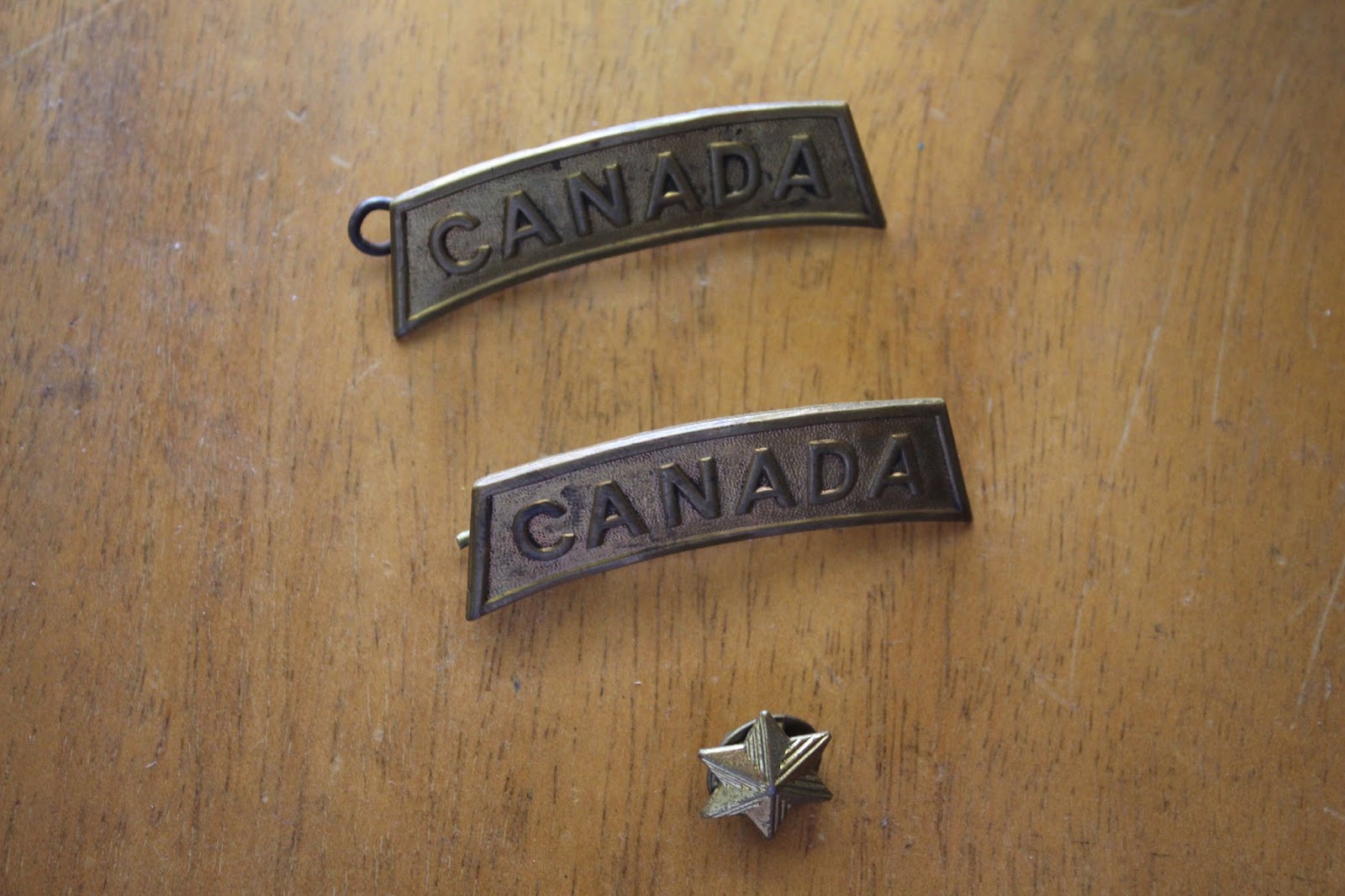
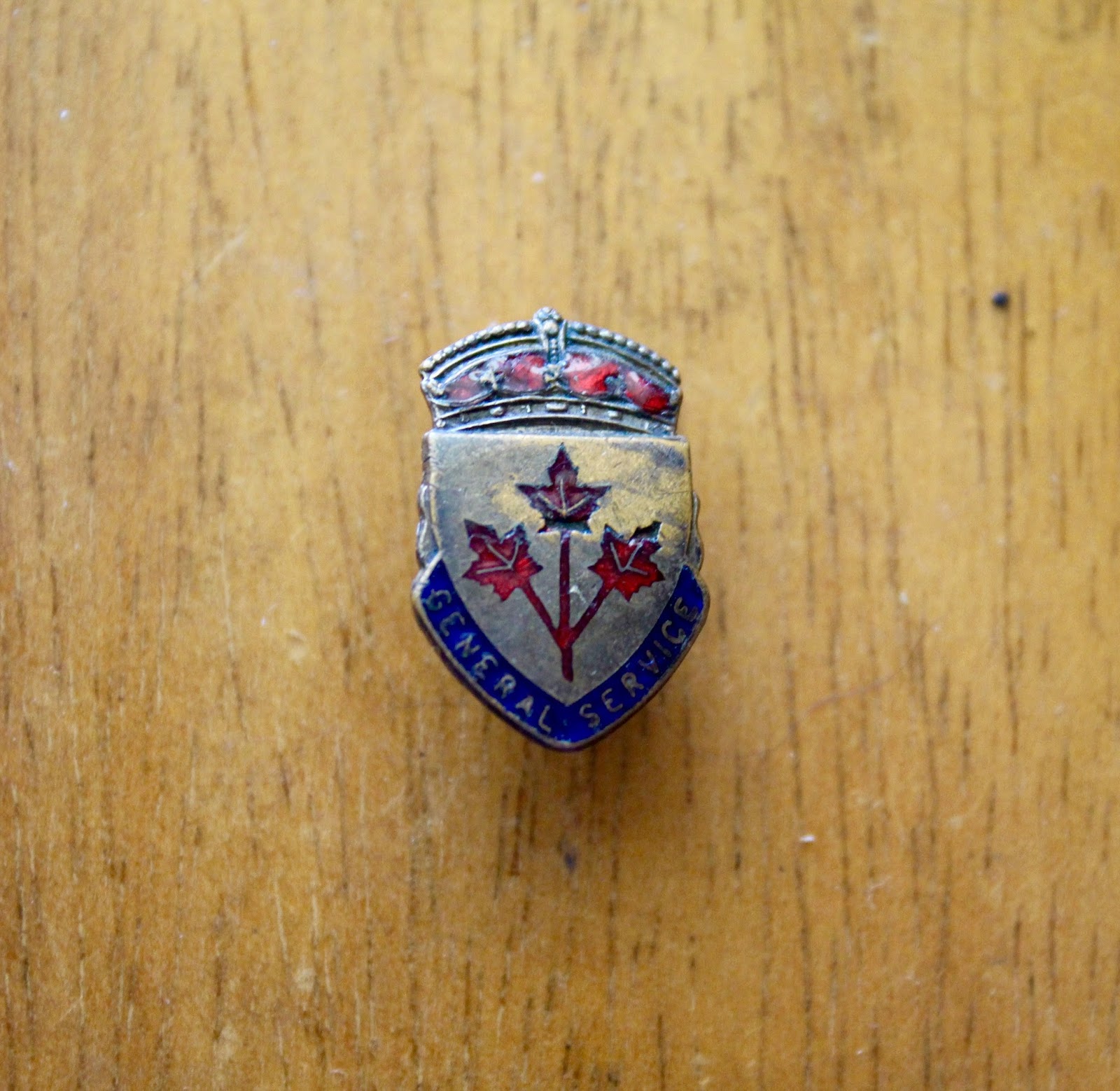
My dad was discharged on August 23rd 1946 returning to Toronto. These are his ID tags. He received the 1939-45 Star, France-Germany Star and Canadian Volunteer Service Medal.


Above all from the writer's own collection

Ironically Russ returned from France without a scratch. However, he became ill with rheumatic fever upon his return to Canada and was admitted to Sunnybrook Hospital as one of the first veteran patients. For some reason the doctors decided to operate on his knee and he was left with a limp for the rest of his life. Thanks to the Veteran's Act he was able to fulfill his dream, attending the University of Toronto and graduating with Mus. Bac.
SaveSave