Showing posts with label Saskatchewan. Show all posts

Monday, 9 October 2023

Jacob Besler's Long Journey to Canada Part Two: From Liverpool to Landestreu

This is part two of a two part story about Jacob Besler’s journey to Canada from Galicia. If you missed part one you can read it here.

The morning of June 14 1902 dawned clear and sunny. It was going to be a beautiful day, especially since Jacob’s journey across the Atlantic was almost at an end. He’d heard that they were now in the middle of the St Lawrence River and would soon be arriving in Quebec. Jacob and his cousins Johann Kendel and Philip Besler were excited and glad they would soon be on dry land. The 722 3rd class passengers had been tightly packed into the ship and they longed for open space. The ship stops and a boat approaches - the medical superintendent Dr. G.E. Martineau is now boarding the ship to check for illness.


Jacob and his cousins line up. Behind them in the line they hear coughing and sniffling. That doesn’t sound good. They turn to see fellow Galicians the Sloboda family. The Landestreu group are the only German speaking Galicians on the voyage but they know enough Ukrainian to converse with their fellow passengers. Jacob, Johann and Philip pass their examination with flying colours. But Maria Sloboda and her children aren’t so lucky - they have the measles. The doctor also finds one case of smallpox and one of chickenpox. As a result 352 steerage passengers and 15 members of the crew will be quarantined.


Library and Archives Canada. Passenger Lists, 1865-1922
Library and Archives Canada. Immigrants at Grosse Île Quarantine Station 1832-1937

Grosse Ile was established in 1832 as a place to inspect and detain incoming ships and people to prevent disease spreading to North America. Grosse Ile was the perfect spot. It is located 50 kilometres downstream from Quebec City, en route for ships arriving from Europe via the St. Lawrence river. It had a good supply of fresh water, and as an island, was naturally suited for keeping newcomers isolated from the mainland. Years had passed since the cholera and typhus epidemics that struck down so many Irish emigrants. But in 1902 illness was still an issue.  

View of Grosse île from the river

Jacob and his cousins are confused. Why do they have to disembark here? Luckily for the travellers German speaking agents appear to explain the situation.

After a short ride to the island the travellers are brought to the two story disinfection building where they and their possessions will be disinfected. 


The sick passengers are taken directly to the hospital


The ship will be sprayed with mercury bichloride to kill micro-organisms and then fumigated with sulphur dioxide gas to kill any pests.


All of Jacob’s possessions are taken and put into numbered bags. The bags are put into a large wire mesh box and then onto railcars to be brought into the steam chambers for dry steam cleaning to kill any pathogens. 


Next: a refreshing disinfecting shower! Jacob looks down the corridor and sees 44 steel stalls. Each stall has a metal door with chicken wire around the top to prevent any peeping on your neighbour. Jacob enters, undresses and gives his clothing to the agent for disinfection. Jacob hesitates, then enters the shower. For 15 minutes water sprays from above and from the side. The solution is a mixture of hot water and diluted mercury bichloride. First class passengers are used to showers but this is a new experience for Jacob. There were no showers in Galicia.


Exiting the shower Jacob is glad to see his clothes have been returned to him. He dresses, receives his disinfection certificate and is reunited with his luggage. 


He is relieved to see Johann and Philip and is glad that they’re allowed to stay together. They are now approached by nurses who inspect them again for signs of disease and check to ensure they've been vaccinated against smallpox – a legal requirement to enter Canada. All is in order so the trio heads to the third class hotel where they will complete the mandatory quarantine period with daily medical exams.


The third class room is the space between the two couches

At the third class hotel Jacob, Philip and Johann share a room. The quarters are cramped but food is provided.


There are no toilets or sinks in the building so the travellers must visit the nearby washhouse.


There are no lounges but they are able to go for walks around the island. The weather during their quarantine is pleasant though some days are rainy. Jacob and his companions don’t become ill but some others come down with measles: all 6 members of the Vasilinchuk family, all 7 members of the Panchuk family and the rest of the Sloboda family, among others. 


By July 2 most of the passengers have successfully completed their quarantine and are ready to leave. Jacob and his companions are excited to finally be on their way after eighteen days.


They board a shuttle boat to the port of Quebec. The pier building, similar to Pier 21 in Halifax, is no longer there. Here is a photo of the site. 

A medical inspection confirms that the Landestreu group is now healthy. They also must pass a civil inspection - Jacob only has $6 in his pocket as does Johann. Their older cousin Philip has $40 which should be enough to get them to their final destination and the land they plan to homestead.  


At 6pm on Wednesday July 2 they board the CPR train to Winnipeg. This is a later schedule but gives you an idea of the time involved - they don’t arrive in Winnipeg until 9:50 am on Saturday July 5. 

CPR Schedule, 1912. https://open.library.ubc.ca/collections/chung/chungtext/items/1.0357107

Winnipeg’s current train station wasn’t built until 1912 so the facilities would have been more basic. Trains didn’t run north into Saskatchewan until 1909 and at the time Saskatchewan was still a territory. Jacob would have had to purchase supplies and once again travel by horse and cart to his new life. It was a long journey but he had finally arrived in Canada and now the hard work of clearing and settling could begin. On Thanksgiving Day I am thankful a young man of 19 decided to make a better life in the new world. 


Sunday, 8 October 2023

Jacob Besler’s Long Journey to Canada Part One: From Landestreu to Liverpool


I’ve written before about my grandfather’s life in Galicia here, and earlier about his arrival in Canada here. But only recently have I been able to fill in some gaps in between: how did he get from his small village in Galicia to the Canadian prairies? Here’s what I learned.

As the third son in the Besler family Jacob’s prospects in the tiny village of Landestreu were slim. Lured by the prospects of his own farm in Canada Jacob decided to seek his fortunes overseas. Everyone in Landestreu was related to each other so he likely had heard about villagers who had emigrated to Landestreu Saskatchewan. Accompanied by cousins Johann Kendel and Philip Besler he made his travel plans and in the spring of 1902 began his journey.


Jacob probably hadn’t ventured too far from his home in his life so he would have excited but on the other hand nervous about leaving Landestreu for good. The first step in the journey would have been to travel to one of the nearby towns to catch a train. The Galician Railway was extensive with about 1540 kilometres of lines connecting the eastern part of the Austro Hungarian Empire with Vienna, Berlin and Warsaw. 


The Lemberg-Czernowitz Line was built in 1866 and included a station at Stanislau (now Stanisławów), the closest to Landestreu. If the travellers were lucky they would have been transported by horse and cart. Jacob’s passport listed his occupation as Wagner (wagon driver) so he may have had access to a cart which would have shortened the nine hour walk. Once in Stanislau they would have boarded a train for the first step of their journey to Lemberg (now Lviv).


Stanislau Station https://sudilovski.livejournal.com/77246.html

Lemberg Station Interior https://sudilovski.livejournal.com/77246.html
Lemberg reception building https://sudilovski.livejournal.com/77246.html 


In Lemberg Jacob and his cousins would have visited one of the many travel agents whose windows were decorated with posters meant to lure travellers in. They would have discovered that it was cheaper to travel to Canada instead of the US as the government subsidized the emigration cost via a fee paid to travel agents for each immigrant they booked. They also would have discovered that an indirect route to Canada was cheaper than a direct journey. That meant sailing from a port such as Hamburg, Bremen, Antwerp, Danzig, Stettin or Rotterdam to Grimsby, Humber or Hull in the UK. 

A train would then take them to Liverpool where they would board a ship sailing to Canada. The package they purchased would have included the cost of food and lodging, train ticket to the port, steamship ticket to Hull, train ticket to Liverpool and steamship ticket to Canada. The cost was about $40-50 or about $2000 in 2023 Canadian dollars, a not insubstantial amount of money. The group paid the sum and headed off on a journey that would have taken about 3 weeks in total.


The only passenger lists easily accessible for this period are the Hamburg passenger lists. I was unfortunately unable to find Jacob and his companions on any of lists for ships sailing from Hamburg to either Grimsby or London in the spring of1902. It’s most likely that they sailed to the port of Hull/Grimsby, probably via the Wilson Lines as the train trip to Liverpool was the shortest route to a port in terms of time and distance.


Special immigrant trains left Hull at 11 am on Monday arriving in Liverpool at 2 to 3 pm that day, though trains could run on an “as needed” basis linked with the regularity of Wilson Line steamships. The railway carriages left directly from Victoria Dock in Hull and ended at Riverside Quay in Liverpool - the travellers weren’t allowed to visit either city as officials didn’t want to chance disease ridden migrants mixing with townsfolk. The immigrant trains took precedence over others due to their length - there were sometimes so many emigrants that 17 carriages were pulled by one steam engine. Baggage was stored in the rear four carriages. The trains were low standard 3rd class carriages equipped with wooden benches to sit on and no toilets.


Paragon Station Hull, photo by Richard Croft

Once in Liverpool the travellers would stay in immigrant lodging houses until their ship to North America was ready. The stay could take from 1-10 days. The Dominion sailed for Quebec on a Thursday so Jacob and his companions would have had a few days to cool their heels. 

Liverpool Mercury June 2 1902 findmypast.co.uk

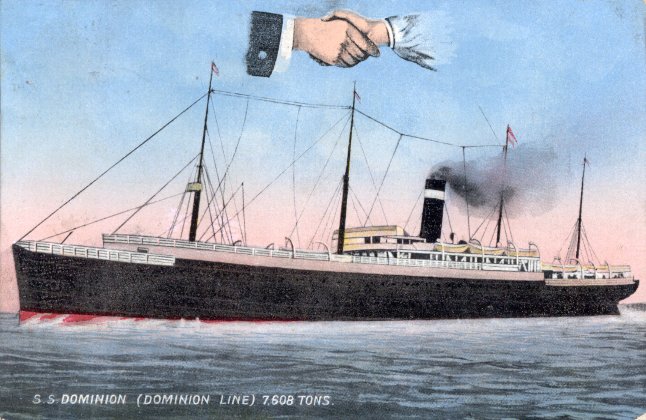
The Dominion was a huge ship weighing 7.000 tons, built in Belfast in 1894 and originally named the Prussia. It was purchased by the Dominion Line from the Hamburg America Line in 1898 and renamed the Dominion. The ship measured 445 feet by 50 feet and could carry 1120 passengers: 200 1st class, 170 2nd class and 750 3rd class. In 1902 the ship had already crossed the Atlantic three times, heading for Portland in January, March and April. The June crossing to Quebec was the first and only of the season as the season for travel to Canada was short due to ice in the St Lawrence River.


I was able to locate the passenger list for Jacob’s voyage from Liverpool. His name was misspelled as “Pessler”, a common error. The Landestreu party were 3 out of 722 third class passengers, the new and improved term for steerage class. It was interesting to note that English, Scottish and Irish passengers were listed first, before the “foreigners”. Included in this group were 75 British Home Children ranging in age from 3 to 18. All third class passengers were bound for Quebec. The 99 second class and 40 first class passengers were bound for Montreal. 

findmypast.co.uk

The morning of June 5 was cool and overcast with a light breeze. The 861 passengers queued up and boarded the Dominion. Under the command of Master Jones the ship began the 9 day trip to Quebec.


To be continued …


Wednesday, 12 July 2023

Adventures in the 1931 Census Part 1: Those Who Were Where They Were Supposed to Be

June 1st 2023 was a day of great excitement in the home of many a genealogist, including mine. It was the day the 1931 Census was released! I jumped right in, ready to browse away. I had particular goals with this census release as it marked the first appearance of both of my parents.

Let’s start with my mom. My grandfather arrived in Canada in 1902 and headed directly for Saskatchewan and what soon became the family farm: Section 24, Township 25, Range 30, West of the 1st Meridian, Calder. I found him there in the 1906, 1911, 1916, 1921 and 1926 censuses with his growing family. I was disappointed that the 1926 census was taken on June 1st as my mother was born in September, just missing out on her first appearance! Though I am appreciative that the decision was made to add the additional western censuses on the ‘6’s’.

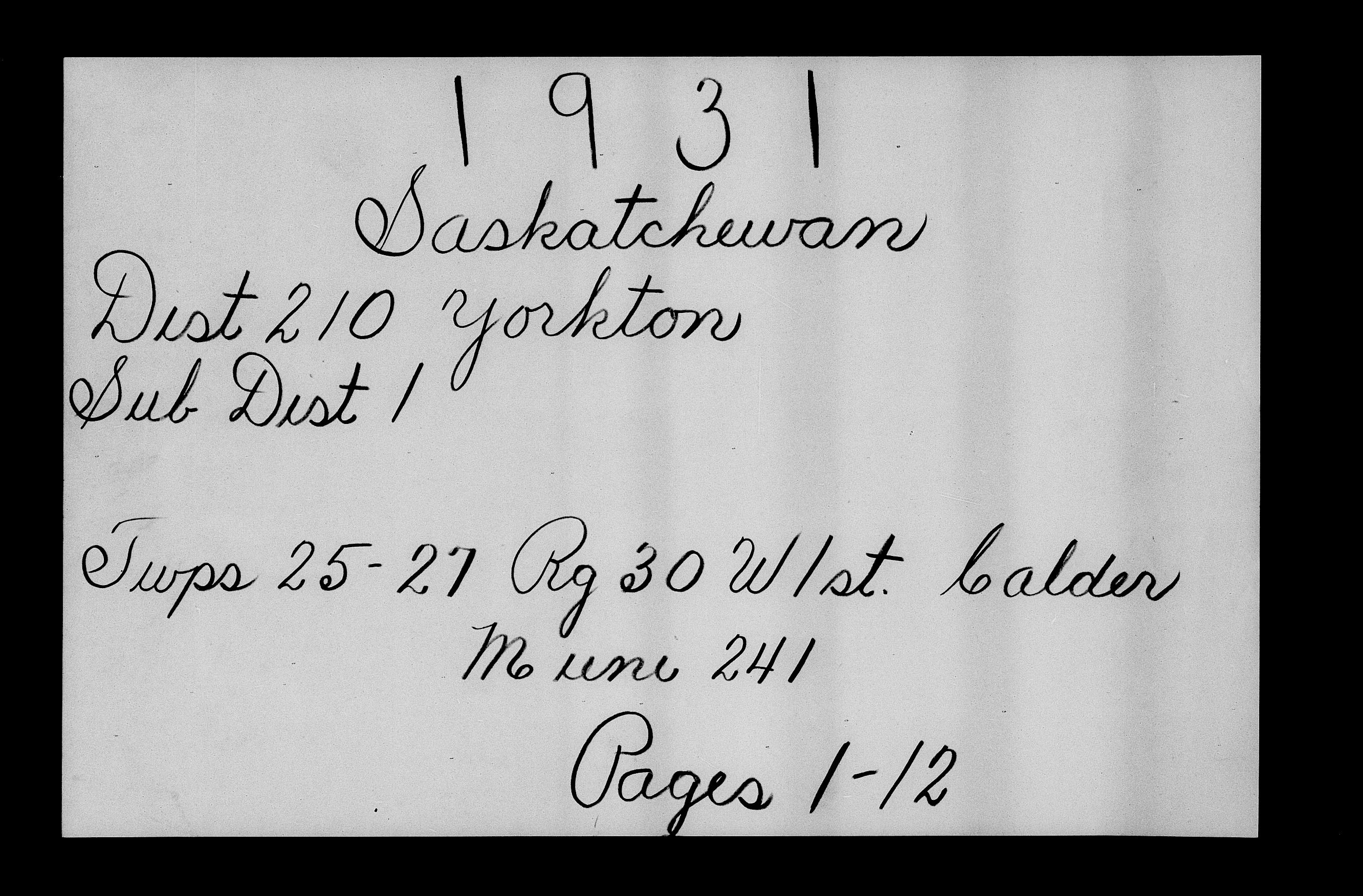
Library and Archives Canada Seventh Census of Canada 1931

Many people experienced great levels of frustration on the first day of the release due to the huge demand for the records. But for some reason I was easily able to find the record I wanted (though my luck disappeared for the rest of the day). Calder was a sub-district in the district of Yorkton in the 1926 census so I pulled up District 210 Yorkton, Sub district 1 Twps 25-27., Rg 30 W 1st Calder Muni 241. Hmm, this sounds familiar! And just like that there they were, surrounded by family members by the name of Faustmann and Baumung. 


Library and Archives Canada Seventh Census of Canada 1931 Yorkton Calder Saskatchewan


It was fun showing my mother her family. Not many people can say they appear on this census.


My grandmother’s two younger sisters were nearby - Carolena and her husband Ferdinand Mundt farmed in a neigbouring section and Christina and her husband John Schneider lived in the thriving village of MacNutt. 


The village’s census is populated with teachers, merchants, cooks, garage repair men, the postmaster and the pastor. My great grandfather is still employed in running his shoe repair shop. It’s interesting to note that the census in the village was completed on June 2 and 3. it likely took a fair amount of time to visit all the neighbourhood farms on June 1 leaving no time for the rest of the area population.


Library and Archives Canada Seventh Census of Canada 1931 Melville MacNutt Village

Downtown MacNutt where my great-grandfather's shop and residence was located, in 2019

The next day, June 2, I was able to find my father and his family. However,  there are a few twists to their story. We last saw the Brooks family in Toronto in 1922 at the time of my father’s birth. You can read that story here. I knew that the family left Toronto to reside in Brantford and Owen Sound based on correspondence that I found in my grandmother’s possession. I did a bit of research to find out why they moved and when. The City of Toronto directories showed the family living on Sparkhall Avenue until 1929. Bill had changed jobs leaving his position at the John Hillock Co and moving to the E L Ruddy Company which was located at 317 Spadina Avenue. At both companies he was a salesman. The Hillock company was no longer listed in the 1928 directory so it may have ceased operations leading to a change in employment. 


Brantford Refrigerators by Ruddy 1930 Toronto Public Library Digital Archives

I was able to find some information about the Ruddy Company.  It was listed in the Toronto directory through 1931 but the head office was always located in Brantford. A 1930 prospectus described the company as “The Largest Refrigerator Manufacturers in the British Empire”, proudly owned and operated by Canadians. Apparently "Our employees are all Britishers, many of whom came out from the British Isles, the rest being Canadians of British descent"!!. A selling feature at that time I suppose. Apparently the refrigerator would be mounted in the wall of the house so the ice chamber could be accessed from the outside by the ice man, though most models could be converted to electricity. The Toronto Public Library’s digital archives contained a number of brochures produced by the company.


Brantford Refrigerators by Ruddy Toronto Public Library Digital Archives

Vernon City Directory Brantford 1932 FamilySearch


I had luck finding the family in the Brantford City Directory. In 1930 and 1931 the family resided at 278 Marlborough Street with Bill listed as a clerk at the Ruddy Mfg Co. 


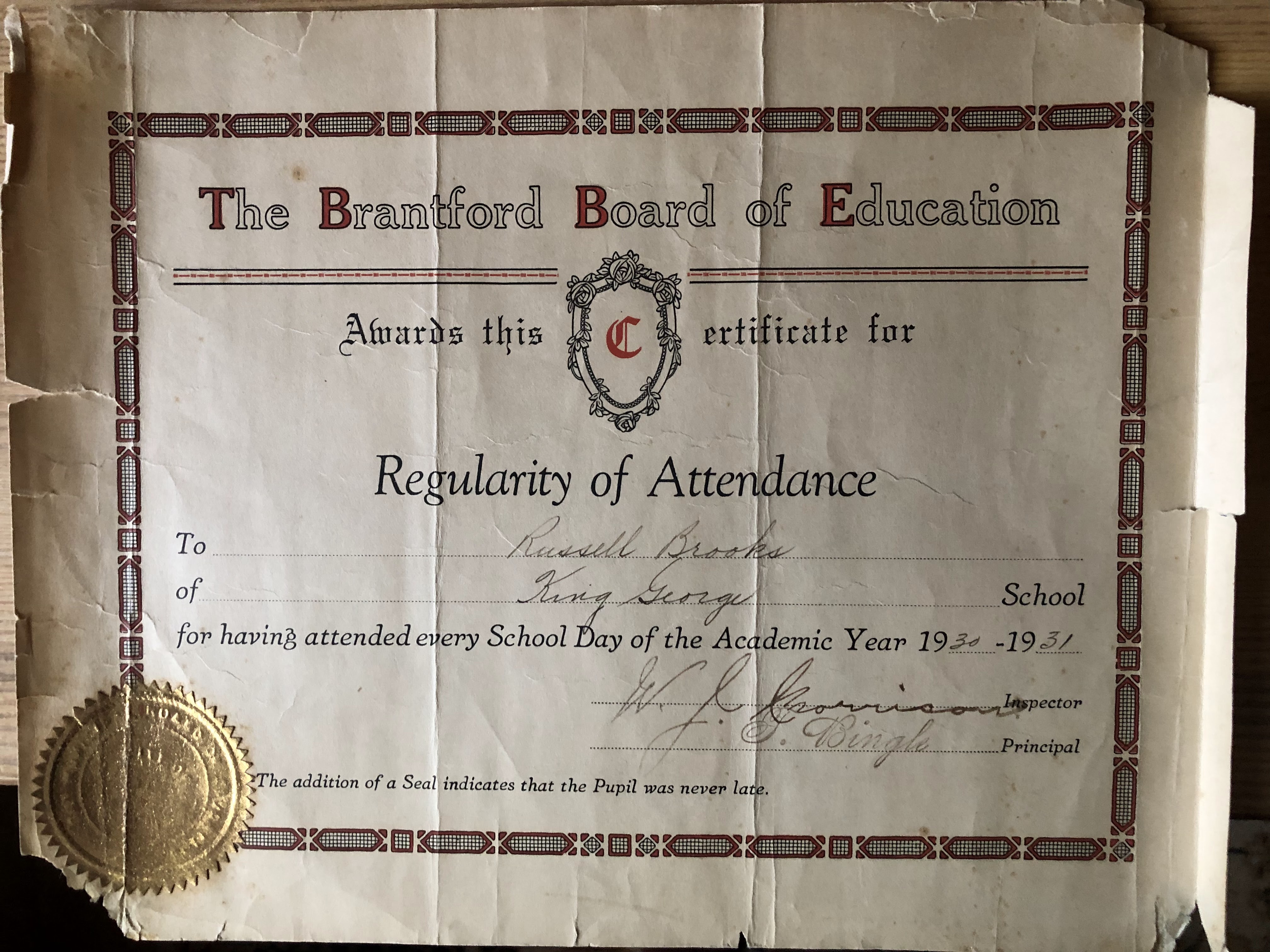
In the 1932 and 1933 directory the family lived at 154 Elgin Street. The Ruddy plant was located on Elgin Street (the building is long gone) so Bill would have been able to walk to work. The kids settled in,  attending King George School, where Russ had perfect attendance in the 1930-31 school year (and was never late!).


Bill is listed as an estimator of kitchen equipment. I imagine he took measurements in preparation for the installation of the fridge. He made the princely sum of $1,500 a year, worth about $24,838.97 in today’s dollars. The Brooks family paid $30/month to rent a brick home with 6 rooms - this works out to less than $500/month in today’s money for a nice looking two story home, comparable to the Sparkhall property. Also, they were the only family I located in the 1931 census that owned a radio. 

Library and Archives Canada Seventh Census of Canada 1931 Brantford City Ward 3


The family was found in the 1933 Brantford Directory but they moved on that year. It’s not clear if the move was voluntary or not but Bill was next employed by the Eureka Refrigerator Company in Owen Sound in 1933. Shortly after he lost his job and the family returned to Toronto. Only the 1938 Owen Sound directory was available so I do not have their address for their residence in that town. In 1935 they had returned to Toronto and were listed on the voter’s list at 177 Queensdale Avenue East York. Bill was able to find work with the Town of East York and he and Gertie remained there for the rest of their lives.


Finally, I was able to find the rest of the Brooks family in Scarborough. It was interesting to see that John Brooks senior was actually the enumerator for Malvern Village, I recognized his signature from correspondence I have. As a lifelong Scarborough resident he no doubt knew everyone in the vicinity and enjoyed chatting as he completed his returns. Son John and his family lived on the same property and helped with the farm; son George lived nearby.


Library and Archives Canada Seventh Census of Canada 1931York South Malvern Village


So the Brooks and Beslers cooperated and were where they were supposed to be. But not all my ancestors were so cooperative. Part II will follow - the elusive hidden Kingswells.

Sunday, 26 August 2018

Manitoba School Days

Everyone's heard the story that begins "When I was a child I had to walk 5 miles up hill through a snow storm to get to school" or something like that. Well, my mother has a story like that and it's true! She and her siblings had to walk about 5 km up and down hill and through a ravine and by a creek to get to school in another province! Here is a picture of my mom in front of the school - she's the girl to the far left, in front of her brother Art. He must be poking her or something, she looks terribly unhappy!
From the writer's collection
I've written before about my mother's family and how they settled in MacNutt Saskatchewan. They actually lived a fair distance out of town and could not easily get there on a regular basis. There was a school located in town but this was not the school that the Besler children attended. There was a much closer school located in Manitoba!

The following map shows where my grandfather's two sections were located and where the school was. You can see MacNutt on the map way to the south of the Besler property.
Created using lsdfinder.com
The children attended Cupar School No. 1633. The one room school house was built in 1911 and is located in what is today the Municipality of Roblin. Here is a photo taken by School Inspector R. J. MacKenzie, date unknown. I don't recognize anyone in the photo but it gives you a good look at the school itself.
Archives of Manitoba, School Inspectors Photos.
The Besler family walked from their farm to school and back every day. There were not real roads back then which made for a tough journey. My mother recalls a bear sighting one day when she was quite young - her older siblings took off and left her to fend for herself. Luckily she made it home in one piece! The teacher at the time was a Miss Campbell who was teased unmercifully by the farm boys - they called her Miss Camel and one day locked her in the outhouse (my uncle Art apparently was the instigator)

The school is still standing but has been turned into a private home. We were able to find it during our vacation this summer but no-one was around so we weren't able to get too close. Here's a picture I shot through the trees. The location is isolated now so I can only imagine how isolated it was back in the 1930s


The Beslers moved to Winnipeg in 1936 and my mother continued her education at Victory School located near their home in West Kildonan. This school was built after World War One and opened in 1920. Here's a picture from 1922.
Winnipeg Tribute, September 16 1922
Here's my mother and her classmates outside the school. She is 6th from the right in the second row. The second picture is from the pageant at this school, probably in her last year. She's fourth from the right in the second row.
From the writer's collection

And here's my mom visiting the school in 2012. We were able to go into the school but the school was drastically enlarged in 1950 and she really didn't recognize anything. The main door looks to be the same though!


In 1940 she graduated from Victory School - here's a notice from the Winnipeg Free Press on June 1st 1940 commemorating the occasion.
newspaperarchive.com
As the article note students from Victory School moved to Centennial School for Grade 10. Centennial School was built in 1913 and later became part of West Kildonan Collegiate. Unfortunately I was not able to get a picture before it was torn down but here is an undated picture showing what it looked like.
Source: A Historical Study of Public Education in West Kildonan to 1959 by Raymond Ronald Bailey, 1966
Later that year my mother's class was photographed for an article in the Winnipeg Free Press that ran on November 14th 1940. She still has a copy of this article showing the cooking and sewing skills being mastered. She is second from the right in the cooking photo. Answer to a bachelor's prayer indeed.
newspaperarchive.com
My mother only spent a brief time at Centennial School before she had to enter the work force but she remembers her school days fondly. She has never stopped learning and conveyed her love of reading (and sewing!) to my sister and I.