Showing posts with label MacNutt. Show all posts

Wednesday, 12 July 2023

Adventures in the 1931 Census Part 1: Those Who Were Where They Were Supposed to Be

June 1st 2023 was a day of great excitement in the home of many a genealogist, including mine. It was the day the 1931 Census was released! I jumped right in, ready to browse away. I had particular goals with this census release as it marked the first appearance of both of my parents.

Let’s start with my mom. My grandfather arrived in Canada in 1902 and headed directly for Saskatchewan and what soon became the family farm: Section 24, Township 25, Range 30, West of the 1st Meridian, Calder. I found him there in the 1906, 1911, 1916, 1921 and 1926 censuses with his growing family. I was disappointed that the 1926 census was taken on June 1st as my mother was born in September, just missing out on her first appearance! Though I am appreciative that the decision was made to add the additional western censuses on the ‘6’s’.
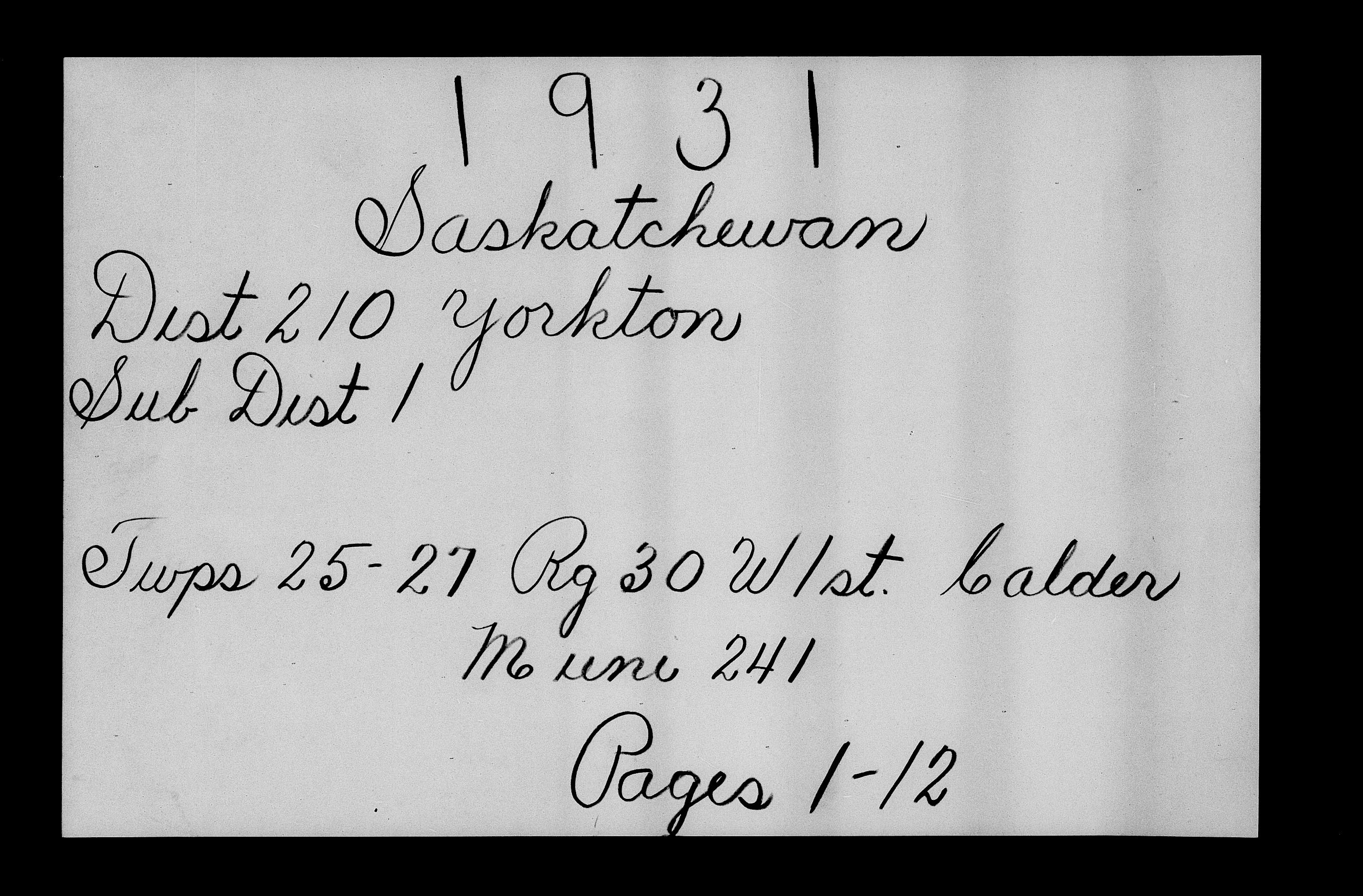
Library and Archives Canada Seventh Census of Canada 1931

Many people experienced great levels of frustration on the first day of the release due to the huge demand for the records. But for some reason I was easily able to find the record I wanted (though my luck disappeared for the rest of the day). Calder was a sub-district in the district of Yorkton in the 1926 census so I pulled up District 210 Yorkton, Sub district 1 Twps 25-27., Rg 30 W 1st Calder Muni 241. Hmm, this sounds familiar! And just like that there they were, surrounded by family members by the name of Faustmann and Baumung. 


Library and Archives Canada Seventh Census of Canada 1931 Yorkton Calder Saskatchewan


It was fun showing my mother her family. Not many people can say they appear on this census.


My grandmother’s two younger sisters were nearby - Carolena and her husband Ferdinand Mundt farmed in a neigbouring section and Christina and her husband John Schneider lived in the thriving village of MacNutt. 


The village’s census is populated with teachers, merchants, cooks, garage repair men, the postmaster and the pastor. My great grandfather is still employed in running his shoe repair shop. It’s interesting to note that the census in the village was completed on June 2 and 3. it likely took a fair amount of time to visit all the neighbourhood farms on June 1 leaving no time for the rest of the area population.


Library and Archives Canada Seventh Census of Canada 1931 Melville MacNutt Village

Downtown MacNutt where my great-grandfather's shop and residence was located, in 2019

The next day, June 2, I was able to find my father and his family. However,  there are a few twists to their story. We last saw the Brooks family in Toronto in 1922 at the time of my father’s birth. You can read that story here. I knew that the family left Toronto to reside in Brantford and Owen Sound based on correspondence that I found in my grandmother’s possession. I did a bit of research to find out why they moved and when. The City of Toronto directories showed the family living on Sparkhall Avenue until 1929. Bill had changed jobs leaving his position at the John Hillock Co and moving to the E L Ruddy Company which was located at 317 Spadina Avenue. At both companies he was a salesman. The Hillock company was no longer listed in the 1928 directory so it may have ceased operations leading to a change in employment. 


Brantford Refrigerators by Ruddy 1930 Toronto Public Library Digital Archives

I was able to find some information about the Ruddy Company.  It was listed in the Toronto directory through 1931 but the head office was always located in Brantford. A 1930 prospectus described the company as “The Largest Refrigerator Manufacturers in the British Empire”, proudly owned and operated by Canadians. Apparently "Our employees are all Britishers, many of whom came out from the British Isles, the rest being Canadians of British descent"!!. A selling feature at that time I suppose. Apparently the refrigerator would be mounted in the wall of the house so the ice chamber could be accessed from the outside by the ice man, though most models could be converted to electricity. The Toronto Public Library’s digital archives contained a number of brochures produced by the company.


Brantford Refrigerators by Ruddy Toronto Public Library Digital Archives

Vernon City Directory Brantford 1932 FamilySearch


I had luck finding the family in the Brantford City Directory. In 1930 and 1931 the family resided at 278 Marlborough Street with Bill listed as a clerk at the Ruddy Mfg Co. 


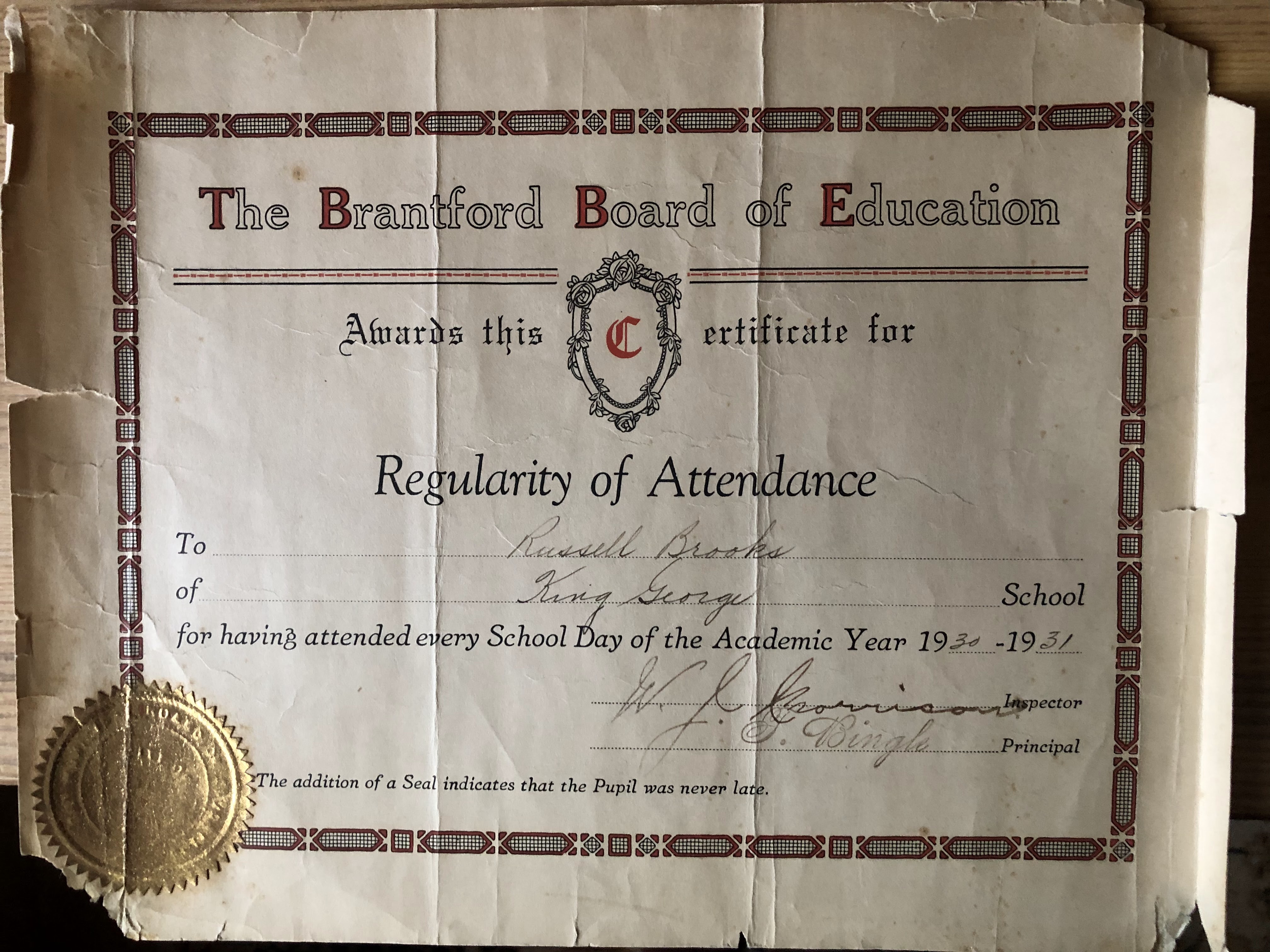
In the 1932 and 1933 directory the family lived at 154 Elgin Street. The Ruddy plant was located on Elgin Street (the building is long gone) so Bill would have been able to walk to work. The kids settled in,  attending King George School, where Russ had perfect attendance in the 1930-31 school year (and was never late!).


Bill is listed as an estimator of kitchen equipment. I imagine he took measurements in preparation for the installation of the fridge. He made the princely sum of $1,500 a year, worth about $24,838.97 in today’s dollars. The Brooks family paid $30/month to rent a brick home with 6 rooms - this works out to less than $500/month in today’s money for a nice looking two story home, comparable to the Sparkhall property. Also, they were the only family I located in the 1931 census that owned a radio. 

Library and Archives Canada Seventh Census of Canada 1931 Brantford City Ward 3


The family was found in the 1933 Brantford Directory but they moved on that year. It’s not clear if the move was voluntary or not but Bill was next employed by the Eureka Refrigerator Company in Owen Sound in 1933. Shortly after he lost his job and the family returned to Toronto. Only the 1938 Owen Sound directory was available so I do not have their address for their residence in that town. In 1935 they had returned to Toronto and were listed on the voter’s list at 177 Queensdale Avenue East York. Bill was able to find work with the Town of East York and he and Gertie remained there for the rest of their lives.


Finally, I was able to find the rest of the Brooks family in Scarborough. It was interesting to see that John Brooks senior was actually the enumerator for Malvern Village, I recognized his signature from correspondence I have. As a lifelong Scarborough resident he no doubt knew everyone in the vicinity and enjoyed chatting as he completed his returns. Son John and his family lived on the same property and helped with the farm; son George lived nearby.


Library and Archives Canada Seventh Census of Canada 1931York South Malvern Village


So the Brooks and Beslers cooperated and were where they were supposed to be. But not all my ancestors were so cooperative. Part II will follow - the elusive hidden Kingswells.

Sunday, 26 August 2018

Manitoba School Days

Everyone's heard the story that begins "When I was a child I had to walk 5 miles up hill through a snow storm to get to school" or something like that. Well, my mother has a story like that and it's true! She and her siblings had to walk about 5 km up and down hill and through a ravine and by a creek to get to school in another province! Here is a picture of my mom in front of the school - she's the girl to the far left, in front of her brother Art. He must be poking her or something, she looks terribly unhappy!
From the writer's collection
I've written before about my mother's family and how they settled in MacNutt Saskatchewan. They actually lived a fair distance out of town and could not easily get there on a regular basis. There was a school located in town but this was not the school that the Besler children attended. There was a much closer school located in Manitoba!

The following map shows where my grandfather's two sections were located and where the school was. You can see MacNutt on the map way to the south of the Besler property.
Created using lsdfinder.com
The children attended Cupar School No. 1633. The one room school house was built in 1911 and is located in what is today the Municipality of Roblin. Here is a photo taken by School Inspector R. J. MacKenzie, date unknown. I don't recognize anyone in the photo but it gives you a good look at the school itself.
Archives of Manitoba, School Inspectors Photos.
The Besler family walked from their farm to school and back every day. There were not real roads back then which made for a tough journey. My mother recalls a bear sighting one day when she was quite young - her older siblings took off and left her to fend for herself. Luckily she made it home in one piece! The teacher at the time was a Miss Campbell who was teased unmercifully by the farm boys - they called her Miss Camel and one day locked her in the outhouse (my uncle Art apparently was the instigator)

The school is still standing but has been turned into a private home. We were able to find it during our vacation this summer but no-one was around so we weren't able to get too close. Here's a picture I shot through the trees. The location is isolated now so I can only imagine how isolated it was back in the 1930s


The Beslers moved to Winnipeg in 1936 and my mother continued her education at Victory School located near their home in West Kildonan. This school was built after World War One and opened in 1920. Here's a picture from 1922.
Winnipeg Tribute, September 16 1922
Here's my mother and her classmates outside the school. She is 6th from the right in the second row. The second picture is from the pageant at this school, probably in her last year. She's fourth from the right in the second row.
From the writer's collection

And here's my mom visiting the school in 2012. We were able to go into the school but the school was drastically enlarged in 1950 and she really didn't recognize anything. The main door looks to be the same though!


In 1940 she graduated from Victory School - here's a notice from the Winnipeg Free Press on June 1st 1940 commemorating the occasion.
newspaperarchive.com
As the article note students from Victory School moved to Centennial School for Grade 10. Centennial School was built in 1913 and later became part of West Kildonan Collegiate. Unfortunately I was not able to get a picture before it was torn down but here is an undated picture showing what it looked like.
Source: A Historical Study of Public Education in West Kildonan to 1959 by Raymond Ronald Bailey, 1966
Later that year my mother's class was photographed for an article in the Winnipeg Free Press that ran on November 14th 1940. She still has a copy of this article showing the cooking and sewing skills being mastered. She is second from the right in the cooking photo. Answer to a bachelor's prayer indeed.
newspaperarchive.com
My mother only spent a brief time at Centennial School before she had to enter the work force but she remembers her school days fondly. She has never stopped learning and conveyed her love of reading (and sewing!) to my sister and I.

Sunday, 1 July 2018

From Landestreu to Landestreu

This is my maternal grandfather. His name was Jacob Besler and he was born on 28 December 1883 in Landestreu a town in Galicia, a province in what was then the Austro-Hungarian empire.


From the writer's collection

Landestreu was a small town populated by members of Jacob's extended family - Baumungs, Kandels, Lowenbergers and Beslers (spelled Bößler in this town map. 


Courtesy of GalizienGermanDescencants.org

Beslers were among the earliest residents of Landestreu moving from Germany in the 1770s. The Austro-Hungarian Empire invited foreign settlers into its newly acquired province of Galizien. German settlers found the offers of transportation and special status attractive and moved east.

More emigration was to come, this time westward. In 1872 the Dominion Land Act was enacted by Canada's Parliament. For a $10 registration fee a settler would receive 160 acres of land. He would have to live on the land for six months of the year for three years, clear at least 30 acres, erect a house worth at least $300 and be a naturalized British citizen. Canadian officials actively recruited in Europe for immigrants to settle western Canada.


Library and Archives Canada, collecitonscanada.gc.ca

Some of the first settlers to take advantage of the Act were residents of Landestreu. They moved to Saskatchewan in 1890 and founded a village also named Landestreu in honour of their home in Galicia. The name of the town was eventually to changed to MacNutt in 1909 in honour of Thomas MacNutt, who was the Member of the Legislative Assembly at the time. But in 1902 it was still called Landestreu and this was the town that Jacob Besler emigrated to.

I have not yet been able to find Jacob on a passenger list but hope one day to locate him. I like to picture him heading for North America with other young men from his town, perhaps some of the Baumung and Kandel cousins who show up on Census records in the same part of Saskatchewan. He appears to have left Galicia in 1902 as his passport shows that year as does his land patent application. He was 18 years old


From the writer's collection

Jacob's passport lists his employment as "wagner" (wagon driver or wagon maker). Perhaps his opportunities were limited in the small village of Landestreu. No doubt the lure of free land beckoned.

By 1910 Jacob had met all the Land Act requirements and successfully claim his property. In reviewing his file I found that he had returned his first plot of land as it was too rocky to farm


Taken by the writer June 2018

The first land was granted to another settler; Jacob had more luck with is second grant of land which he took possession of in 1906.


Saskatchewan Archives Board, Department of the Interior

The immigration agents did not tell potential immigrants how hard it was to farm in Canada. They did not tell them how harsh the prairie winters were. But the farmers carried on. My grandparents married in 1915. A wife and family were needed to help farm as hired help were few and far between. My grandmother Bena and the older Besler children were expected to help with chores. My mother was the youngest girl and didn't have too many chores during the farm years. Here she is as a baby.


And with her Dad outside the family home.

From the writer's collection

The family resided in the log cabin that Jacob built. It was neither roomy nor well-insulated. My mother remembers lying in bed looking at the icicles that had formed on the roof of the cabin. The three girls slept together for warmth. The children walked several miles to a one room school house that was actually located over the provincial border in Manitoba.

My sister, niece and I recently visited the area with the mother - it was the first time she had returned to Saskatchewan since she was a child. 


Taken by the writer June 2018


Obviously there were changes but the isolation remains. Homes are far apart on large plot of land. As of 2006 there were only 80 people living in MacNutt. 


Taken by writer June 2018

Winters were particularly isolating. Even now the roads in the area are dirt and gravel only. There would have been no snow clearing. The family rarely went into town and did not even attend church on a regular basis. My mother remembers attending the Christmas pageant at the school. The family would pile into the sleigh with warm bricks wrapped in blankets to keep the cold out.

The 1930s were especially harsh in Saskatchewan and unfortunately Jacob was no longer able to support his family by farming. After over 30 years he abandoned the farm and moved to Winnipeg. I can only imagine how difficult it must have been for him. Jacob worked for the Canadian National Railway in Winnipeg. In the late 1940s Jacob and Bena moved to Toronto to join their children. My grandfather died in 1961 when I was two years old so I don't really remember him. I do like this picture of him and me though!


From the writer's collection

On Canada Day I salute Jacob Besler for leaving his home in Europe to come to Canada. He was a 20th Century pioneer and played an important role in settling our western provinces. He helped make Canada the wonderful country it is today through sacrifice and perseverance and I am thankful that he did.

Wednesday, 7 March 2018

The Matzke Women

March 8th is International Women's Day and March is International Women's History Month. When I hear those words I think of famous and noteworthy women, but I also think of the women in my family. Not a lot of fame but many noteworthy and interesting. Despite being just average folk I've been able to find some of my relatives in the newspaper and I'd like to share their stories in this month's post.

From the writer's collection
Here's a picture of some Matzke women - from left to right they are Josephine Faustman Matzke (my great-grandmother), Christina Matzke Schneider (my great-aunt), Iris Schneider Allard (my first cousin once removed) and Bonita Allard Reis (my second cousin). Before I get to the newspaper article some background on the family.

I've written before about the Matzke family and their long journey to Canada from Romania. The driving force behind this journey was Josephine. She was born on July 8th 1875 in Atmagea Romania, a small village located inland from the Black Sea on the east coast of Romania. Though born in Romania Josephine and her family were of German background and were staunch Lutherans. On February 1st 1894 Josephine married Franz Matzke from the nearby village of Tulcea. Franz had been raised a Roman Catholic but the couple was married in the Lutheran Church. Josephine was in charge from the start!


A young Josephine, from the writer's collection
Josephine had one sibling that I am aware of - her younger brother Karl. Karl had moved to Canada in 1906 and settled in the community of Landestreu in Saskatchewan. Landestreu was eventually renamed MacNutt. No doubt he suggested to his sister the she and her family join him in Canada, and eight years later they did.

The Matzke family - Carolina, Josephine, Christina, Jacobena and Franz 
Life was hard on the Canadian prairies. Franz tried farming but was unsuccessful. He ultimately started a shoe repair business in town. Meanwhile, Josephine managed the family. She was strict - there was no dancing or card playing allowed on Sundays. But her girls were lively and all married young - my grandmother Bena married in 1915 at the age of 17, my great-aunt Lena married in 1919 at the age of 16 and great-aunt Tina married in 1925 at the age of 16.

In 1936 my grandparents left their farm in MacNutt and moved to Winnipeg with their six children. Josephine and Franz followed. It must have been hard to leave behind their two younger daughters as they likely weren't able to visit too often. Lena and her husband Fred had three children, Tina and her husband John had six children.  

And that brings me to the newspaper article that I found. In earlier times newspapers were great sources of social information. I was searching the Winnipeg Free Press for my family and discovered this article dated July 19th 1944:


Courtesy of the Winnipeg Free Press

A visit from Saskatchewan was an exciting occasion for the Matzkes and also made for a great human interest story. The ages of the women make for a neat little fact and I think is a really cool article. You'll note that Tina's eldest daughter Iris continued the family tradition of marrying early and starting a family right away!

The picture may have been taken by the newspaper photographer and presented to Josephine but I don't know for sure. I do know that she treasured the photo and had it nicely framed. Unfortunately all the women in this picture have now passed away. On International Women's Day I'm remembering them and all my other female ancestors.


SaveSaveSaveSave