Showing posts with label York. Show all posts

Thursday, 12 July 2018

The Glorious 12th - the Orange Lodge and my family

I inherited this picture from my dad after he died. I found it rolled up in a box of photos. You can see from the cracks on the paper that it had not been unrolled for some time.

From the writer's personal collection

In the middle are my grandfather Bill Brooks and my dad who had just had his third birthday. I know who and where (Kew Gardens in the Beach area of Toronto) but wasn't sure of the occasion. What was the RBP and who were these serious looking gentlemen? 

I knew my family were Orangemen and my sleuthing revealed that there was a connection. But first some background. The Loyal Orange Lodge was inspired by the July 12th 1690 victory of the Protestant William of Orange over the Catholic King James II at the Battle of the Boyne near Dublin in Ireland.

grandorangelodge.ca
The first Orange Lodge was founded in Northern Ireland about 100 years later to uphold the Protestant Ascendancy during another period of Protestant-Catholic strife. Its goal was to defend Protestant civil and religious liberties. The order spread to Scotland, primarily around Glasgow and then to Canada in the early 19th century. Most of the early members were Irish but many Scots and English also joined. And this is where my family comes into the story.

My great grandfather John Andrew Brooks was a staunch Tory and a staunch Orangeman. He belonged to the Malvern Lodge 3019 and I believe he was one of the founding members. At one point he was the Grand Master of the Lodge. 

              Toronto Telegram, date unknown

Unfortunately I wasn't able to find out much more about his involvement with the Lodge. Like many societies the Orange Order is somewhat secretive about their rules and operations. I found an interesting Catalogue of Orange Supplies that had paraphernalia for sale but no real explanation of what the goods were to be used for. 

Guess this is where the term "hoodwinked" came from.

Toronto Public Library "Catalogue of Orange Supplies"
Or you could order your own flag:

Toronto Public Library "Catalogue of Orange Supplies"

My grandfather followed his father into the Order, no doubt feeling that involvement would give him status and a step up in the world. This 1920 letter talks about his moving from a lodge in the Dufferin Bloor area to one closer to home in the East end.


From the writer's collection

Bill became quite involved in the Lodge and two of its brother organizations. There is even less information available about the other two orders but I do know you had to be a member of the Orange Lodge before you could join the other organizations. The first was the Royal Arch Purple. My grandfather had this handsome certificate. It's huge and I was only able to scan it in two pieces.


From the writer's collection

And the other organization he belonged to was the RBP that started my story: The Royal Black Preceptory. It appears that the other two orders were stepping stones to get to the RBP which was seen as a more dignified and religious group. It was interesting to note that my grandfather apparently reached the Red Cross Degree which was the highest level of the RBP.


From the writer's collection

The Catalogue of Orange Supplies had some interesting stuff for this group:

Toronto Public Library "Catalogue of Orange Supplies"

But the most interesting item in the Catalogue is this page which clears up helps clear up the mystery of the picture and an item that's been in my sister's possession for a number of years:


Toronto Public Library "Catalogue of Orange Supplies"

We just knew them as Grandpa's jewels but didn't really know what they meant. Here they are in the handsome case. He sprung for the higher level jewels in the "original and artistic design" to show he belonged to York Royal Black Preceptory No. 686 that met at the Ulster Temple at 214 Main Street on the 3rd Friday in every month


From the writer's collection

This organization was obviously very important to my grandfather as $15 was a lot of money in the 1920s/30s. It was interesting to read about these groups as I never thought of him as a religious person. Religion was an important component of the Orange Lodge and the other organizations but I think the fraternal and benevolent side was also important and clearly filled a place in men's lives in the 19th and 20th centuries in Toronto. As the Order declined in relevance and Lodges closed my grandfather didn't continue his membership though I can't say for sure when his involvement ended.

From the writer's collection
Today is the 12th of July. The Orangemen still march but the event is nowhere near as popular as it used to be. Thankfully the 12th is no longer the day for sectarian violence and riots (at least not in Canada). Their slogan today: "Civil and religious liberty for all, special privileges for none".

Monday, 9 April 2018

National Sibling Day

April 10th is National Sibling Day. Most people have siblings, though not as many as in earlier times. My 4x great-grandmother Elizabeth McKay Thomson was one of eleven siblings, all of whom survived to adulthood. She had nine children herself, and most of her siblings had families of the same size.

I have one younger sister. Here's a picture of us from a few years back - she's the little blonde:


She's ok though she insists I tried to kill her when she was a baby. My story is that I was just looking into the crib to see what they brought home when it tipped over. She survived.


My father liked to joke.


Speaking of my father, he also had a younger sibling. My dad and his brother Mel were close. They were two and a half years apart in age.


My dad on the left, my uncle on the right
Jones Falls, 1938
They remained close into adulthood. My mother recently shared a lovely story about the brothers. Upon his return from WWII my dad underwent major surgery on his leg which left him with a permanent limp. After his discharge from Sunnybrook Hospital he needed to use crutches for a period  of time. At the same time he had fulfilled his lifelong dream of attending the University of Toronto and studying music. Travelling from East York to downtown Toronto by streetcar on crutches would have been a nightmare. My uncle volunteered to drive my dad to class then pick him up later to bring   
him home. This would have been on top of holding down a full time job. 


My grandma Gertie was Russ and Mel's mother. She was one of twelve children, eight of whom survived to adulthood. The Kingswell clan was a close one. My grandmother's photo album is filled with pictures of her sisters and brothers. 


The family moved from Kingston to Toronto, and most of the family remained in the Toronto area. The exception was my great uncle Alf who moved to Buffalo. He was only a year older than Gertie and they remained close with many visits between the families over the years, even during war times. 


Gertie was also close with her younger sister Chrissie, the baby of the family. Chrissie spent lots of time with Gertie's family when the boys were young. My dad had fond memories of going to the movies with his aunt before the war. Gertie was close with her other two sisters Ollie and Liz as well.


So not a lot of heavy research in this post, just a bunch of fun pictures and memories of some of the siblings in my family.

Tuesday, 13 February 2018

Bill and Gertie - A love story

In honour of Valentine’s Day my blog this month is the story of my paternal grandparents Bill and Gertie Brooks. When I was a child I never thought of my grandparents as young people meeting and falling in love. They were just, you know, old! Yet it happened!

William Thomas Brooks was born in Scarborough then moved to Toronto to begin his career as a bookkeeper. He spent 1916-1919 in England and France as a member of the Canadian Expeditionary Forces, returning to Toronto when he was demobilized (see my November 2016 blog for further details). The 1920 Toronto City Directory (prepared in 1919) showed him boarding at 64 Homewood Avenue.


Gertrude Maud Kingswell was born in Kingston Ontario. She spent her formative years living at 32B Clergy Street with her parents and 6 siblings. By 1917 her brothers Ernest and William had moved to Toronto. Gertrude had been working as a stenographer in Kingston. Her employer at the Oddfellows Association provided her with a glowing reference as she prepared to move in 1919. 


The 1920 Toronto City Directory shows her boarding at 29 Saulter Street with her sister Elizabeth and Elizabeth’s husband James Essex.


I have no idea how my grandparents met. They both lived in the east end of the city which was a start. Gertie was Anglican and Bill was Presbyterian so the likely didn't meet at church. Bill worked at John Hillock and Co on George Street, Gertie worked at Eaton’s on Yonge Street which was nearby. Maybe they met at a lunch counter? Maybe they were introduced by friends? Or they met at a dance? We'll never know.

What I do know is that by 1920 they were an item. I have a few mementos of their early days together. This postcard was sent by Bill from Wingham. Not sure why he was in Wingham - there is no family connection that I know of, maybe work? 


He also sent flowers. The card and some petals were carefully saved so the bouquet must have been important to her.


And a birthday card 

The 1921 census was taken on June 2nd 1921. Gertie was listed with her family living on 471 Queen Street East. I couldn't find Bill or his brothers anywhere in east Toronto or Scarborough. I like to think they were celebrating Bill 's upcoming marriage - Bill and Gertie were married on June 7th

Gertie carefully preserved some flowers from her wedding bouquet as well as her headdress. 


As you can see from the picture she was a flapper bride.


Bill and Gertie had a long marriage. We had a Golden Wedding anniversary party for them in June of 1971. I know they loved having this certificate signed by Bill Davis, as they were both staunch Tories.


Unfortunately, Bill's health began to decline as he entered his 80's. He resided in Sunnybrook Hospital's K Wing with other WW1 veterans for several years. Gertie made the trip every day to visit him and help him eat his lunch. It was a long bus ride from her apartment on Cosburn Avenue – I took the trip with her a few times. Bill’s Alzheimer’s grew progressively worse but Gertie continued with her visits. He likely did not know who exactly she was by the end of his life. Bill died on March 26 1981. In June of that year they would have been married 60 years. 


Gertie died on March 30th 1985 and was laid to rest in Highland Memory Gardens next to her husband of 59 years. Happy Valentine's Day to them both!


Thursday, 7 December 2017

From Loyalist to Rebel

180 years ago Upper Canada was in turmoil. Years of control by the Family Compact had left reform minded citizens frustrated and angry. Average working men were inspired by William Lyon Mackenzie and became rebels. The Upper Canada Rebellion culminated with the battle at Montgomery's Tavern on December 7th 1837. One of my spouse's ancestors was involved in the battle and this is his story.

Ludwig Widmen was born in Northampton Pennsylvania on September 21st 1781. He was the third of twelve children born to Philip Wideman and Sarah Ann Long. Ludwig's grandparents had emigrated from Baden-Wuertemberg in Germany and the family had strong German ties. He was baptized in Christ Lutheran Church:

Historical Society of Pennsylvania, ancestry.ca
The family joined William Berczy's German Company settlement in Markham. No doubt they had heard of the availability of land in Upper Canada from other German families who had made the trek from Pennsylvania to Canada. This census shows the family settled in 1801 at lot 35, 8th Concession Markham. Philip received 200 acres to settle.


Library & Archives Canada MG 23 H II 6
Ludwig was only 20 when the family moved to Canada but he soon turned his mind to acquiring his own land. In 1806 he petitioned for 200 acres of land, advising that he had sworn the oath to the Crown. The majority of settlers in Upper Canada at this time were born in the United States and it was important to affirm their loyalty to Great Britain.

Library & Archives Canada, Upper Canada Land Petitions

Not long after the War of 1812 began. Ludwig showed his loyalty to Great Britain once again by serving under Peter Robinson in the Rifle Company of the First York Militia, first as a Sergeant, then as an Ensign. As a reward for his service he was granted land in 1821. It was thrilling to be able to review Ludwig's military file in Ottawa this summer (though not sure why the signature was torn off his certificate!).

Library & Archives Canada, Land Claim Certificates of Upper Canada Militiamen

The completion of Ludwig's War of 1812 service coincided with the birth of his first daughter Christiana and the unfortunate subsequent death of her mother, Ludwig's first wife Christiana Kribs. Ludwig subsequently remarried in 1817 - he and his second wife Elizabeth Macklem had seven children together.

The Widemans were fine upstanding citizens. They continued to farm their land in Markham. In 1818 Ludwig was appointed Lieutenant in the 1st Regiment of York Militia.

Library & Archives Canada, Wideman family collection

He and his brother Philip appeared on militia lists through the 1820s. But then things changed. The election of 1836 was hotly contested.


Toronto Public Library, election broadsheets

According to The Story of the Upper Canada Rebellion by John Charles Dent (published in 1885) "During that election he rode to Newmarket to exercise his franchise but as he was know to be a Reformer the strongest attempts were made to prevent him from voting. Notwithstanding that he was known to have resided on his farm for more than 30 years, and that he had spent two years fighting for his country at the time of her utmost need, a demand was made that he should take the oath of allegiance. He felt all the  just indignation which such treatment might be expected to arouse, and from that time forward was prepared to adopt any and every means to destroy the domination of the Compact..." (Volume 2, page 137)


Library & Archives Canada, voters driven from the polling station
Mackenzie was a popular figure in the Markham/Whitchurch area and apparently announced his rebellion plan in Stouffville on December 2nd 1837. Ludwig was said to have hosted the meeting.


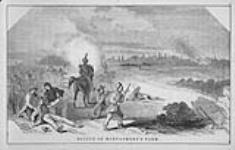
 On December 7th 1837 the Militia marched up Yonge Street towards Montgomery's Tavern. A battle ensued, and when it was over Ludwig lay dead. He was the only rebel casualty.


Toronto Public Library collection


Apparently there was some dispute over whether Ludwig had been killed during the battle. John Charles Dent wrote how Mackenzie wrote in 1847 "that 'a ball struck my worthy friend Capt. Wideman, in the head, killing him on the spot"... There are three persons in Toronto at this moment who saw him fall. He was struck by a bullet which passed through the centre of his forehead and came out at the occiput... the body was conveyed to Whitchurch by a cousin of the deceased, and was there interred by his relatives..." (Volume 2, page 136).

Here is Ludwig's grave - he is buried in Dickson Hill Cemetery. 

From the writer's collection
The rebels were defeated. Many, including Mackenzie, fled to the US. Many others, including Ludwig's brother Philip were captured and imprisoned. Philip was imprisoned from December 12th 1837 until May 10th 1838 when he was pardoned and released. If Ludwig had lived perhaps he would have shared his brother's fate.

Ludwig wrote his Last Will and Testament on the 27th day of May 1837. Perhaps he had a premonition that he would die that year. His property was left to his wife and children. His eldest daughter was left £75, a substantial amount for the time. By the time of her father's death Christiana was married with three children, living in Bruce County. I wonder how long it took for the news of her father's death to reach her and what she thought of it all. Christiana was my spouse's great-great-great-grandmother.