Sunday, 6 July 2025

My Father's Loom

An object might seem to be just an object but the same object can have a story to tell.  A diamond ring might tell the story of love and marriage. A christening gown could tell the story of the multiple babies who wore it. But what kind of story can a loom tell? As it turns out an interesting one with a personal twist to it! Here is the loom and here is its story.

In 1946 my father Sergeant Gordon Russell Brooks was demobilized from the Canadian Armed Forces. After four years in Europe serving first in the Medical and then the Provost Corps, Russ was eager to return to Toronto to get on with his life. Never robust, he miraculously managed to survive his service without injury, but upon his return home developed severe problems in his right knee. As a veteran, he first was treated in the old Christie Street Hospital which was still in operation when the first soldiers returned from Europe. He was subsequently transferred to the spanking new Sunnybrook Medical Centre where he underwent surgery (he was one of the first 100 patients to be admitted). Recovering from surgery, Russ was bedridden for some time. The Sunnybrook occupational therapist team devised a treatment plan to keep his hands busy and his spirits up. He was prescribed a Guildcraft-Thackeray Loom, produced by the Guild of All Arts in Scarborough.


The Guild of All Arts was founded by Rosa and Spencer Clark as an artists’ co-operative and centre promoting the Arts and Home Crafts Industries movement in Canada. It was situated on the grounds of the Bickford Estate, a property purchased by the widowed Rosa Breithaupt Hewetson in 1932 just before her marriage to Spencer Clark.

Bickford Estate 1944 photo TPL Digital Archives


Rosa and her three daughters from her first marriage enjoyed working with looms so it was no surprise that the first studio established at the Guild in 1932 was hand-loom weaving. Other crafts soon followed - pottery, wrought iron working, sculpture, painting, and cabinet making, among others. Workshops were set up on the Clark’s property, staffed with professional crafts people who lived on site and would demonstrate their particular craft to the public. Quality pieces produced by the artists would be sold on site or at the Guild of All Arts Shop on 44 Bloor Street West. This postcard, purchased and sent home by one visitor in 1940, shows the popularity of the weaving studio.This particular visitor was from New Jersey - visitors came from near and far to visit.


The first looms produced and used in the weaving studio were huge, noisy and complicated. The Guild’s 100” wide loom, billed as the largest hand-loom in Canada, was set up at the CNE for visitors to marvel at. The Clarks soon began to look for a smaller loom that could be manufactured and sold to customers who wanted to learn the craft. The Clarks learned of a unique light and portable loom that had been created by Captain Henry James Thackeray, a member of the British Arts and Crafts movement, and a 3rd cousin of author William Makepeace Thackeray. The Captain had  died in 1926 but his widow continued on with his work of promoting the loom.  


In the July 11 1931 edition of the Yarmouth Independent Margaret 

Thackeray spoke of “efforts being made at Elsing to revive the old village  industry of weaving by means of a simple loom invented by her husband, the late Captain Thackeray. Its use was deftly demonstrated upon the terrace overlooking the lily-starred moat, and fabrics so made were much admired”. In the mid 1930s Rosa and Spencer visited England and stayed with Margaret at Elsing Hall, the family estate located in Norfolk. The Clarks were successful in securing the North American as well as the British patent and design rights to the loom. Despite the fact that she no longer controlled sales of the loom Margaret continued to promote it. In the 1939 Register of England she described herself as “Estate Owner and Seller of Thackeray Loom”.  


Back in Canada production of the Guildcraft-Thackeray Utility Loom was soon underway in the Guild's wood-working shop supervised by Herman Riedl. Assistance was provided by the metal-working shop. The loom proved incredibly popular and was marketed to schools, camps and rehabilitation hospitals, as well as the enterprising home weaver. The loom was light, portable, and small enough to be used by a seated patient such as my father. It was reasonably priced and many were sold by mail order. Potential weavers could visit the Guild of All Arts Shop on the 6th floor of Simpsons for a free demonstration. 


The loom could be purchased on a “Home Lovers Plan” for only $2.50 now and $2.50 monthly. Customers were encouraged to take the loom to the cottage as “During the holidays you can readily weave smart materials for suitings, hand bags, scarfs, table runners, and many gifts for Christmas” (Toronto Star June 14 1935). It became a major source of revenue for the Guild with more than 30,000 shipped worldwide, The Globe and Mail and Toronto Star were filled with ads touting the benefits of the loom and  news articles featuring Rosa and her daughters modelling clothing made from cloth they wove themselves.

Globe and Mail February 2 1938

The Canadian magazine published a glowing report about the Guild’s looms in its November 1937 article. “The Guildcraft and Thackeray looms are the biggest news the weaving world has had for centuries” as “The very smartest Parisian women and the most advanced Americans have seized on the brand-new vogue for hand-weaving with such glee that The Canadian would like to wager that you will find yourself plunged into the craze for hand-weaving before you know what has happened to you”.


The instruction book for the Loom noted that “Guildcraft Looms have revolutionized home weaving until it is now one of the easiest and simplest of home occupations. Study your loom and your work with patience and care. You will be an expert before you realize it”. The booklet featured a picture of the Hewetson girls at work on their looms on the grounds of the Guild.  

My father was extremely creative and he enjoyed using the loom to make various projects. I still have a wee blanket and a placemat/napkin set. He must have made more woven items and given them as presents as he had labels created. I don’t ever remember my father using the loom but he kept it safe through his life. It remains a reminder of a difficult but rewarding time in my dad’s life and an interesting connection to my current home in Guildwood Village.


The Guild of All Arts is no longer in operation but the site still exists though in a different form. The property has recently been renovated and turned into an event venue. The City of Toronto took over the property in 1978 and the park is open to the public. Of interest is the open air art gallery. In the1950s and 60s many older buildings in Toronto were razed for new development. The Clarks collected the decorative stonework from many of these buildings. Relics from over 50 buildings can be seen in the park.  


This is the facade from the Royal Conservatory of Music formerly located at the corner of University Avenue and College Street in Toronto. My dad studied at the Conservatory and later at the Faculty of Music located in the same building. The facade features a portrait of Sir Ernest MacMillan, dean of the Faculty when my father studied there. Sir Ernest was apparently an occasional guest at the Guild of All Arts taking the time away from his day to day activities to write music. A nice reminder of my dad’s music studies close to my home.

Friday, 10 November 2023

The McKays of Quebec City. Part One: The Road to Quebec

In honour of Remembrance Day I’d like to share the story and commemorate the service of my 6x great grandfather, a career soldier and United Empire Loyalist.

Hugh McKay was born around 1735, somewhere in Scotland. I have yet to determine where. As a young man he followed in the footsteps of many others and joined the British army, probably around 1758. According to one of his wife’s later Land Petitions he “faithfully served His Majesty George the Third as a paymaster sergeant in the 8th regiment of infantry for the space of 18 years”. The records of the 8th regiment of Foot are available at the National Archives at Kew in London and I hope to be able to see them one day, though details on enlisted men are often not 

extensive.

Uniform of King's Regiment (centre) David Morier Collection, Wikimedia Commons


Historical Record of the Eigth, or the King's Regiment of Foot Wikimedia Commons

The 8th, or “King’s”, Regiment of Foot was one of the most senior regiments, originally raised in 1685. During the Seven Years War (1756-63) the 8th was involved in some raids on the French coast in 1757-58. Later it fought in battles in Germany in 1760-62, including the Battle of Warburg on 31 July 1760, the Battle of Vellinghausen     on 15 July 1761, and the battle that ended the Seven Years War in Europe, the Battle of Wilhelmstahl on 24 June 1762.


At this point Hugh and the 8th would have returned to England and Hugh began his family life. Around this time Hugh and Mary Embling were married. I know very little about Mary who was born around 1743. My 5x great grandmother Elizabeth was born around 1763 so presumably the couple was married at some point before this date. Hugh must have been stationed away from Mary (or perhaps some children died in infancy) as the next birth I could document was six years later. At this point the McKays were in Canada. The 8th landed on Île D’Orleans in the summer of 1768 and was then deployed to surrounding posts. 


According to A Military History of Quebec it was customary for soldiers wishing to marry to seek permission from their commanding officers. If granted, dependents were then entitled to quarters and rations. When a regiment left the UK for overseas only a limited number of wives were entitled to accompany them, be borne on regimental strength and receive rations from the government. The general ratio was 6 wives for every 100 men but this was often broken. Either way, Mary and Elizabeth were granted permission to travel with Hugh to Canada.


Hugh was likely stationed with the 8th at Fort Oswegatchie (now Ogdensburg in upper New York State). It was from here that Captain George Forster led a force of 40 regulars and 200 Indigenous warriors across the St Lawrence to attack Fort Cedars, just outside Montreal. This post was held by the Americans, who had invaded Canada in 1775 under the leadership of Benedict Arnold. The British were victorious in the battle (actually a series of skirmishes) that took place between May 18 and 27 1776. The Americans subsequently withdrew from Quebec. 


Bibliothèque Nationale de France from Wikimedia Commons. The Cedars are in the lower left of map


The regiment’s next engagement was the siege of Fort Stanwix in August 1777. Hugh was also involved in the Battle of Orskany on 6 August 1777, fighting alongside Sir John Johnson’s King’s Royal Regiment of New York. According to a later memorial:


 … his conduct in a Temporary Station under the Command of Major Forster(a Vollantier [sic]) on an Expedition against the Rebels at the Cedars; and soon after a second Time a Vollantier with Sir John Johnson on his first coming into Canada, was such as gained him the particular Notice of these brave Officers, and by whose Recommendation he obtained his Discharge


Shortly afterwards he obtained his first Assistant Commissary position at Isle aux Noix, in the Richelieu River. Returns of Provisions Condemned by Survey at Isle Aux Noix refers to the “time of Mr. McKay” prior to May 1778.

Haldimand Papers, Contingent and Current Accounts Relating to the Commissariat 1767-1782


By October 1778 Hugh and his family had relocated to Carleton Island where Hugh was appointed Assistant Commissary and acting Barrack Master.  Carleton Island is located in the middle of the St Lawrence River between New York and Ontario and was named after Sir Guy Carleton. The island became a base for British ships and construction of a fort was begun, though never completed. During the McKay’s stay over 1000 merchants, camp followers, soldiers, sailors and displaced Loyalists were living on the island which fell under the command of Sir Frederick Haldimand, “Captain General and Governor in Chief in and over our province of Quebec in America”.


Plan of Carleton Island by A. Gray Asst Qr Mr Genl Quebec 29 Dec 1810 Wikimedia Commons


Sir Frederick Haldimand produced a voluminous quantity of correspondence that is housed in manuscript form in the British Library. Library and Archives Canada have a copy of the material which is digitized on heritage.canadiana.ca. In his role as Captain General he was closely involved in the running of the various military bases, including Carleton Island. It’s amazing that a man with his responsibilities was so on top of the minutiae of day of day operations. His papers have proved a treasure trove of information on Hugh McKay’s trials and tribulations in his activities after his army service.


Hugh and Mary’s family had grown: Anne born in 1769, Deborah born in 1770, Mary born in 1775, Isabella born in 1777, Jane born in 1779 and Bridget born 1780. Church records for the baptisms of the children are unavailable as the military chaplain records are lost. Many a family historian has tried to locate but to no avail. 


Shortly after his arrival at Carleton Island Hugh encountered difficulties and his woes are well documented in the Haldimand papers. It appears that Mary McKay had requested and received permission to run a small business to supplement Hugh’s earnings of five shillings a day, an amount that was not adequate to support a family of nine.


In a Memorial to Haldimand  Hugh stated that the family arrived at Carleton Island 22 October 1778. There was no place to live and nothing was provided for him. He had to build at a very great expense, a place to live:


But by the Industry of my wife and daughter, who carry’d on a small   trade in dry goods in which I had no connection, I have been able to support my wife and seven children  


The family carried on until April 1780 when disaster struck - General Haldimand was informed that Hugh was engaged in trade and determined to discourage this practice, removed him from his post. Hugh was devastated and spent the next few years protesting his innocence and requesting reinstatement and vindication. He relocated his family to Quebec City where he continued to contact Haldimand. On 19 December 1782 he wrote to Haldimand:


… some time after Totally dismiss’d His Majesty’s Service, without giving your Memorialist an opportunity of Vindicating his Conduct (which Indulgence has been doubly granted to one, who never Served His Majesty in any other, and of less standing in that Department) was uncommon to one whose long and faithfull Services Justly intitled him to  


 Hugh felt he had discharged his duty in the strictness manner, settled the last ounce of provisions, but in the process gained enemies. He felt he had borne an “unblemished character through life, both as a man, and a soldier” and demanded a Board of Inquiry review his case.


It took until the following December for a Board to be arranged to review Hugh’s case. In a March 1784 memorial Hugh shares his good news to General Haldimand. The Board of Inquiry could not find “the last vestige of that fraud which calumny had suggested”. His character had been reinstated, but “his misery has not been removed”. His family still depends on him, though “now in an advanced period of life unable to act with that vigour and activity he has so faithfully exhausted and spent in the Service of his King and Country”.


Hugh sought pay from the time of his dismissal until 24 December 1783 when a reduction in every department took place, based on Haldimand’s 24 April 1780 letter promising a continuation of his pay. He had received payment for the provisions taken from him 2 years ago but he sustained a loss as the property was undervalued at £8.19.5, a loss he cannot sustain, as the money went directly into the hands of his creditors.


Haldimand Papers Hugh McKay 19 December 1782 Memorial 


It is interesting to note that in 1781 there is mention that the above provisions were transferred from the Kings Store to Mr. Thompson, the Shop keepers house. This would appear to be Archibald Thompson who shortly marry Hugh’s daughter Elizabeth. 


As it was not possible to be reinstated into his former position, Hugh asked that he receive his share of land based on his last military service in Sir John Johnson’s Corps. His petitions were unsuccessful, but by this time Hugh had established himself in Quebec City, rising to a new level of respectability and success. Stay tuned for part 2 of his story.

Monday, 9 October 2023

Jacob Besler's Long Journey to Canada Part Two: From Liverpool to Landestreu

This is part two of a two part story about Jacob Besler’s journey to Canada from Galicia. If you missed part one you can read it here.

The morning of June 14 1902 dawned clear and sunny. It was going to be a beautiful day, especially since Jacob’s journey across the Atlantic was almost at an end. He’d heard that they were now in the middle of the St Lawrence River and would soon be arriving in Quebec. Jacob and his cousins Johann Kendel and Philip Besler were excited and glad they would soon be on dry land. The 722 3rd class passengers had been tightly packed into the ship and they longed for open space. The ship stops and a boat approaches - the medical superintendent Dr. G.E. Martineau is now boarding the ship to check for illness.


Jacob and his cousins line up. Behind them in the line they hear coughing and sniffling. That doesn’t sound good. They turn to see fellow Galicians the Sloboda family. The Landestreu group are the only German speaking Galicians on the voyage but they know enough Ukrainian to converse with their fellow passengers. Jacob, Johann and Philip pass their examination with flying colours. But Maria Sloboda and her children aren’t so lucky - they have the measles. The doctor also finds one case of smallpox and one of chickenpox. As a result 352 steerage passengers and 15 members of the crew will be quarantined.


Library and Archives Canada. Passenger Lists, 1865-1922
Library and Archives Canada. Immigrants at Grosse Île Quarantine Station 1832-1937

Grosse Ile was established in 1832 as a place to inspect and detain incoming ships and people to prevent disease spreading to North America. Grosse Ile was the perfect spot. It is located 50 kilometres downstream from Quebec City, en route for ships arriving from Europe via the St. Lawrence river. It had a good supply of fresh water, and as an island, was naturally suited for keeping newcomers isolated from the mainland. Years had passed since the cholera and typhus epidemics that struck down so many Irish emigrants. But in 1902 illness was still an issue.  

View of Grosse île from the river

Jacob and his cousins are confused. Why do they have to disembark here? Luckily for the travellers German speaking agents appear to explain the situation.

After a short ride to the island the travellers are brought to the two story disinfection building where they and their possessions will be disinfected. 


The sick passengers are taken directly to the hospital


The ship will be sprayed with mercury bichloride to kill micro-organisms and then fumigated with sulphur dioxide gas to kill any pests.


All of Jacob’s possessions are taken and put into numbered bags. The bags are put into a large wire mesh box and then onto railcars to be brought into the steam chambers for dry steam cleaning to kill any pathogens. 


Next: a refreshing disinfecting shower! Jacob looks down the corridor and sees 44 steel stalls. Each stall has a metal door with chicken wire around the top to prevent any peeping on your neighbour. Jacob enters, undresses and gives his clothing to the agent for disinfection. Jacob hesitates, then enters the shower. For 15 minutes water sprays from above and from the side. The solution is a mixture of hot water and diluted mercury bichloride. First class passengers are used to showers but this is a new experience for Jacob. There were no showers in Galicia.


Exiting the shower Jacob is glad to see his clothes have been returned to him. He dresses, receives his disinfection certificate and is reunited with his luggage. 


He is relieved to see Johann and Philip and is glad that they’re allowed to stay together. They are now approached by nurses who inspect them again for signs of disease and check to ensure they've been vaccinated against smallpox – a legal requirement to enter Canada. All is in order so the trio heads to the third class hotel where they will complete the mandatory quarantine period with daily medical exams.


The third class room is the space between the two couches

At the third class hotel Jacob, Philip and Johann share a room. The quarters are cramped but food is provided.


There are no toilets or sinks in the building so the travellers must visit the nearby washhouse.


There are no lounges but they are able to go for walks around the island. The weather during their quarantine is pleasant though some days are rainy. Jacob and his companions don’t become ill but some others come down with measles: all 6 members of the Vasilinchuk family, all 7 members of the Panchuk family and the rest of the Sloboda family, among others. 


By July 2 most of the passengers have successfully completed their quarantine and are ready to leave. Jacob and his companions are excited to finally be on their way after eighteen days.


They board a shuttle boat to the port of Quebec. The pier building, similar to Pier 21 in Halifax, is no longer there. Here is a photo of the site. 

A medical inspection confirms that the Landestreu group is now healthy. They also must pass a civil inspection - Jacob only has $6 in his pocket as does Johann. Their older cousin Philip has $40 which should be enough to get them to their final destination and the land they plan to homestead.  


At 6pm on Wednesday July 2 they board the CPR train to Winnipeg. This is a later schedule but gives you an idea of the time involved - they don’t arrive in Winnipeg until 9:50 am on Saturday July 5. 

CPR Schedule, 1912. https://open.library.ubc.ca/collections/chung/chungtext/items/1.0357107

Winnipeg’s current train station wasn’t built until 1912 so the facilities would have been more basic. Trains didn’t run north into Saskatchewan until 1909 and at the time Saskatchewan was still a territory. Jacob would have had to purchase supplies and once again travel by horse and cart to his new life. It was a long journey but he had finally arrived in Canada and now the hard work of clearing and settling could begin. On Thanksgiving Day I am thankful a young man of 19 decided to make a better life in the new world. 


Sunday, 8 October 2023

Jacob Besler’s Long Journey to Canada Part One: From Landestreu to Liverpool


I’ve written before about my grandfather’s life in Galicia here, and earlier about his arrival in Canada here. But only recently have I been able to fill in some gaps in between: how did he get from his small village in Galicia to the Canadian prairies? Here’s what I learned.

As the third son in the Besler family Jacob’s prospects in the tiny village of Landestreu were slim. Lured by the prospects of his own farm in Canada Jacob decided to seek his fortunes overseas. Everyone in Landestreu was related to each other so he likely had heard about villagers who had emigrated to Landestreu Saskatchewan. Accompanied by cousins Johann Kendel and Philip Besler he made his travel plans and in the spring of 1902 began his journey.


Jacob probably hadn’t ventured too far from his home in his life so he would have excited but on the other hand nervous about leaving Landestreu for good. The first step in the journey would have been to travel to one of the nearby towns to catch a train. The Galician Railway was extensive with about 1540 kilometres of lines connecting the eastern part of the Austro Hungarian Empire with Vienna, Berlin and Warsaw. 


The Lemberg-Czernowitz Line was built in 1866 and included a station at Stanislau (now Stanisławów), the closest to Landestreu. If the travellers were lucky they would have been transported by horse and cart. Jacob’s passport listed his occupation as Wagner (wagon driver) so he may have had access to a cart which would have shortened the nine hour walk. Once in Stanislau they would have boarded a train for the first step of their journey to Lemberg (now Lviv).


Stanislau Station https://sudilovski.livejournal.com/77246.html

Lemberg Station Interior https://sudilovski.livejournal.com/77246.html
Lemberg reception building https://sudilovski.livejournal.com/77246.html 


In Lemberg Jacob and his cousins would have visited one of the many travel agents whose windows were decorated with posters meant to lure travellers in. They would have discovered that it was cheaper to travel to Canada instead of the US as the government subsidized the emigration cost via a fee paid to travel agents for each immigrant they booked. They also would have discovered that an indirect route to Canada was cheaper than a direct journey. That meant sailing from a port such as Hamburg, Bremen, Antwerp, Danzig, Stettin or Rotterdam to Grimsby, Humber or Hull in the UK. 

A train would then take them to Liverpool where they would board a ship sailing to Canada. The package they purchased would have included the cost of food and lodging, train ticket to the port, steamship ticket to Hull, train ticket to Liverpool and steamship ticket to Canada. The cost was about $40-50 or about $2000 in 2023 Canadian dollars, a not insubstantial amount of money. The group paid the sum and headed off on a journey that would have taken about 3 weeks in total.


The only passenger lists easily accessible for this period are the Hamburg passenger lists. I was unfortunately unable to find Jacob and his companions on any of lists for ships sailing from Hamburg to either Grimsby or London in the spring of1902. It’s most likely that they sailed to the port of Hull/Grimsby, probably via the Wilson Lines as the train trip to Liverpool was the shortest route to a port in terms of time and distance.


Special immigrant trains left Hull at 11 am on Monday arriving in Liverpool at 2 to 3 pm that day, though trains could run on an “as needed” basis linked with the regularity of Wilson Line steamships. The railway carriages left directly from Victoria Dock in Hull and ended at Riverside Quay in Liverpool - the travellers weren’t allowed to visit either city as officials didn’t want to chance disease ridden migrants mixing with townsfolk. The immigrant trains took precedence over others due to their length - there were sometimes so many emigrants that 17 carriages were pulled by one steam engine. Baggage was stored in the rear four carriages. The trains were low standard 3rd class carriages equipped with wooden benches to sit on and no toilets.


Paragon Station Hull, photo by Richard Croft

Once in Liverpool the travellers would stay in immigrant lodging houses until their ship to North America was ready. The stay could take from 1-10 days. The Dominion sailed for Quebec on a Thursday so Jacob and his companions would have had a few days to cool their heels. 

Liverpool Mercury June 2 1902 findmypast.co.uk

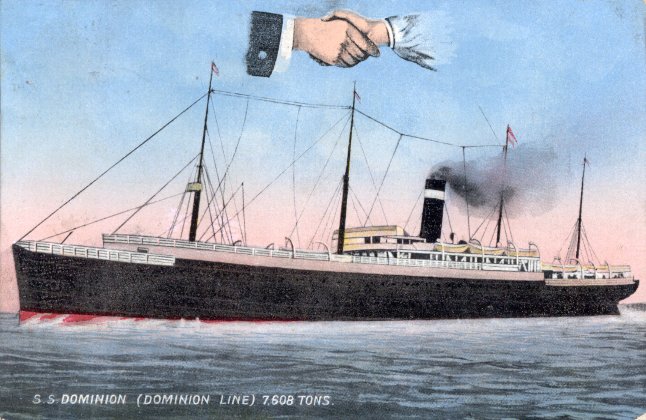
The Dominion was a huge ship weighing 7.000 tons, built in Belfast in 1894 and originally named the Prussia. It was purchased by the Dominion Line from the Hamburg America Line in 1898 and renamed the Dominion. The ship measured 445 feet by 50 feet and could carry 1120 passengers: 200 1st class, 170 2nd class and 750 3rd class. In 1902 the ship had already crossed the Atlantic three times, heading for Portland in January, March and April. The June crossing to Quebec was the first and only of the season as the season for travel to Canada was short due to ice in the St Lawrence River.


I was able to locate the passenger list for Jacob’s voyage from Liverpool. His name was misspelled as “Pessler”, a common error. The Landestreu party were 3 out of 722 third class passengers, the new and improved term for steerage class. It was interesting to note that English, Scottish and Irish passengers were listed first, before the “foreigners”. Included in this group were 75 British Home Children ranging in age from 3 to 18. All third class passengers were bound for Quebec. The 99 second class and 40 first class passengers were bound for Montreal. 

findmypast.co.uk

The morning of June 5 was cool and overcast with a light breeze. The 861 passengers queued up and boarded the Dominion. Under the command of Master Jones the ship began the 9 day trip to Quebec.


To be continued …