Friday, 8 March 2019

Brooks, Martha, wife

Today is International Women's Day, and March is Women's History month in the US (in Canada October is Women's History Month). 

In genealogy it can be extremely difficult to research women. They just don't show up in the general records. Once married they would generally take their husband's name and retreat into the home, never to be seen in the public record until perhaps when her husband died and she was named in his will. It can be hard to get a real picture of their lives. They're almost forgotten.

Case in point is my great-grandmother Martha Ellen Walker Brooks. Martha was born in Scarborough on 29 September 1873 to Thomas Walker and Hannah Topper. Thomas was born in Scarborough on 3 January 1830 and was a descendant of the founding family of Scarborough, the Thomsons. Hannah was born in Lincolnshire on 12 Jul 1841. She emigrated to Canada sometime between 1851 and 1862 with her siblings Sarah, George and Martha. Frank, William and Christopher joined their siblings at a later date (there were 13 children in total in the family). I don't have a picture of Thomas but here is a picture of Hannah, my great-great grandmother.


Hannah Topper Walker


I don't have the exact date of their marriage but they appear to have married some time in 1862. Their first child Sarah Ann was born in 1863 followed by Mary Jane in 1864. The next two children David (born in 1866) and Thomas (born in 1867) both died in infancy, George David was born in 1870, William Henry in 1871 and then Martha. Tragedy struck in 1876. The Walker's last child Thomas was born on 18 March 1876. He died on 23 May 1876 as a result of congestion of the lungs. 


His mother followed him to the grave on 21 April 1876 as a result of pyaemia from puerperal inflammation, duration of about 5 weeks dating back to the birth of her last child. Pyaemia was a type of septicaemia (blood poisoning)caused by the spread in the bloodstream of pus-forming bacteria released from an abscess. Without antibiotics the disease is almost always fatal.


Maternal mortality had improved by the end of the 19th century but many women still succumbed to complications from giving birth. The informant of the death was Thomas' older brother Andrew. Thomas must have been devastated. In fact he never remarried which was unusual in the 19th century, especially with a man running a farm with 5 young children.


It must have been difficult for Martha growing up without a mother. No doubt her older sisters helped her father parent their younger sister but by 1881 Mary Jane had moved out. She married in 1883 and Sarah Ann in 1891. By 1891 Thomas was living alone, which again was unusual. It was the custom for widowed parents to move in with one of their married children. I was unable to locate either Martha nor her two brothers in 1891 census so I don't know where they were living. They didn't appear listed with their married sisters, nor were they living with any of their Topper or Walker aunts, uncles or cousins. I like to think that Martha may have had an opportunity to have any interesting job but we'll never know for sure.

She finally surfaces on 13 December 1893 when she marries my great-grandfather John Andrew Brooks in Agincourt. She was 20 years old. Her brother William Henry was a witness as was her cousin Alice Hastings. Alice was also born in 1873 and also grew up without a mother. Elizabeth Ann Wallker died in 1875 of consumption, The new husband is listed as a farmer. In 1893 the employment of the bride was not listed. All we know is that she was single.

Now Martha is a married woman and that status will define her place in the world for the rest of her life. In each census she is listed as Brooks, Martha, wife. No employment is ever listed though she has her hands full working as a farm wife and raising her three sons. The 1901, 1911 and 1921 censuses all read the same.


1911 Canadian census
I've located the family on voter lists. On the 1935, she is listed as Brooks, Mrs. John Sr, housewife. As was the custom, her first name was not used. On the 1940 and 1945 list she is Brooks, Mrs. J, In 1949 her first name is used: Brooks, Martha hw. 


1935 Voter list
It was unlikely that Martha voted in the 1949 election. She had already developed dementia and a nurse was hired to help look after her. Nurse Edna attended my parents' wedding as well.


John Brooks Sr, Nurse Edna, Martha Walker Brooks, Anne Brooks, John Brooks Jr.

These are the only other pictures I have of Martha, taken with her son my grandfather William Thomas Brooks and my father Gordon Russell Brooks. 

 
I'm not sure when these pictures were exactly taken. I love her sweet smile. She died on June 24th 1952 at the age of 78 and was buried two days later in the Melville Presbyterian Church Cemetery in West Hill.


And that's what I know of her life. I wish I knew her hopes, her dreams and her disappointments. There was more to her life that I will never be able to learn about. But she was important in her own right. So for International Women's Day I leave you with the story of my great-grandmother, descendent of Scarborough pioneers, hardworking farm wife and beloved mother and grandmother. She is not forgotten to me.

Tuesday, 26 February 2019

You know you're a boomer when ...

I read a post recently that pointed out that genealogists sometimes forget that they too are part of the family tree and should document their own story as well as their ancestors. So on the occasion of a landmark birthday (and National Retro Day!) here is the story of a baby boomer.

You know you're a boomer when:

1. Your parents brought you home from the hospital in a 1958 pink Chevy. I think this car really epitomizes the 50s. Maybe not as flashy as some of the 50s cars but it was popular at the time. Here's my mom and I heading home for the hospital. 


You can't really see the car too well so here's a screen shot from a film my dad shot in the summer of 59 where you can see the car better.


2. You had special baby dishes. I still have some of the gifts my parents received when I was born. I still love my bunnykins!


3. You had a stay at home mom. My mom stopped working when she had me and chose not to return to the work force once her children were older. Her days were filled with gardening, sewing, cooking and sometimes painting. We were lucky to have the attention. She taught me to read well before I started school and later how to sew, knit and crochet, and to cook as you can see here!


 My first book!


4. You wore cat's eye glasses I was around 7 when I had to get glasses. It was not a happy day. My eyesight is terrible so it was good that I could see but it led to my being bullied through elementary school which was not good. Not cat's eye glasses are considered cool but not in the 60s for a little girl. They were the only choice til later in the 60s when wire rimmed glasses like John Lennon wore became popular. Here's a picture of me on my 8th birthday with the dreaded glasses on with my sister and grandmother


I'd like to point out something else in this picture. My mother painted the beautiful trees and birds on the walls of our kitchen. I wish it was still there.


5. You had original Barbies that your mother made clothes for. 
And here they are!


6. You walked to school on your own. I attended Sharon Public School and walked to it. Times were different when I started school. There was no kindergarten so I started school in Grade 1. The first principal was extremely old fashioned and girls were not permitted to wear pants. My mother was appalled that I was not able to wear pants to keep warm during winter recesses. A trip to the principal was made and the practice was abandoned. A wonderful example of activism for a budding feminist! 

7. You were kept busy with all kinds of activities. I was a Brownie, took swimming and dance lessons. Didn't get too far with Brownies but here I am.


8. You watched the first moon landing on a black and white TV. It was July 20 1969 and I was 10. I got to stay up late and watch Neil Armstrong walk on the moon. I can't remember exactly when we finally got a colour TV but it was a bit later.

9. You had lots of groovy clothes. I loved my platform shoes even though I frequently twisted my ankles falling off them. I also had mini skirts, maxi skirts, hot pants and knickers. My mother sewed me all kinds of beautiful clothes in the latest styles. Later I learned to sew my own clothes.


10. Your first concert was at the CNE Grandstand. The Grandstand is long gone though the CNE is still going strong. My first concert was the Osmonds when I was about 13. Couldn't see very well but it was terribly exciting. I saw a number of other concerts there over the years including my first real "rock" show - Fleetwood Mac. My friend and I missed the last bus to Newmarket from Finch and had to call her Dad to pick us up. I also saw my first Blue Jays game there when major league baseball came to town. Lots of memories.


And finally... you know you're a baby boomer when you celebrate your 60th birthday! Happy birthday to me and all the other boomers out there!


Saturday, 22 December 2018

Oscar Lancelot Nicholls - Christmas Tragedy

World War One officially ended on November 11th 1918. However, the Great War continued on past that date for many Canadian soldiers. One such soldier was Oscar Lancelot Nicholls, cousin of my partner's paternal grandmother Adeline Lucinda Nicholls. 


Lance was born on February 6th 1894 in Bolsover Ontario, the son Robert Andrew Nicholls and Hannah Marie Dunn. He was the 2nd of 5 children. The family was listed in the 1911 Canadian Census:


Bolsover was a small town and Lance appeared to have ambitions beyond life on the farm. 

By 1913 he was living in Toronto working as a clerk at the Imperial Bank. 

His career in banking was cut short by the war  

Lance had transferred to Montreal and enlisted there on August 22nd 1917 at the age of 23. His C.E.F. is much slimmer than some others that I have reviewed as he he quickly transferred to the Royal Flying Corps on November 6th 1917.


Like many young men at the time he developed an interest in the new field of aviation. Canada did not have their own air force so aspiring Canadian pilots joined the British service. Lance was quickly sent to Hicks Field in Texas for training. According to Wikipedia Hicks Field operated as a training school from October 1917 through April 2018 for American and Canadian pilots. It was turned over to the Americans in 2018 for their exclusive use. 

His RAF file lists Lance's skills:


The Curtiss JN-4 was nicknamed the "Jenny". The Jenny was built by the Curtiss Aeroplane Company and used to train pilots at Hicks Field. Here's what she looked like:


Lewis Machine guns were designed in the US and manufactured in the UK and used extensively by the British army in World War One. It was the first gun fired from an aeroplane. Here is a Lewis gun mounted at the front of a plane.


And a Vickers gun was a British machine gun that was also used from planes as in this picture.


Duly trained, Lance was dispatched to England where he was posted to the Central Flying School in Upavon, Wiltshire for advanced training. Upon arrival he and his fellow cadets were granted commission as a 2nd Lieutenant as noted in the June 14th 2018 London Gazette.


Lance was still posted at the Central Flying School when the war ended on November 11th 2018. Despite that, he was still considered to be on active duty. This clipping from the Toronto Star tells the sad story of what happened next:


Lance's family were no doubt excited and happy that he would be returning to them in 1919. What a sad truth for them. According to the death register cause of death was a fractured skull. His RAF file was also slim and gave no further details of the maneuver that led to his death. Many young men died at the Central Flying School before and after the Armistice - flying was a danger endeavour in those days. 

Lance was buried in Upavon. His heartbroken family erected a memorial to him in the Bolsover Cemetery.


Lance is listed in the Canadian Book of Remembrance. Today is December 22nd and that is the day that his page is displayed for public viewing. He is one of 1,388 Canadians who died while serving in the British Flying Services, 100 years ago.


Thursday, 8 November 2018

The Moorecroft Boys - A Family's Sacrifice

Last Remembrance Day I wrote about my grandfather-in-law Frederick Alexander Moorecroft and his service in World War One. You can read about his story here. He wasn't the only member of the Moorecroft family to serve and this year I'd like to share the stories of three of his brothers.

Arthur Davis Moorecroft came to Canada from Ireland as a child in 1873. By 1886 he had married Agnes White, a Markham girl and began raising their family of 8 children. In the 1911 census we find them living at 60 Galt Avenue in the Gerrard and Jones area of Toronto. 


This house would be the family home for many years. According to the census eldest daughter Ethel had married and left the home. Second daughter Alma had died at less than a year old in 1889. Remaining at home were the five Moorecroft boys: Arthur Albert born in 1889, Robert Herman born in 1891, Frederick Alexander born in 1893, Percy Lorenzo born in 1895 and Albert Shedden born in 1902. Last but not least was the youngest daughter Madeleine (who would die at the age of 7 in 1915).


Life for the Moorecroft would change with the start of World War One. Within 8 months the four eldest Moorecroft sons had joined the Canadian Expeditionary Force:

Fred enlisted August 13th1915 at the age of 22
Percy enlisted August 14th1915 at the age of 18
Herman enlisted October 7th1915 at the age of 23
Arthur enlisted April 8th1916 at the age of 26.

All promptly shipped out to France.


PERCY LORENZO MOORECROFT 1895-1924


Percy enlisted in the 15th Battalion, 1st Canadian Division. His unit sailed on May 20th 1916, the same day as his brother Fred – I wonder if the brothers spent any time together on the ship. Percy was in and out of hospital during his tour of duty. He is treated in France in 1918 for Disordered Action of the Heart (DAH) a condition brought on by stress or fatigue, Pyrexia of Unknown Origin (PUO) or Trench Fever and Bronchitis.


Percy sailed for home on the Empress Britain and arrived in Halifax February 25th 1919. He was discharged as Medically Unfit on March 25th 1919. His medical file stated that he would not be able to return to his pre-war job as a plumber. According to the 1920 and 1921 Toronto City Directory he is living again at 60 Galt Street and working as an electrician. But by the time the 1922 Directory he is no longer living at home. Percy has taken up residence in the Mountain Sanatorium in Hamilton.

The hospital was opened in 1906 to care for patients suffering from tuberculosis, a highly contagious disease. Patients came from all across Canada to be provided with bed rest, fresh air and good food. Here is a picture of the Sanatorium that I took before it was torn down in 2014.


Some patients stayed for many years but Percy's stay was brief as his Casualty Record outlines. He died on April 12th 1924


Percy's lung disease was deemed to be caused by his war service. The family declined the official military tombstone. Despite the note on the record the family never did erect a tombstone at St John's

ROBERT HERMAN MOORECROFT 1891-1975


Herman enlisted in the 18th Battalion Canadian Infantry.


This patriotic event was noted in the Toronto Star on October 9th 1915. He sailed for England on March 29th 1916 on the S.S. Olympic and headed to France on September 27th 2016.


Earlier Herman had spent 3 years in the 2nd Canadian Engineers so he was transferred to the Canadian Mounted Rifles as a Sapper. A sapper performed military engineering duties such as bridge building, laying minefields and working on road repairs, dangerous work indeed.


Herman experienced health issues as well during his tour of duty in France. He was in and out of hospital for pleurisy (inflammation of the lungs and chest which causes pain while breathing) and was tested for tuberculosis. Unlike his brother Percy, Herman did not contract TB. The chest pain appears to have been caused by a wall falling on him, likely as he performed his sapper duties. He also was treated for digestive issues (no doubt due to stress) and rheumatism (likely from the dampness in the trenches).


Herman sailed for Halifax on November 10th 2018 on the Neuralia. He was admitted to the Brant Military Hospital in Burlington to be treated for debility resulting from the pleurisy and was discharged on December 20th 1918 with a clean bill of health.

Herman returned to civilian life and his home at 60 Galt Street. The 1921 City Directory lists his employment as a fireman. I found this awesome picture of Herman in the October 10th 1921 Toronto Star.


Herman moved around a bit in the 1920s and applied for naturalization in the US in 1926 but by the mid 1930s he returned to Toronto. Another gem from the Toronto Star, February 22nd 1937.


Herman never married. It appears he looked after his parents in their old age then remained in the Galt Street home until he died in  1975. He is buried beside his brother Percy in St. John's Norway


ARTHUR ALBERT MOORECROFT 1889-1918

Arthur enlisted in the 3rd Canadian Battalion on April 5th 1916. At the time of enlistment he was single but that changed before he left Canada on March 26th 1917 - on January 4th 1917 he married his sweetheart Ada Fraser. Here is Arthur in his uniform:


Arthur arrived in France on April 8th 1917. There is nothing remarkable in his service file until a skirmish on September 27th 1918 when he sustained a gunshot wound to the head. He died the next day.


Arthur was buried in France and his young widow was notified of the death. It was noted in the Toronto Star on October 11th 2018.

Ada received a Special Pension Bonus of $80 for the loss of her husband. Albert is remembered in the Book of Remembrance housed in the Canadian Parliament in Ottawa.


The Moorecroft family's experiences were no different than that of any other Canadian family during World War One. Two sons dead from war related injuries, one permanently disabled from his war wounds and one seemingly untouched but no doubt mentally scarred by his experiences. 

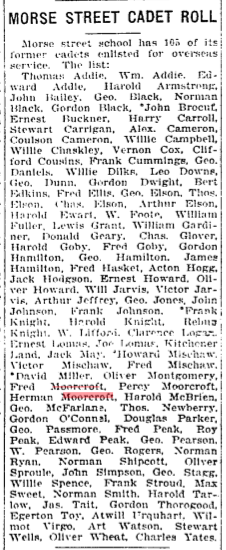
I'll close with these two clippings from the Toronto Star in 1917. The Morse Street and Leslie Street Schools remember the Moorecroft boys and so do we on Remembrance Day 100 years later.