Wednesday, 6 September 2023

My family was German - what the heck were they doing in Ukraine?


Distance, expense and finally the pandemic and war have prevented me from visiting my grandfather’s ancestral village of Landestreu, which was located in Eastern Europe in what was once Galicia. Luckily, I came across Andriy Dorosh, owner of Dorosh Heritage Tours and Ancestry Research based in Lviv Ukraine. Andriy and his team were able to visit Landestreu and produce a wonderful video tour of the village which is now known as Zelenyi Yar, Ivano-Frankivsk Oblast, Ukraine. You can visit my You Tube channel to see the video here:


Of course, that raises the million dollar question: my grandfather Jacob Besler and his family were German speaking Lutherans. How the heck did they end up in what is now the western part of Ukraine? Here’s a quick history lesson that explains it all!


Our family originally came from the tiny village of Biedesheim located in the Rhineland-Palatinate area of Germany. Approximately 650 people live there today and there probably weren’t many more in the 1700s. Though the region contained good farming land, the region was impoverished due to frequent wars with nearby France. Many Palatinates left for North America in the early part of the 18th century. Our family chose a different route.


Meyers Gazetteer

In the late 1700s the Hapsburgs, led by Empress Maria Theresa, ruled the powerful Austrian-Hungarian empire. Austria, along with Prussia and Russia, wanted to solidify its position in Eastern Europe. This led to the partitioning of Poland. In the first partition in 1772, Austria took a piece of Poland known as Galicia. This part of the world had good farm land but was sparsely populated. The Empress tried to encourage her Austrian subjects to move to Galicia, hoping that good Catholic merchants and artisans would settle there. Very few took her up on the offer. After her death, her son Joseph II took a different approach. In 1781 Joseph opened up settlement in Galicia to German Protestant farmers. Potential settlers were offered tax exemption, exemption from military service and freedom of religion. Hoping for a better life, about 14,000 Germans took the offer and decided to emigrate to Galicia. About 1/3 of these people came from the Palatinate. Immigration to Galicia was boosted by the American Revolution which had stopped travel to North America.

Baptism of Johann Konrad Besler 1750 archion.de

The earliest record I have from Biedesheim is the marriage of my 5x Great grandparents Michael Besler and Margaretha Elisabeth Knickel on 7 October 1738. My 4x Great grandfather Johann Konrad Besler was born on 15 March 1750 in Biedesheim (see record above). He married Maria Katharina Vetter on 3 January 1773. Their first three children Philip Heinrich, Johann Heinrich (our 3x Great grandfather) and Susanna Anna Margaretha were born in Biedesheim in 1773, 1775 and 1779. Shortly afterwards the family packed up for the moved to Galicia.


This map shows the current route from Biedesheim to Landestreu in Galicia. By car with paved highways the journey takes a good 16 hours. Imagine the journey in a horse drawn cart with three young children. The full journey in 1783 took many weeks. First they travelled from Biedesheim to Ulm where they would have boarded a riverboat that took them along the Danube to Vienna. From there they would have joined a caravan consisting of other settlers and government officials bringing carts loaded with supplies. The Beslers made it, arriving as one of the founding families in their village. 


List of original settlers of Landestreu familysearch,org

Support was provided by the Austrian government in the form of food, accommodation, livestock and household goods. Land was confiscated from Polish kings and monasteries and turned into farms. Most of our ancestors described themselves as Kolonist or Grundwirt (landowner) though there were blacksmiths, millers and teachers in the mix. The village was named Landestreu -  true land in German. The village remained almost exclusively German speaking and Protestant.


As this map shows the village was laid out as a parallel two line row settlement. A church was soon built. Farming was good - orchards were plentiful and Landestreu was the only German village in Galicia to have a water supply. In addition to the fresh water there was a salt water spring and a bell foundry. As the settlers prospered many children were born and many survived. As a result many young men were not able to find land to farm when they came of age. In our grandfather’s case, he had two older brothers and his prospects were poor. This led to his decision to emigrate to Canada in 1902. This turned out to be a wise decision. You can read more about his journey to Canada here.


Everything soon changed. After World War One Galicia was returned to Poland. I noticed that church records began to be written in Polish instead of German. The German population was resented by their Polish neighbours. The village was renamed Mazurówka. In 1939 Galicia was divided between Poland and Russia due to the Molotov Ribbentrop agreement. The Eastern section where the Beslers lived was now controlled by the USSR. The German population was encouraged to relocate closer to the homeland under a program called Heim ins Reich. The remaining Beslers left their home in Landestreu to be resettled on farms in Poland that had been seized from their Polish owners. You can read about their experiences here. Those who survived the war probably ended up in Germany but I have no idea where.

From Der Treck der Volksdeutschen

The village of Landestreu was resettled by Ukrainians like the gentlemen interviewed in the video. It’s sad that nothing really remains of my grandfather’s village but the video gives a good flavour for life in the village. The gentleman in the video lives in the house of the former Jacob Haas, house #6 on the map. My family lived in house #7, right next door. I can imagine my grandfather walking down the main street of the village, until he was 18 and left for Canada. You can read about his journey in this earlier post here and I have a new post to follow with more information on his trip.

Wednesday, 12 July 2023

Adventures in the 1931 Census Part 1: Those Who Were Where They Were Supposed to Be

June 1st 2023 was a day of great excitement in the home of many a genealogist, including mine. It was the day the 1931 Census was released! I jumped right in, ready to browse away. I had particular goals with this census release as it marked the first appearance of both of my parents.

Let’s start with my mom. My grandfather arrived in Canada in 1902 and headed directly for Saskatchewan and what soon became the family farm: Section 24, Township 25, Range 30, West of the 1st Meridian, Calder. I found him there in the 1906, 1911, 1916, 1921 and 1926 censuses with his growing family. I was disappointed that the 1926 census was taken on June 1st as my mother was born in September, just missing out on her first appearance! Though I am appreciative that the decision was made to add the additional western censuses on the ‘6’s’.

Library and Archives Canada Seventh Census of Canada 1931

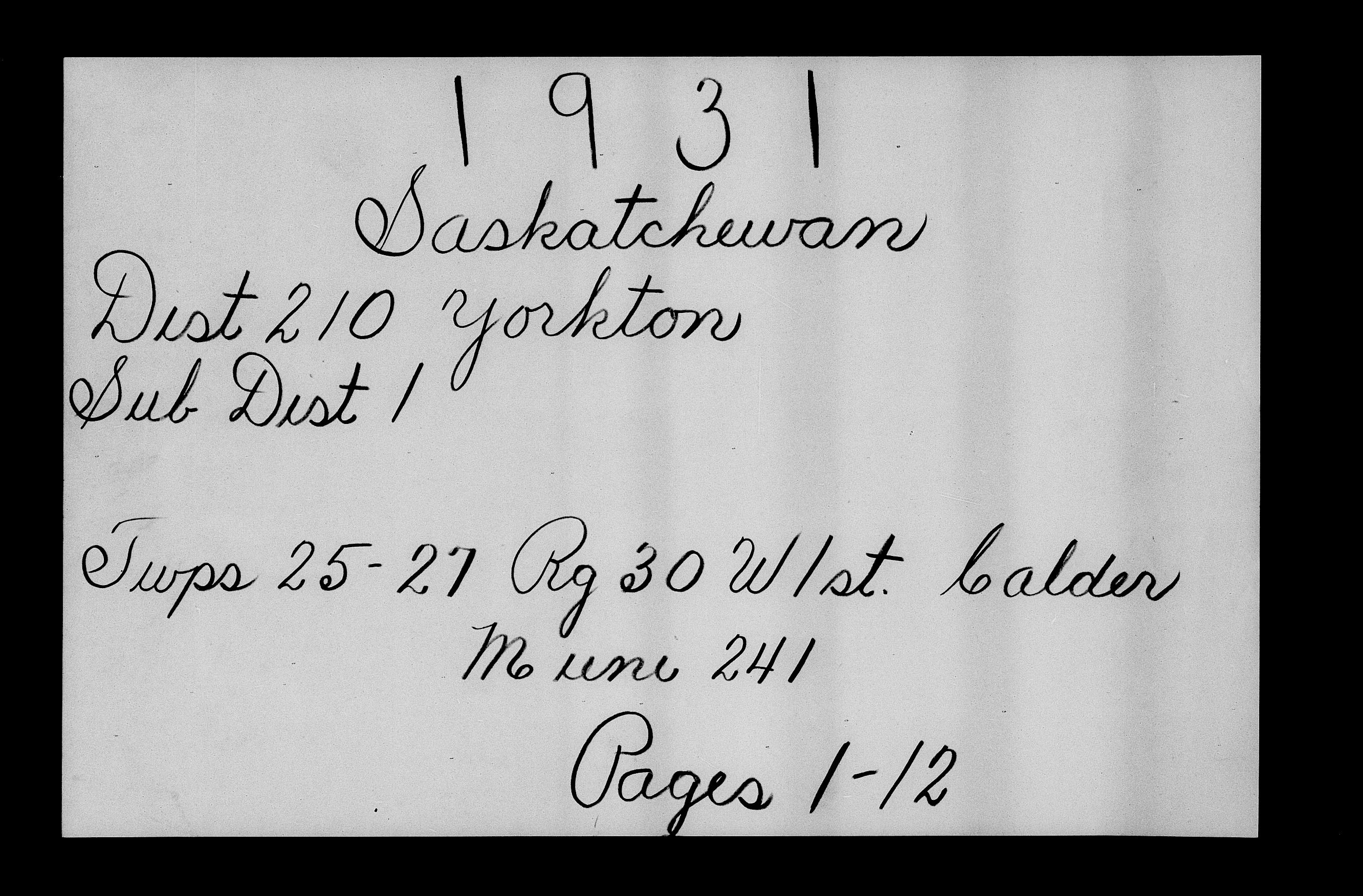
Many people experienced great levels of frustration on the first day of the release due to the huge demand for the records. But for some reason I was easily able to find the record I wanted (though my luck disappeared for the rest of the day). Calder was a sub-district in the district of Yorkton in the 1926 census so I pulled up District 210 Yorkton, Sub district 1 Twps 25-27., Rg 30 W 1st Calder Muni 241. Hmm, this sounds familiar! And just like that there they were, surrounded by family members by the name of Faustmann and Baumung. 


Library and Archives Canada Seventh Census of Canada 1931 Yorkton Calder Saskatchewan


It was fun showing my mother her family. Not many people can say they appear on this census.


My grandmother’s two younger sisters were nearby - Carolena and her husband Ferdinand Mundt farmed in a neigbouring section and Christina and her husband John Schneider lived in the thriving village of MacNutt. 


The village’s census is populated with teachers, merchants, cooks, garage repair men, the postmaster and the pastor. My great grandfather is still employed in running his shoe repair shop. It’s interesting to note that the census in the village was completed on June 2 and 3. it likely took a fair amount of time to visit all the neighbourhood farms on June 1 leaving no time for the rest of the area population.


Library and Archives Canada Seventh Census of Canada 1931 Melville MacNutt Village

Downtown MacNutt where my great-grandfather's shop and residence was located, in 2019

The next day, June 2, I was able to find my father and his family. However,  there are a few twists to their story. We last saw the Brooks family in Toronto in 1922 at the time of my father’s birth. You can read that story here. I knew that the family left Toronto to reside in Brantford and Owen Sound based on correspondence that I found in my grandmother’s possession. I did a bit of research to find out why they moved and when. The City of Toronto directories showed the family living on Sparkhall Avenue until 1929. Bill had changed jobs leaving his position at the John Hillock Co and moving to the E L Ruddy Company which was located at 317 Spadina Avenue. At both companies he was a salesman. The Hillock company was no longer listed in the 1928 directory so it may have ceased operations leading to a change in employment. 


Brantford Refrigerators by Ruddy 1930 Toronto Public Library Digital Archives

I was able to find some information about the Ruddy Company.  It was listed in the Toronto directory through 1931 but the head office was always located in Brantford. A 1930 prospectus described the company as “The Largest Refrigerator Manufacturers in the British Empire”, proudly owned and operated by Canadians. Apparently "Our employees are all Britishers, many of whom came out from the British Isles, the rest being Canadians of British descent"!!. A selling feature at that time I suppose. Apparently the refrigerator would be mounted in the wall of the house so the ice chamber could be accessed from the outside by the ice man, though most models could be converted to electricity. The Toronto Public Library’s digital archives contained a number of brochures produced by the company.


Brantford Refrigerators by Ruddy Toronto Public Library Digital Archives

Vernon City Directory Brantford 1932 FamilySearch


I had luck finding the family in the Brantford City Directory. In 1930 and 1931 the family resided at 278 Marlborough Street with Bill listed as a clerk at the Ruddy Mfg Co. 


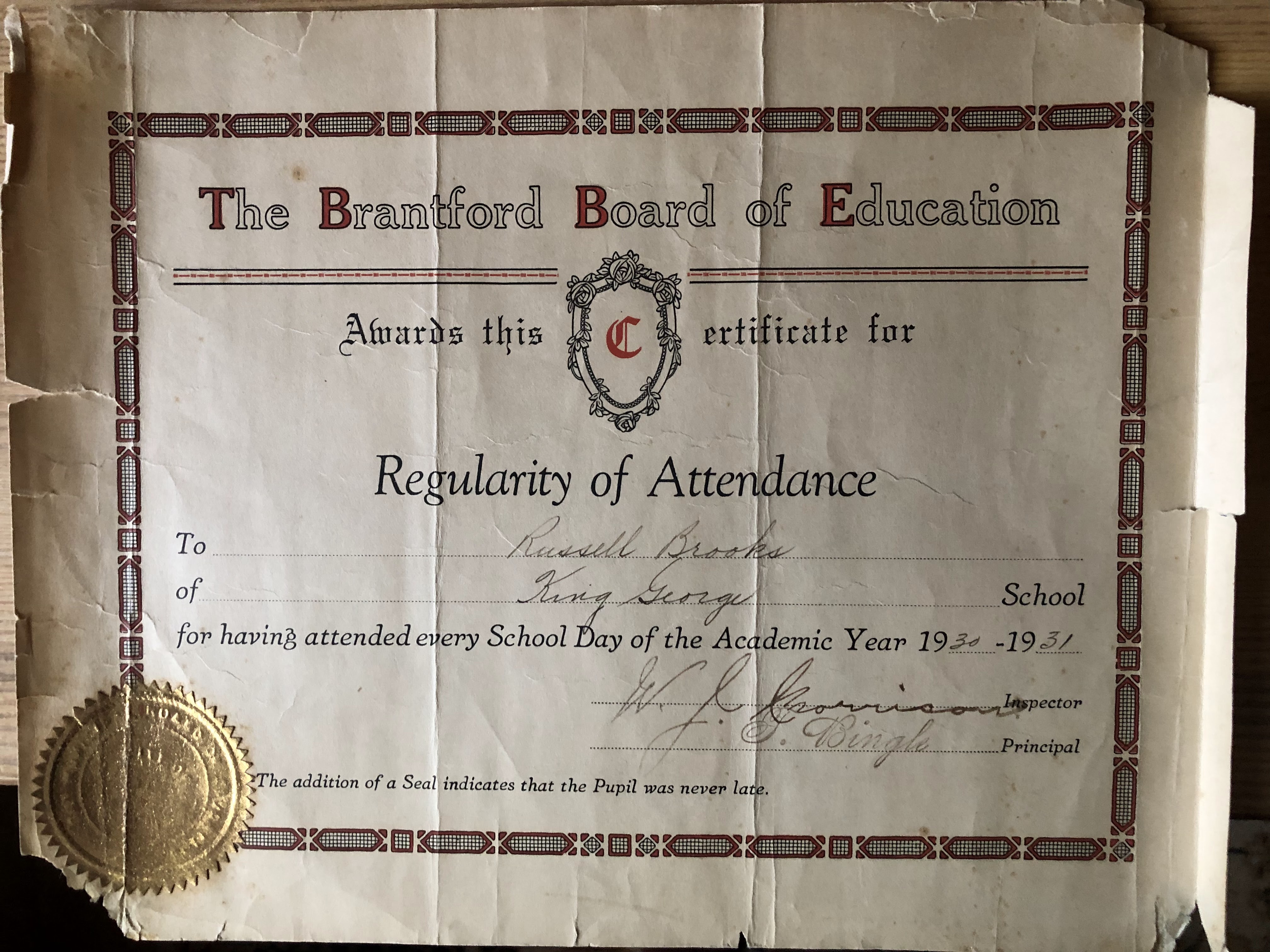
In the 1932 and 1933 directory the family lived at 154 Elgin Street. The Ruddy plant was located on Elgin Street (the building is long gone) so Bill would have been able to walk to work. The kids settled in,  attending King George School, where Russ had perfect attendance in the 1930-31 school year (and was never late!).


Bill is listed as an estimator of kitchen equipment. I imagine he took measurements in preparation for the installation of the fridge. He made the princely sum of $1,500 a year, worth about $24,838.97 in today’s dollars. The Brooks family paid $30/month to rent a brick home with 6 rooms - this works out to less than $500/month in today’s money for a nice looking two story home, comparable to the Sparkhall property. Also, they were the only family I located in the 1931 census that owned a radio. 

Library and Archives Canada Seventh Census of Canada 1931 Brantford City Ward 3


The family was found in the 1933 Brantford Directory but they moved on that year. It’s not clear if the move was voluntary or not but Bill was next employed by the Eureka Refrigerator Company in Owen Sound in 1933. Shortly after he lost his job and the family returned to Toronto. Only the 1938 Owen Sound directory was available so I do not have their address for their residence in that town. In 1935 they had returned to Toronto and were listed on the voter’s list at 177 Queensdale Avenue East York. Bill was able to find work with the Town of East York and he and Gertie remained there for the rest of their lives.


Finally, I was able to find the rest of the Brooks family in Scarborough. It was interesting to see that John Brooks senior was actually the enumerator for Malvern Village, I recognized his signature from correspondence I have. As a lifelong Scarborough resident he no doubt knew everyone in the vicinity and enjoyed chatting as he completed his returns. Son John and his family lived on the same property and helped with the farm; son George lived nearby.


Library and Archives Canada Seventh Census of Canada 1931York South Malvern Village


So the Brooks and Beslers cooperated and were where they were supposed to be. But not all my ancestors were so cooperative. Part II will follow - the elusive hidden Kingswells.

Tuesday, 16 August 2022

August 17th 1922


Toronto Daily Star 
Thursday August 17
1922
Toronto Public Library

The morning of August 17 1922 dawned warm and sunny in the Brooks household on 100 Sparkhall Avenue. It was going to be another hot one, which was to be expected in August in Toronto. The Toronto Star’s 5 o’clock edition noted a temperature of 78 degrees, cooler than the 93 degree high the day before when a “coat today felt like a woollen blanket” and it felt “as if Toronto were shifting towards the Sahara desert”. The thunderstorm on the 16th had cooled the city down to more pleasant temperatures.

This picture of my grandparents was taken in the early 1920s. Before they were married my grandfather William Thomas "Bill" Brooks had resided in a boarding house at 88 Main Street, and later 44 River Street. Both these residences no longer exist.
Might's City of Toronto Directory 1922, archive.org
Both provided easy access to the streetcar line taking him to his place of employment George Street downtown. My grandmother Gertrude Maud "Gertie" Kingswell boarded at 29 Saulter Street (now a park) and took the Queen car down to her job as a stenographer at Eaton's. Her younger sister Chrissie worked alongside her older sister at Eaton's as a packer.
Might's Greater Toronto City Directory, 1920, archive.org


Might's City of Toronto Directory 1922, archive.org
Downtown Toronto 1920s. City of Toronto Archives
Gertie had moved back to her parents' home on 471 Queen Street East shortly before her marriage. The couple were married on June 7th 1921 in her parents’ living room by Reverend George I.B. Johnson of St. Saviour’s Anglican church. Home marriages were still popular in the 1920s but probably chosen in this case due to the difference in religions - Gertie’s family were strict Anglicans and Bill's were staunch Presbyterians. Bill’s family remained in Scarborough but Gertie likely wished to be close to her family on Queen Street (currently an empty lot). The house on Sparkhall Avenue seemed to be a perfect choice.

This is a picture of the house today. It's a lovely tree lined street busy with moms with their babies and dog lovers heading to the park with their pups


I was surprised at how quickly the couple purchased a home, especially as the cost would have been managed on one salary. Mortgages would have been secured from the bank at a rate in the 6% range, and according to the FSCO (Financial Services Commission of Ontario) website only monthly interest was paid on the loan while the borrower saved towards repayment of the original sum in full. This practice would lead many borrowers to financial ruin in the 1930s, including the Brooks. However, the 1921 census showed that 46% of residents of Toronto owned their home so many took advantage of the opportunity. 

The 1920s were indeed roaring in Toronto. The home was new when Bill and Gertie purchase it and according to the 1922 Toronto Assessment Roll was assessed at $1,000 and the land at $560. 


City of Toronto Assessment Roll, Ward No. 1, Div. No 3, page 119, May 20 1922


Toronto Globe, July 9 1921


In 1922 Bill worked as a Purchasing Agent and Timekeeper for John Hillock and Company, Refrigeration Manufacturers, after starting in the shipping department. A timekeeper kept track of hours worked by employees for payroll purposes. Hopefully the Brooks received an employee discount that helped them purchase this fine Arctic Refrigerator, one of Hillock's finest products! Bill likely earned a respectable $1,500/yr according to the 1921 census.


Located in the Riverdale area of Toronto, Sparkhall Avenue runs between Broadview and Logan Avenues. There were lots of activities available in the area for a young couple in the early 1920s. Riverdale Park was the perfect location for strolls, picnics and baseball games.

Riverdale Park 1922, City of Toronto Archives

The Riverdale Zoo had an astonishing number of exotic animals for all to marvel at.
Toronto Zoo, 1926, City of Toronto Archives

At the other end of Sparkhall there was Withrow Park with an outdoor skating rink. There were shops and services within an easy walking distance. The amazing Sunnyside Pavilion had opened earlier that year and would be a fun place to bathe and dance the night away. The Star on August 15th noted that “ Sunnyside in the west and the beaches in the east proved the most attractive spots to citizens. The former was simply crowded last night. As one humorist put it, there are so many automobiles flashing by at Sunnyside that there is bound to be a breeze”. 

Sunnyside 1922, Toronto Public Library digital archives

Center Island was an easy ferry ride away. And later in August the CNE would open with fun in the midway and tasty treats in the Pure Foods Building. Bill would likely have visited on Warriors Day to march with fellow World War One veterans and enjoy free admission to the park.

Warriors' Day 1922, City of Toronto Archives

It had been a hot few weeks and summer activities would have beckoned to Toronto residents. But on August 17 1922 Bill and Gertie had other matters to think about. Gertie would have resigned her position at Eaton’s at the time of her marriage as was the custom in the day. It would have been expected that she remain at home to manage the household. The Eaton’s catalogue of the time would have provided all the best supplies for a 1920s home and it was an easy car ride down to the store on Queen Street to shop. 

Eaton's Fall and Winter Catalogue 1920-21, archive.org

All that was needed to complete the home was a family. Gertie came from a family of 8 children that survived infancy, a large family for the time. According to the 1921 census the average family size was 2.35. Bill had only two brothers. This was a small family given that the family farmed and would have needed the help. Bill had no interest in the family farm and moved into the city as soon as he could, as did his brother George, leaving the middle brother John to take over the Agincourt farm.


The families were close and the young couple likely entertained at home. Gertie was a talented musician and loved to play the Heintzman piano that would have had a place of honour in the home’s living room. She also loved to read. But there would be no time for any of these entertainments today. For today Gertie would give birth to her first child. 


The birth certificate doesn’t give the time of the birth and for some reason I never thought to ask my dad when he was born. Given the heat of the day I hope it was early! Hospital births were becoming more common in 1922. There was a hospital in the area but the Riverdale Hospital was restricted to patients suffering from communicable diseases, such as tuberculosis, and was known as the Isolation Hospital. Toronto East General was not built until 1929. So Gertie gave birth at home, attended by Dr. Roy Belfry whose office was located around the corner on Broadview in a fine home that still stands today. Her mom Fanny likely was also there to help her daughter through her first labour and perhaps one or more of her sisters.


I found this birth announcement in my grandmother’s papers. It was probably clipped from the Toronto Telegram which was my grandparents’ newspaper of choice given its Conservative slant. Unfortunately the Telegram hasn’t been digitized so I wasn’t able to produce a better copy but I did what I could to minimize the stains. Unfortunately neither the Star nor the Globe had a notification.


He was cute as a button and his parents were obviously pleased to have their first son. Gordon Russell Brooks was the first grandchild for John Andrew Brooks and Martha Walker. He was the fifth grandchild for Charles Kingswell and Frances Mary Wilkes. In the future there would be many Kingswell and Brooks cousins to visit and play with. Russ was joined in 1925 by his beloved brother Mel. My dad died on 29 September 1992 just past his 70th birthday. I miss him every day. Happy 100th birthday Daddy!


Friday, 25 February 2022

Branching Out: The Beslers of Landestreu

Heimat Galizien im Bild,  Hilfskomitee der Galiziendeutschen 

I've been researching my grandfather’s family in Galicia lately which is a perfect lead in for this month’s topic. The picture above is Landestreu, Galicia. My grandfather Jacob Besler left his home there in 1902 at the age of 18 to emigrate to Canada. He never returned to his homeland and never again saw most of his family. I don’t know if he exchanged letters with his family. If he did the letters have not survived. He was busy raising his own family and trying to survive in the harsh climate of Saskatchewan but he must have thought of his parents and siblings and wondered what became of them. Here’s what I discovered.


My grandfather was the 8th of 10 children born to Johann Heinrich Besler and Maria Barbara Baumung as well as the youngest son. Large families were common in the village of Landestreu and land was scarce. Most of the inhabitants of the village were described as Grundwirts or Landwirts which translates to farmer in English. A promising future was not in store for young Jacob so his decision to emigrate to Canada made sense. You can read my earlier blog post about his journey here


Survival into adulthood was difficult. Many children in these large families did not make it past their first year. Heinrich and Barbara’s first child Johann Christian was born in 1868. Their next four children died young: Katharina Elisabeth born in 1871 lived 2 1/2 months and died of Schwäche (weakness), Johann Philipp born in 1872 lived 8 months and died of Zahnen (teething), Jakob Adolf born in 1874 lived to 6 1/2 and died of Auszehrung (weakness/emaciation, possibly tuberculosis) and Maria Katharina born in 1876 lived just 3 weeks before succumbing to fraise (infant spasms). In other families masern (measles), keuchhusten (whooping cough) and rachitis (rickets) claimed many children, causes of infant mortality that we don’t see any more. Luckily for the Beslers their last 5 children were healthy and lived well into adulthood.


Heinrich died on 28 Nov 1912 at the age of 69 from some sort of cranial issue, perhaps a stroke? (Gehirnenig). Barbara died on 26 Oct 1920 at the age of 73 of Alterschwäche (old age). When Jacob married in 1915 he noted that both his parents were dead which leads me to believe that he did not receive letters from his family once he settled in Canada. Perhaps mail wasn’t coming through during WWI leading him to guess that they were dead. 


Record book of deaths. Ugartsthal-Landestreu commune agad.gov.pl

Once the senior Beslers died their oldest son Christian took over the family residence House #7. He had married Eleonora Löwenberger in 1895 and was listed as a Grundwirt or Landmann.


Record book of Weddings, Ugartsthal-Landestreu commune, agad.gov.pl


The couple had 8 children that I know of. I don’t know when or where Christian or Eleonora died nor the fate of 4 of their children.  Fred and his wife Minnie emigrated to Canada, settling in Winnipeg. My mother was close to their daughter Eleanor. Minnie and her husband Wilhelm Schick settled in Toronto. John settled in Toronto as well. 


I wasn’t able to determine the fate of Johann Georg Besler born in 1878. Perhaps he died young or moved to another village in Galicia.


Eleonora Besler married Johann Friedrich Lowenberger in 1896 and had 9 children that I know of. Friedrich died in 1920 of the Spanish Flu, one of a number of relatives that succumbed to the deadly virus. I don’t know of Eleanor’s fate but she remained in Europe. Two of the 9 children emigrated to Canada: Fred and his wife Hedwig and George and his wife Irma settled in Toronto.


Katharina Besler married Johann Reihl in 1913. They had one child that I am aware of. I do not know their fate.


Finally Dorothea Besler married Rudolf Kandel in 1906. This is the only sibling that my grandfather even saw again. First Rudy then Dorothy emigrated to Canada in 1912 with their two eldest children. They settled in Brandon Manitoba. My mother has fond memories of her Aunt Dorothy and stayed in touch with her cousins even when she moved to Toronto.


Hamburg Passenger Lists 1850-1934, ancestry.ca

Jacob and Dorothy were the lucky ones as they left Galicia before the first World War. The inhabitants suffered greatly but many residents remained even after the territory was divided after the War. Things improved in the inter war years but little did they know that the worst was yet to come in the form of World War Two. 


In 1939 Poland was divided between Germany and the Soviet Union as a result of the Ribbentrop-Molotov agreement. One of the terms of this agreement was that those of German ethnic background were to be relocated from the Russian area to the German area. So the residents of Landestreu had to leave; likely they did not want to stay in Russian controlled territories though it was a difficult decision to leave their homeland. Always particular, the Nazis created Einwandererzentralstelle forms, translated as Immigration Centre documents. The documents were stored in the Berlin Document Centre and captured by the American army at the end of the war. Starting in 1939 hundreds of thousands of people were recorded as they packed up to leave their homes. 


In English Landestreu means “faithful land” and the Beslers were indeed faithful to their land. The family moved to Landestreu from Biedesheim in the Rheinland Palatinate in the late 1700s. The village was founded in 1783 and my 4x great grandfather Konrad Besler was listed on the first census of residents taken in 1788.   


Ludwig Schneider, Das Kolonisationswert Josefs II in Galizien


This was the only home they had ever known. Despite speaking German and worshipping in the Lutheran church their ties to German were very weak. They were moved to camps in German controlled territories in Poland and often into farms that were cleared of their original Polish inhabitants. The intent was that they would produce food and provide other services to support Germany and the Nazi war machine. 


The Galizien German Descendants has indexed many of the EWZ forms relating to Galizien residents.  The forms from 1940-1941 are available on Family Search to view. I was not able to find my great Uncles and Aunts though I did find a variety of more distant cousins. Then, by chance I realized I was looking at one of my mother’s cousins. Her record had not been indexed and I found it as I browsed the records looking for someone else.


Eleonora Besler was born on 13 May 1900, the second daughter and third child to Johann Christian Besler and Eleonora Löwenberger. Her birth record is not yet available but I located the record of her marriage to Jakob Weiss on 15 February 1920. 


Record book of Weddings, Ugartsthal-Landestreu commune, agad.gov.pl


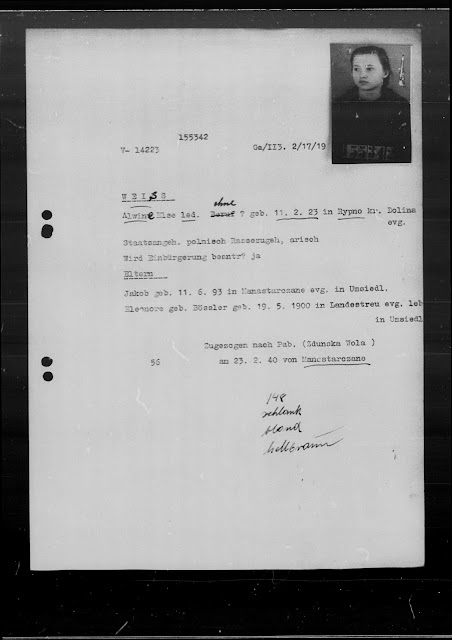
After her marriage she lived a quiet life in Landestreu, until she presented herself and her 17 year old daughter Alwine to authorities in Pabianice on 23 February 1940. They had been moved from their home in Landestreu to nearby Manasterczany then to Zdunska Wola, near Łodz for processing. Today this is a 10 hour drive. Eleonora and Alwine likely spent many more hours on a train to get to the relocation camp. The photos are poignant. They look apprehensive and rightly so. They were headed to an unknown future in a new town. They were separated from Jakob who had apparently already been relocated. The form notes that they are of Polish nationality, the Evangelisch (Lutheran) religion and of the Aryan race (not likely that anyone would say otherwise to this question!). They both wished to apply for German citizenship. At the bottom a physical description is added by hand. Eleonora is 156 cm tall, slim with blond hair and blue eyes. Alwine is 148 cm tall, slim with blond hair and light brown eyes.


Stamblätter 1940-1941, Deutschland Einwandererzentralstelle FamilySearch.org    


Their post-war fate is unknown but likely tragic given their location in the path of the advancing Soviet army.  It was a sad end to what began as hopeful emigration and emphasizes how fortuitous my grandfather’s decision to emigrate was.  


To conclude here is a German newsreel clip from early in 1940 showing Galician emigrants in the course of their journey. 


No names are provided but likely some of the people in this film were my family members. The enthusiastic greeting by the Nazis was no doubt put on for the camera - I’ve seen anecdotal evidence that their possessions were stolen and compensation for the loss of their lands never provided. Today Landestreu is in western Ukraine and has been renamed Zelenyi Yar. The fate of this area of the world is once again uncertain.