Sunday, 28 October 2018

Gertrude Maude Kingswell - A woman's life told by her books

October is Women's History Month, as well as Family History month. That makes it the perfect time to write about my grandmother Gertrude Maude Kingswell Brooks. Gertie started me on my genealogy journey by sharing stories of her family. Here I will share her story.

I inherited from Gertie a pile of amazing vintage books that she collected at various stages in her life. In this post I will use her books to tell her story.

Gertie was born in Kingston Ontario on August 22nd 1899. I've written about her family before click here to read their story. This is the earliest picture of my grandmother. 


Her mom looks not bad for a woman who just gave birth to her 9th child.


The Kingswells initially lived in an area of Kingston known as Portsmouth. The Kingston Penitentiary is located in the same part of town.


The Kingswells were staunch Anglicans and Gertie attended Sunday School at St. John's Church in Portsmouth. This is the earliest book in her collection, a hymn book.


I don't know which primary school she attended but I found this picture in her collection. It was captioned Portsmouth 1910 on the back. Gertie is standing second from the left.


The next book in Gertie's collection was a gift from her mother to Gertie and her sister Chrissie. They were the youngest of the Kingswell brood and clearly in need of some guidance to become proper young ladies! (Chrissie on the left, Gertie on the right, age about 9 and 14)


The family had moved to 32B Clergy Street and Gertie attended nearby Kingston Collegiate Institute.She clearly enjoyed her English classes, keeping some of the classic novels she studied.


The Kingswell family lived near Queens University and Gertie would have loved to have attended Queens. Her collection included this book which spoke to her love of music and desire to have a University education. 


Unfortunately the cost of university tuition was above the means of a lower income family and it still wasn't the norm for women to seek higher education. Instead Gertie attended Kingston Business College and developed skills that led her to work as a stenographer.


Before meeting and marrying my grandfather Gertie had several beaux. She would often remark to the family that she could have married a doctor, no doubt after an argument with her husband! Some of her book collections had intriguing inscriptions. 


These mystery men can probably be seen in the many photos from Gertie's collection that remain unidentified.


After marriage Gertie still took time out to read. This popular novel was in her collection.


Gertie was a doting mother to her two boys. Both my dad and my uncle served overseas during World War Two. My dad sent this Bible home in 1944 and it had a special place in her collection.


I don't remember seeing my grandmother with a book in her hand and there were no later books in her collection. However, I love this photo of Gertie and me taken on my 2nd birthday. I'm not sure what book she is reading to me, but I still have the second book in my own collection!


My grandmother passed away in 1985. I have a special memory of calling her from England when I made my first trip there in 1982. I had visited the Isle of Wight and saw the church where her parents were married in 1883. It was exciting sharing some of my early genealogical discoveries with the person who started me off. She'd be impressed with what I've found since and I wish she was here to share my finds with.


Sunday, 23 September 2018

Scarborough School Days

When someone thinks of Scarborough Ontario today they envision subdivisions and strip plazas. However, Scarborough began as a rural farming community and remained that way well into the 20th Century, It was definitely rural when my grandfather William Thomas Brooks and his brothers were growing up early in the 1900s.


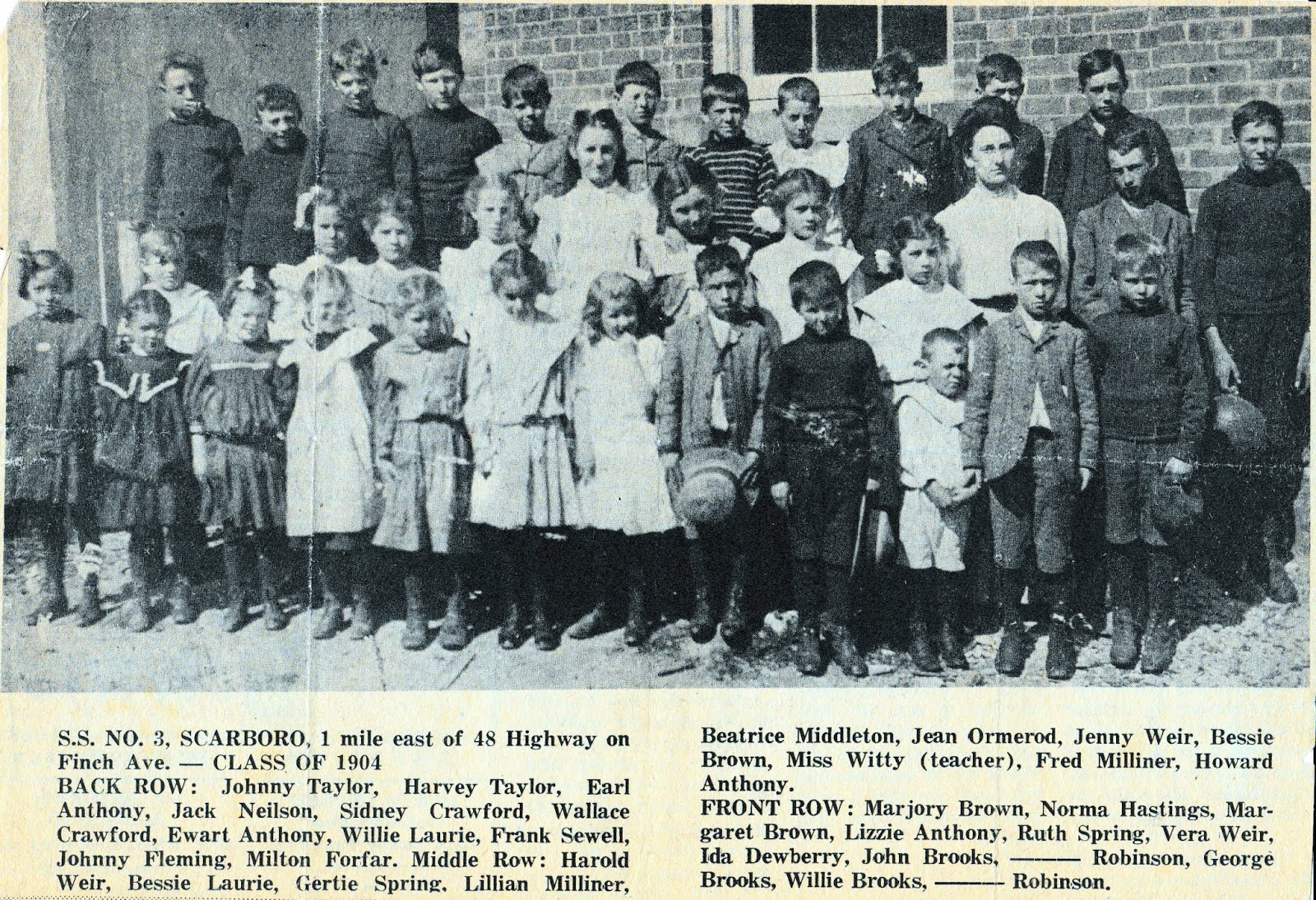
Here they are with their classmates in 1906. But more on this picture later. The Brooks family resided on a farm located in the community of Brown's Corners, one of many small communities that no longer exist. Brown's Corners was located at the corner of Finch Avenue East and Markham Road, named after David Brown who ran the post office on the southwest corner.  

Bill and his brothers John and George attended S.S. #3, also known has C. H. Berner School. The school was located at the corner of Finch Avenue East and Neilson Road and was a 1 km walk from the family farm. The school was opened in 1872, replacing an earlier school that was located on the same site, first established in 1847. You can see the SCH noted in the middle of this map.


Historical Atlas of York County Ontario, 1878

S.S. #3 was your classic one room schoolhouse, though it later received an addition. Here is a photo taken in 1896 at the time of Scarborough's Centenary celebration.


All grades were taught in the one room and about 30 students attended at any one time. I found this undated newspaper clipping in my grandparents' papers. The picture is also featured in the book published by Jean Little to commemorate the school's 100th anniversary in 1972. The photo in Jean's book did not identify any of the students but I was fortunate that the newspaper clipping did.


The clipping indicates this is the class of 1904, the book 1906. I think 1906 is the correct date as my great-uncle George was not born until 1901. So my grandfather, second from the right in the first row would have been 11. He is holding George's hand - he would have been 5 and John, 5th from the right would have been 9.

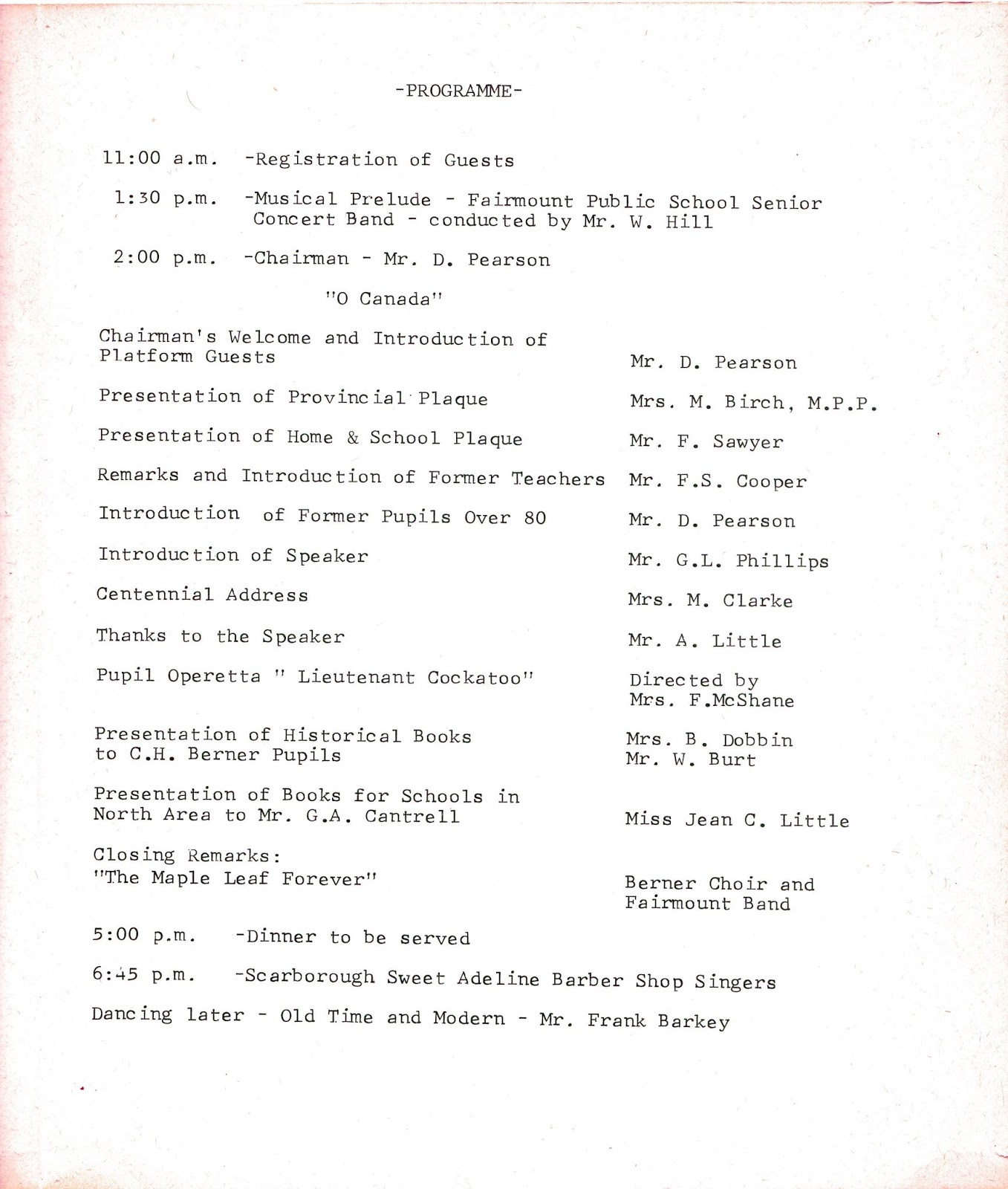
This school was important to the Brooks family, My great-grandfather was a trustee of S.S. #3 from 1909-1911My grandfather attended the 100 year anniversary celebrations in 1972. I found the program in his papers.


The school closed not long after this reunion. It still stands in its location at Finch and Neilson, now part of a private Christian school.


My grandfather would have been near the end of his formal education when he graduated from C.H.Berner as the school would have only gone to grade 8. The first high school in Scarborough, Scarborough High School (now R.H. King Academy), was not built until 1922. The Brooks boys would have returned to work with their father on the farm.

But Bill's quest for education didn't end. As I've written before he eventually became a bookkeeper. To achieve that position he moved to Toronto and returned to school to continue his education. He attended the Central Business College located in Riverdale at Jones and Gerrard. I don't know how long the program he took lasted but he did well as shown in this summary of his marks.


He completed his program in 1914, not long before he enlisted in the Canadian Expeditionary Forces and headed to France.

Among his prize possessions were these textbooks that he used in his studies. I love the ornate signatures. Handwriting is certainly a lost art!


I wonder how he would have done if he had a chance to attend university. Given the times, the Scarborough school boy did not too badly.

Sunday, 26 August 2018

Manitoba School Days

Everyone's heard the story that begins "When I was a child I had to walk 5 miles up hill through a snow storm to get to school" or something like that. Well, my mother has a story like that and it's true! She and her siblings had to walk about 5 km up and down hill and through a ravine and by a creek to get to school in another province! Here is a picture of my mom in front of the school - she's the girl to the far left, in front of her brother Art. He must be poking her or something, she looks terribly unhappy!
From the writer's collection
I've written before about my mother's family and how they settled in MacNutt Saskatchewan. They actually lived a fair distance out of town and could not easily get there on a regular basis. There was a school located in town but this was not the school that the Besler children attended. There was a much closer school located in Manitoba!

The following map shows where my grandfather's two sections were located and where the school was. You can see MacNutt on the map way to the south of the Besler property.
Created using lsdfinder.com
The children attended Cupar School No. 1633. The one room school house was built in 1911 and is located in what is today the Municipality of Roblin. Here is a photo taken by School Inspector R. J. MacKenzie, date unknown. I don't recognize anyone in the photo but it gives you a good look at the school itself.
Archives of Manitoba, School Inspectors Photos.
The Besler family walked from their farm to school and back every day. There were not real roads back then which made for a tough journey. My mother recalls a bear sighting one day when she was quite young - her older siblings took off and left her to fend for herself. Luckily she made it home in one piece! The teacher at the time was a Miss Campbell who was teased unmercifully by the farm boys - they called her Miss Camel and one day locked her in the outhouse (my uncle Art apparently was the instigator)

The school is still standing but has been turned into a private home. We were able to find it during our vacation this summer but no-one was around so we weren't able to get too close. Here's a picture I shot through the trees. The location is isolated now so I can only imagine how isolated it was back in the 1930s


The Beslers moved to Winnipeg in 1936 and my mother continued her education at Victory School located near their home in West Kildonan. This school was built after World War One and opened in 1920. Here's a picture from 1922.
Winnipeg Tribute, September 16 1922
Here's my mother and her classmates outside the school. She is 6th from the right in the second row. The second picture is from the pageant at this school, probably in her last year. She's fourth from the right in the second row.
From the writer's collection

And here's my mom visiting the school in 2012. We were able to go into the school but the school was drastically enlarged in 1950 and she really didn't recognize anything. The main door looks to be the same though!


In 1940 she graduated from Victory School - here's a notice from the Winnipeg Free Press on June 1st 1940 commemorating the occasion.
newspaperarchive.com
As the article note students from Victory School moved to Centennial School for Grade 10. Centennial School was built in 1913 and later became part of West Kildonan Collegiate. Unfortunately I was not able to get a picture before it was torn down but here is an undated picture showing what it looked like.
Source: A Historical Study of Public Education in West Kildonan to 1959 by Raymond Ronald Bailey, 1966
Later that year my mother's class was photographed for an article in the Winnipeg Free Press that ran on November 14th 1940. She still has a copy of this article showing the cooking and sewing skills being mastered. She is second from the right in the cooking photo. Answer to a bachelor's prayer indeed.
newspaperarchive.com
My mother only spent a brief time at Centennial School before she had to enter the work force but she remembers her school days fondly. She has never stopped learning and conveyed her love of reading (and sewing!) to my sister and I.

Thursday, 12 July 2018

The Glorious 12th - the Orange Lodge and my family

I inherited this picture from my dad after he died. I found it rolled up in a box of photos. You can see from the cracks on the paper that it had not been unrolled for some time.

From the writer's personal collection

In the middle are my grandfather Bill Brooks and my dad who had just had his third birthday. I know who and where (Kew Gardens in the Beach area of Toronto) but wasn't sure of the occasion. What was the RBP and who were these serious looking gentlemen? 

I knew my family were Orangemen and my sleuthing revealed that there was a connection. But first some background. The Loyal Orange Lodge was inspired by the July 12th 1690 victory of the Protestant William of Orange over the Catholic King James II at the Battle of the Boyne near Dublin in Ireland.

grandorangelodge.ca
The first Orange Lodge was founded in Northern Ireland about 100 years later to uphold the Protestant Ascendancy during another period of Protestant-Catholic strife. Its goal was to defend Protestant civil and religious liberties. The order spread to Scotland, primarily around Glasgow and then to Canada in the early 19th century. Most of the early members were Irish but many Scots and English also joined. And this is where my family comes into the story.

My great grandfather John Andrew Brooks was a staunch Tory and a staunch Orangeman. He belonged to the Malvern Lodge 3019 and I believe he was one of the founding members. At one point he was the Grand Master of the Lodge. 

              Toronto Telegram, date unknown

Unfortunately I wasn't able to find out much more about his involvement with the Lodge. Like many societies the Orange Order is somewhat secretive about their rules and operations. I found an interesting Catalogue of Orange Supplies that had paraphernalia for sale but no real explanation of what the goods were to be used for. 

Guess this is where the term "hoodwinked" came from.

Toronto Public Library "Catalogue of Orange Supplies"
Or you could order your own flag:

Toronto Public Library "Catalogue of Orange Supplies"

My grandfather followed his father into the Order, no doubt feeling that involvement would give him status and a step up in the world. This 1920 letter talks about his moving from a lodge in the Dufferin Bloor area to one closer to home in the East end.


From the writer's collection

Bill became quite involved in the Lodge and two of its brother organizations. There is even less information available about the other two orders but I do know you had to be a member of the Orange Lodge before you could join the other organizations. The first was the Royal Arch Purple. My grandfather had this handsome certificate. It's huge and I was only able to scan it in two pieces.


From the writer's collection

And the other organization he belonged to was the RBP that started my story: The Royal Black Preceptory. It appears that the other two orders were stepping stones to get to the RBP which was seen as a more dignified and religious group. It was interesting to note that my grandfather apparently reached the Red Cross Degree which was the highest level of the RBP.


From the writer's collection

The Catalogue of Orange Supplies had some interesting stuff for this group:

Toronto Public Library "Catalogue of Orange Supplies"

But the most interesting item in the Catalogue is this page which clears up helps clear up the mystery of the picture and an item that's been in my sister's possession for a number of years:


Toronto Public Library "Catalogue of Orange Supplies"

We just knew them as Grandpa's jewels but didn't really know what they meant. Here they are in the handsome case. He sprung for the higher level jewels in the "original and artistic design" to show he belonged to York Royal Black Preceptory No. 686 that met at the Ulster Temple at 214 Main Street on the 3rd Friday in every month


From the writer's collection

This organization was obviously very important to my grandfather as $15 was a lot of money in the 1920s/30s. It was interesting to read about these groups as I never thought of him as a religious person. Religion was an important component of the Orange Lodge and the other organizations but I think the fraternal and benevolent side was also important and clearly filled a place in men's lives in the 19th and 20th centuries in Toronto. As the Order declined in relevance and Lodges closed my grandfather didn't continue his membership though I can't say for sure when his involvement ended.

From the writer's collection
Today is the 12th of July. The Orangemen still march but the event is nowhere near as popular as it used to be. Thankfully the 12th is no longer the day for sectarian violence and riots (at least not in Canada). Their slogan today: "Civil and religious liberty for all, special privileges for none".