Monday, 9 April 2018

National Sibling Day

April 10th is National Sibling Day. Most people have siblings, though not as many as in earlier times. My 4x great-grandmother Elizabeth McKay Thomson was one of eleven siblings, all of whom survived to adulthood. She had nine children herself, and most of her siblings had families of the same size.

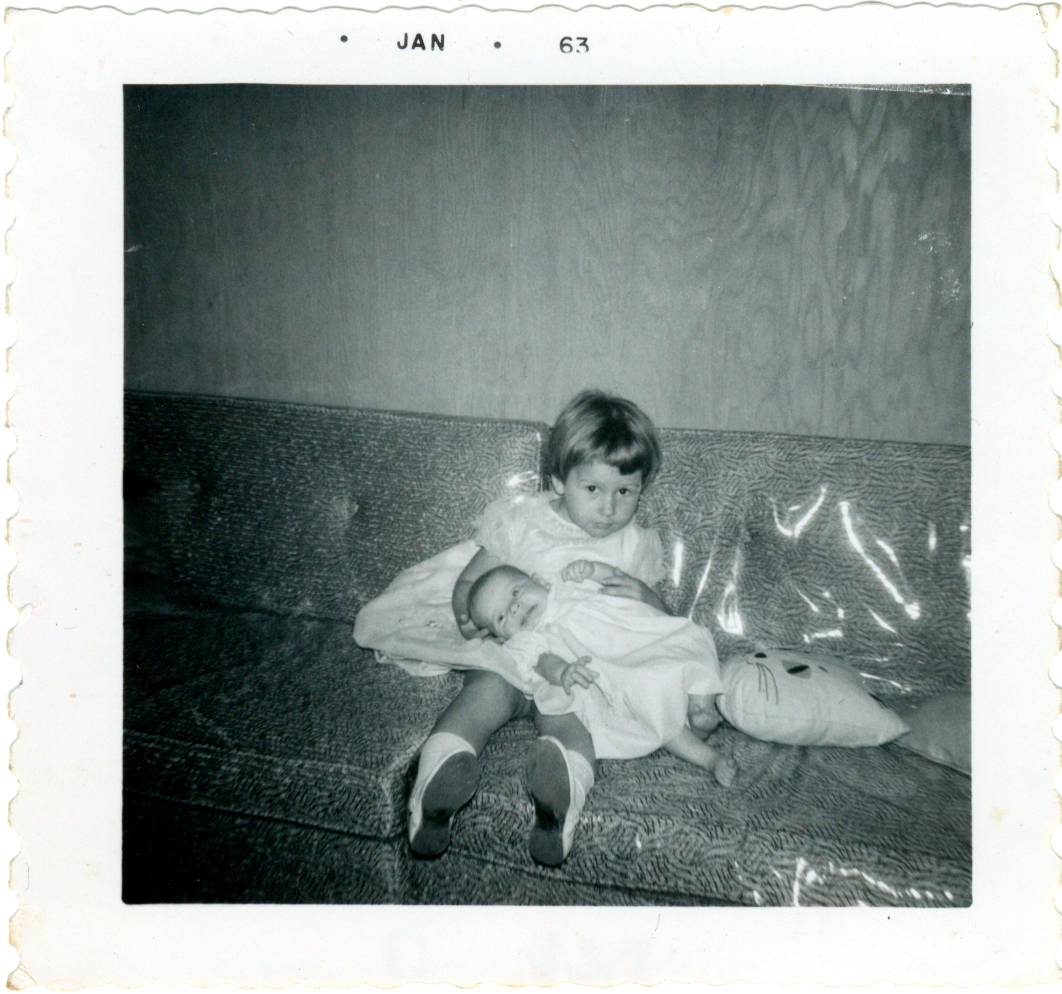
I have one younger sister. Here's a picture of us from a few years back - she's the little blonde:


She's ok though she insists I tried to kill her when she was a baby. My story is that I was just looking into the crib to see what they brought home when it tipped over. She survived.


My father liked to joke.


Speaking of my father, he also had a younger sibling. My dad and his brother Mel were close. They were two and a half years apart in age.


My dad on the left, my uncle on the right
Jones Falls, 1938
They remained close into adulthood. My mother recently shared a lovely story about the brothers. Upon his return from WWII my dad underwent major surgery on his leg which left him with a permanent limp. After his discharge from Sunnybrook Hospital he needed to use crutches for a period  of time. At the same time he had fulfilled his lifelong dream of attending the University of Toronto and studying music. Travelling from East York to downtown Toronto by streetcar on crutches would have been a nightmare. My uncle volunteered to drive my dad to class then pick him up later to bring   
him home. This would have been on top of holding down a full time job. 


My grandma Gertie was Russ and Mel's mother. She was one of twelve children, eight of whom survived to adulthood. The Kingswell clan was a close one. My grandmother's photo album is filled with pictures of her sisters and brothers. 


The family moved from Kingston to Toronto, and most of the family remained in the Toronto area. The exception was my great uncle Alf who moved to Buffalo. He was only a year older than Gertie and they remained close with many visits between the families over the years, even during war times. 


Gertie was also close with her younger sister Chrissie, the baby of the family. Chrissie spent lots of time with Gertie's family when the boys were young. My dad had fond memories of going to the movies with his aunt before the war. Gertie was close with her other two sisters Ollie and Liz as well.


So not a lot of heavy research in this post, just a bunch of fun pictures and memories of some of the siblings in my family.

Wednesday, 7 March 2018

The Matzke Women

March 8th is International Women's Day and March is International Women's History Month. When I hear those words I think of famous and noteworthy women, but I also think of the women in my family. Not a lot of fame but many noteworthy and interesting. Despite being just average folk I've been able to find some of my relatives in the newspaper and I'd like to share their stories in this month's post.

From the writer's collection
Here's a picture of some Matzke women - from left to right they are Josephine Faustman Matzke (my great-grandmother), Christina Matzke Schneider (my great-aunt), Iris Schneider Allard (my first cousin once removed) and Bonita Allard Reis (my second cousin). Before I get to the newspaper article some background on the family.

I've written before about the Matzke family and their long journey to Canada from Romania. The driving force behind this journey was Josephine. She was born on July 8th 1875 in Atmagea Romania, a small village located inland from the Black Sea on the east coast of Romania. Though born in Romania Josephine and her family were of German background and were staunch Lutherans. On February 1st 1894 Josephine married Franz Matzke from the nearby village of Tulcea. Franz had been raised a Roman Catholic but the couple was married in the Lutheran Church. Josephine was in charge from the start!


A young Josephine, from the writer's collection
Josephine had one sibling that I am aware of - her younger brother Karl. Karl had moved to Canada in 1906 and settled in the community of Landestreu in Saskatchewan. Landestreu was eventually renamed MacNutt. No doubt he suggested to his sister the she and her family join him in Canada, and eight years later they did.

The Matzke family - Carolina, Josephine, Christina, Jacobena and Franz 
Life was hard on the Canadian prairies. Franz tried farming but was unsuccessful. He ultimately started a shoe repair business in town. Meanwhile, Josephine managed the family. She was strict - there was no dancing or card playing allowed on Sundays. But her girls were lively and all married young - my grandmother Bena married in 1915 at the age of 17, my great-aunt Lena married in 1919 at the age of 16 and great-aunt Tina married in 1925 at the age of 16.

In 1936 my grandparents left their farm in MacNutt and moved to Winnipeg with their six children. Josephine and Franz followed. It must have been hard to leave behind their two younger daughters as they likely weren't able to visit too often. Lena and her husband Fred had three children, Tina and her husband John had six children.  

And that brings me to the newspaper article that I found. In earlier times newspapers were great sources of social information. I was searching the Winnipeg Free Press for my family and discovered this article dated July 19th 1944:


Courtesy of the Winnipeg Free Press

A visit from Saskatchewan was an exciting occasion for the Matzkes and also made for a great human interest story. The ages of the women make for a neat little fact and I think is a really cool article. You'll note that Tina's eldest daughter Iris continued the family tradition of marrying early and starting a family right away!

The picture may have been taken by the newspaper photographer and presented to Josephine but I don't know for sure. I do know that she treasured the photo and had it nicely framed. Unfortunately all the women in this picture have now passed away. On International Women's Day I'm remembering them and all my other female ancestors.


SaveSaveSaveSave

Tuesday, 13 February 2018

Bill and Gertie - A love story

In honour of Valentine’s Day my blog this month is the story of my paternal grandparents Bill and Gertie Brooks. When I was a child I never thought of my grandparents as young people meeting and falling in love. They were just, you know, old! Yet it happened!

William Thomas Brooks was born in Scarborough then moved to Toronto to begin his career as a bookkeeper. He spent 1916-1919 in England and France as a member of the Canadian Expeditionary Forces, returning to Toronto when he was demobilized (see my November 2016 blog for further details). The 1920 Toronto City Directory (prepared in 1919) showed him boarding at 64 Homewood Avenue.


Gertrude Maud Kingswell was born in Kingston Ontario. She spent her formative years living at 32B Clergy Street with her parents and 6 siblings. By 1917 her brothers Ernest and William had moved to Toronto. Gertrude had been working as a stenographer in Kingston. Her employer at the Oddfellows Association provided her with a glowing reference as she prepared to move in 1919. 


The 1920 Toronto City Directory shows her boarding at 29 Saulter Street with her sister Elizabeth and Elizabeth’s husband James Essex.


I have no idea how my grandparents met. They both lived in the east end of the city which was a start. Gertie was Anglican and Bill was Presbyterian so the likely didn't meet at church. Bill worked at John Hillock and Co on George Street, Gertie worked at Eaton’s on Yonge Street which was nearby. Maybe they met at a lunch counter? Maybe they were introduced by friends? Or they met at a dance? We'll never know.

What I do know is that by 1920 they were an item. I have a few mementos of their early days together. This postcard was sent by Bill from Wingham. Not sure why he was in Wingham - there is no family connection that I know of, maybe work? 


He also sent flowers. The card and some petals were carefully saved so the bouquet must have been important to her.


And a birthday card 

The 1921 census was taken on June 2nd 1921. Gertie was listed with her family living on 471 Queen Street East. I couldn't find Bill or his brothers anywhere in east Toronto or Scarborough. I like to think they were celebrating Bill 's upcoming marriage - Bill and Gertie were married on June 7th

Gertie carefully preserved some flowers from her wedding bouquet as well as her headdress. 


As you can see from the picture she was a flapper bride.


Bill and Gertie had a long marriage. We had a Golden Wedding anniversary party for them in June of 1971. I know they loved having this certificate signed by Bill Davis, as they were both staunch Tories.


Unfortunately, Bill's health began to decline as he entered his 80's. He resided in Sunnybrook Hospital's K Wing with other WW1 veterans for several years. Gertie made the trip every day to visit him and help him eat his lunch. It was a long bus ride from her apartment on Cosburn Avenue – I took the trip with her a few times. Bill’s Alzheimer’s grew progressively worse but Gertie continued with her visits. He likely did not know who exactly she was by the end of his life. Bill died on March 26 1981. In June of that year they would have been married 60 years. 


Gertie died on March 30th 1985 and was laid to rest in Highland Memory Gardens next to her husband of 59 years. Happy Valentine's Day to them both!


Tuesday, 30 January 2018

Elizabeth Cowie Nicholls - exhaustion from melancholia

Mental health has become a popular topic lately.  People suffering from depression and other issues are becoming less stigmatized that they used to be. But this is a fairly recent phenomenon. One hundred years ago things were very different.

Elizabeth Jane Cowie was born on 24 September 1869 to John Cowie and Lucinda Dixon in Mara Township Ontario.  She was the second youngest of nine children. On 4 January 1893 she married Albert Nicholls in Thorah Ontario. Albert was a farmer and the couple settled on his section of the family property, Lot 22 on South Portage Road just outside Bolsover Ontario. The couple had 6 children – 5 daughters (Bertha, Gertrude, Adeline, Ruth and Alberta) and finally one son Carl. 


1911 Canadian Census, Library and Archives Canada


I don’t know a lot about their life but this map shows where they farmed in Eldon Township, Lot 22, south of Portage Road.

Township of Eldon 1916, Drawn & Published by A. E. Guidal


When Albert’s father John died in 1909 he left the property to Albert.

Tragically, Albert died young, passing away on 14 August 1913 due to Primary Lateral Sclerosis, a rare disease similar to what we know as Lou Gehrig’s disease today. This neuromuscular disease would have been a disastrous illness for a farmer. He and his family suffered for 17 months before he passed away. 

Archives of Ontario RG22-279, MS-1519


Albert died intestate but according to probate records he left his property to his widow Elizabeth to care for her minor children. 


From there, things went horribly wrong for the family. Imagine how difficult this situation was for a young widow, with no grown sons to help farm.


A handwritten note on the initial probate note that it was revoked. Elizabeth had intermeddled in the estate (acted as executor) but it appears that she was overwhelmed. The property was subsequently turned over to Willard Walton Dunlop, Inspector of Prisons and Public Charities for the Province of Ontario.


There was a reason for this - on 17 March 1914 Elizabeth was admitted to the Mimico Hospital for the Insane. Unfortunately, the records for this Hospital were not preserved so I have very little information about Elizabeth’s stay besides what was found in the admission register. She was patient #3161 and the 1526th female admitted. She was a 44-year-old widow with her occupation noted as House Keeper.

Archives of Ontario RG 10-299


Contemporary postcard, picture taken at the Lakeshore Grounds

The Mimico Hospital was abandoned after it closed in 1979. Recently Humber College took over the property and restored the buildings and grounds for use as an educational facility. I had the opportunity to tour the grounds last summer. I don’t know which cottage Elizabeth was assigned to but it would have been a building such as this.


Picture taken by the writer 2017

Elizabeth was diagnosed with manic depression mixed -  this syndrome had features unique to both depression and mania – despair, fatigue, morbid or suicidal ideation, racing thoughts, pressure of activity and heightened irritability. In other words, she was bipolar.  This appeared to be a common diagnosis – most of the entries in the death register are some form of manic depression. Treatment was not what we would expect today. It could include immersing the patient in an ice-cold bath or electroshock therapy.


Electroshock machine. Picture taken by the writer 2017

I reviewed some case files at the Archives of Ontario that documented other cases of female patients. In most files there is mention that they are loud and abrasive and excited, with swearing being mentioned. Being quiet and submissive is obviously a good thing. The cause of their admissions varies, from being jealous of a 15 year old daughter having been impregnated by her own father (jealousy is not the way I’d describe this) to not recovering from the birth of a first child.

Archives of Ontario RG 10-299


Ancestry, Ontario Deaths, 1869-1936
On December 31st 1918 Elizabeth died in the Mimico Hospital. Her admission had lasted 4 years, 9 months and 14 days. The cause of death was noted as exhaustion of melancholia. We know melancholia now as depression. It’s hard to imagine dying from depression. Without Elizabeth’s file we can’t know if she had an underlying health issue that caused her death. Perhaps she was so overwhelmed by her issues she simply lost the will to live. 

The death register notes that she was buried by friends. She was lucky. Many residents of the hospital were abandoned by their families and were buried in the hospital cemetery. There are many unmarked graves in this cemetery. It is a sad and poignant place.


Picture taken by writer 2017


Elizabeth was brought home and buried next to her husband in Bolsover.


Bolsover Cemetery, picture taken by writer 2016

All of the Nicholls children eventually moved to Toronto. In 1915 Adeline was the first when she arrived in the city at the age of 17. The 1916 City Directory shows her rooming on Jarvis Street. She was joined the next year by her sister Gertrude; both girls worked at Eaton’s. 


Toronto City Directory, Toronto Public Library


I wonder if they ever visited their mother and if that was the motivation to move to Toronto? Cabbagetown was a long way from Mimico and the trip by streetcar would have taken a long time. 

I also wonder who looked after the children when Elizabeth was admitted to the hospital. The eldest Bertha was 20, the youngest Carl was 7. Both Elizabeth and Albert came from large families so no doubt their siblings stepped in. 

Elizabeth Jane Cowie Nicholls was my spouse’s great-grand mother and we honour her struggles. Life was difficult for our ancestors and sometimes unbearable.